Vinton County’s pottery heritage shaped a regional trade network
Vinton County’s clay once fed a southern Ohio trade network, and the ridges, kiln sites, and brick works still leave marks families can still find today.
Long before Vinton County’s brick stacks and roadside cuts became landmarks, local clay was already pulling buyers into Potters Ridge and Pumpkin Ridge. In the mid-1800s, a pottery boom sent crocks and jars across southern Ohio, turning clay into one of the county’s most important trades.
Clay, ridges and a county built around the ground beneath it
Vinton County was established in 1850 as Ohio’s 82nd county, but its clay story stretches far beyond that date. American Indians used Ohio clay for pottery and ceremonial objects long before European settlement, and the first use of brick by early settlers in Ohio came at Campus Martius in Marietta from 1788 to 1791. By 1799, pottery manufacture was already being mentioned in Cincinnati, and by 1840 Ohio’s geology agency counted nearly 100 factories in 32 counties producing pottery.
More than a dozen pottery shops operated in and near Potters Ridge and Pumpkin Ridge in the mid-1800s, and buyers traveled from many parts of southern Ohio to buy the wares.
What the pottery made and who made it
The county’s best-known pottery products were the practical ones: crock pots and jars. Those were the vessels that kept food stored, carried goods and filled kitchens across the region. Photographs preserved by the Ohio History Connection show Gill Earnheart and others at a kiln and workshop at Potters Ridge, and its archives also reference the Gill-Earnhart Pottery in Vinton County in the late 1800s.

That trail still survives in the landscape. Broken pottery shards can still be found near the old shops and along nearby creeks, and some pieces still preserve the fingerprints of the maker in the clay.
From hand-thrown household goods to industrial brick
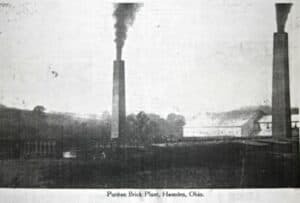
The clay story did not stop with pottery. The same local material later supported a brick-making era that connected McArthur and Hamden to a larger industrial shift. The McArthur Brick Company opened in 1905, and the Puritan Brick Plant followed in 1909. In a 1916 county history chapter on Hamden, the Puritan plant was “placed fairly on its feet” in 1909, and the company was one of the largest brick manufactories in Southern Ohio.
Handmade jars gave way to industrial brick, and the business eventually consolidated when the McArthur Brick Company acquired the Puritan property. Brick operations in that McArthur-Puritan sequence ended in the 1960s.
The state’s first manufacture of pressed brick came in 1829, fire brick in 1841 and paving brick in 1885.
What still remains on the ground
A waymarking entry on the Puritan site records that the company purchased 980 acres of land in the area, and that at least three stacks, building shells, foundations and scattered bricks remained there.
The McArthur Brick Company Historic Preserve makes that legacy visible now. The Ohio Department of Natural Resources is reclaiming the 158-acre property through a $2,825,000 AMLER project. The work includes interpretive and educational signs explaining past mining activities, and the Ohio Department of Natural Resources expects the project to create around 20 jobs, serve about 17,000 community members and bring in 4,000 additional visitors. The preserve also protects wetlands, wildlife, rock outcroppings and historical structures.
A simple way to explore the legacy
A family can still build a day around the county’s clay story with a short, local route:
- Start at Potters Ridge, where photographs show Gill Earnheart and others at a kiln and workshop and archives reference the Gill-Earnhart Pottery in Vinton County in the late 1800s.
- Continue to Pumpkin Ridge, where more than a dozen pottery shops once clustered in and near the ridge country.
- Stop in McArthur, where the brick era took hold with the McArthur Brick Company and later the preserve.
- Add Hamden, where a 1916 county history chapter called the Puritan plant one of the largest brick manufactories in Southern Ohio.
- Look along nearby creeks and old work sites for shards, brick fragments and the remaining shells of the industry.
This article was produced by Prism’s automated news system from verified source data, official records, and press releases, then run through automated quality and moderation checks before publishing. The system is built and supervised by the people who set the standards it runs under. Read our full AI policy.
Did this article answer your question?