NC Supreme Court Strikes Down Leandro Education Funding Plan, 4 to 3
NC's Supreme Court permanently closed the Leandro school funding case 4-3, wiping out a multibillion-dollar education plan that can never be refiled.
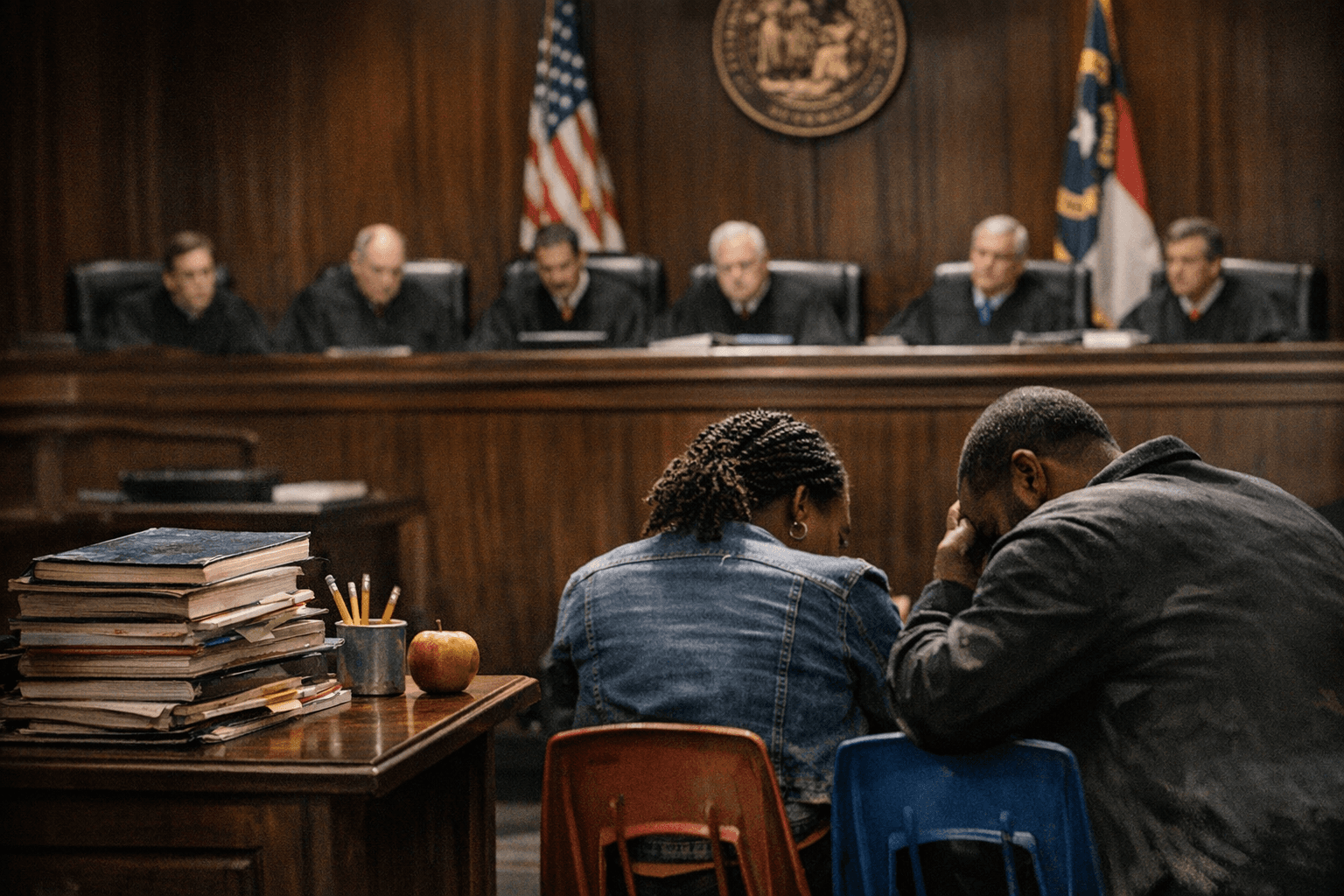
The North Carolina Supreme Court dismissed the Leandro education lawsuit with prejudice Thursday, a 4-to-3 ruling that permanently closes off three decades of litigation and voids the multibillion-dollar funding plan it produced, including all orders tied to a 2022 decision that had directed the legislature to dramatically expand education spending statewide.
Chief Justice Paul Newby wrote the majority opinion, joined by Justices Philip Berger Jr., Tamara Barringer, and Trey Allen. At its core, the 244-page ruling rests on two grounds: the trial court lost jurisdiction when the case expanded far beyond its original narrow scope involving Hoke County and four other low-wealth districts, and the legislature, not the courts, holds authority over state appropriations under the North Carolina Constitution. "In short, the judicial branch is not the venue in which to seek education policy reform," Newby wrote.
Republican Justice Richard Dietz and Democratic Justices Anita Earls and Allison Riggs dissented. Dietz called the decision "the end of Leandro as a lawsuit" while signaling he expects the underlying constitutional questions to resurface in future litigation. Riggs was sharper: "The majority's message to our children is clear: pull yourself up by your bootstraps, but there is nothing this court will do if the political branches never met their obligation to put boots on your feet in the first place."
The Leandro case began in the 1990s and reached a pivotal inflection point in 2002, when Wake County Superior Court Judge Howard Manning concluded the state was failing its students and ordered it to place a high-quality teacher in every classroom, a well-prepared principal in every school, adequate resources, and pre-kindergarten for at-risk children. That directive, along with the sweeping statewide remedies added over the following two decades, now carries no legal force.
Senate leader Phil Berger, R-Rockingham, welcomed the ruling, writing that "for decades, liberal education special interests have improperly tried to hijack North Carolina's constitutional funding process in order to impose their policy preferences via judicial fiat." Senate Republicans signaled they intend to focus on parental involvement and expanded educational options during the upcoming short session.
The dismissal with prejudice eliminates the most powerful legal lever that education advocates had used to push for systemic state funding. Wake County Public School System, the largest district in North Carolina, operated within a landscape where Leandro obligations shaped commitments around special education, teacher recruitment, and student support services. Those existing programs are not automatically cut, but any future expansion or protection of them now runs through legislative appropriations alone.
For Wake County school board members and county commissioners, the immediate calculus involves how to sustain services previously shaped by Leandro-era directives without a court order compelling state dollars to back them. Justice Dietz's expectation that a new constitutional challenge will eventually follow suggests the broader question of what North Carolina owes its students remains unresolved; the Leandro case itself, however, is permanently closed.
This article was produced by Prism’s automated news system from verified source data, official records, and press releases, then run through automated quality and moderation checks before publishing. The system is built and supervised by the people who set the standards it runs under. Read our full AI policy.
Did this article answer your question?