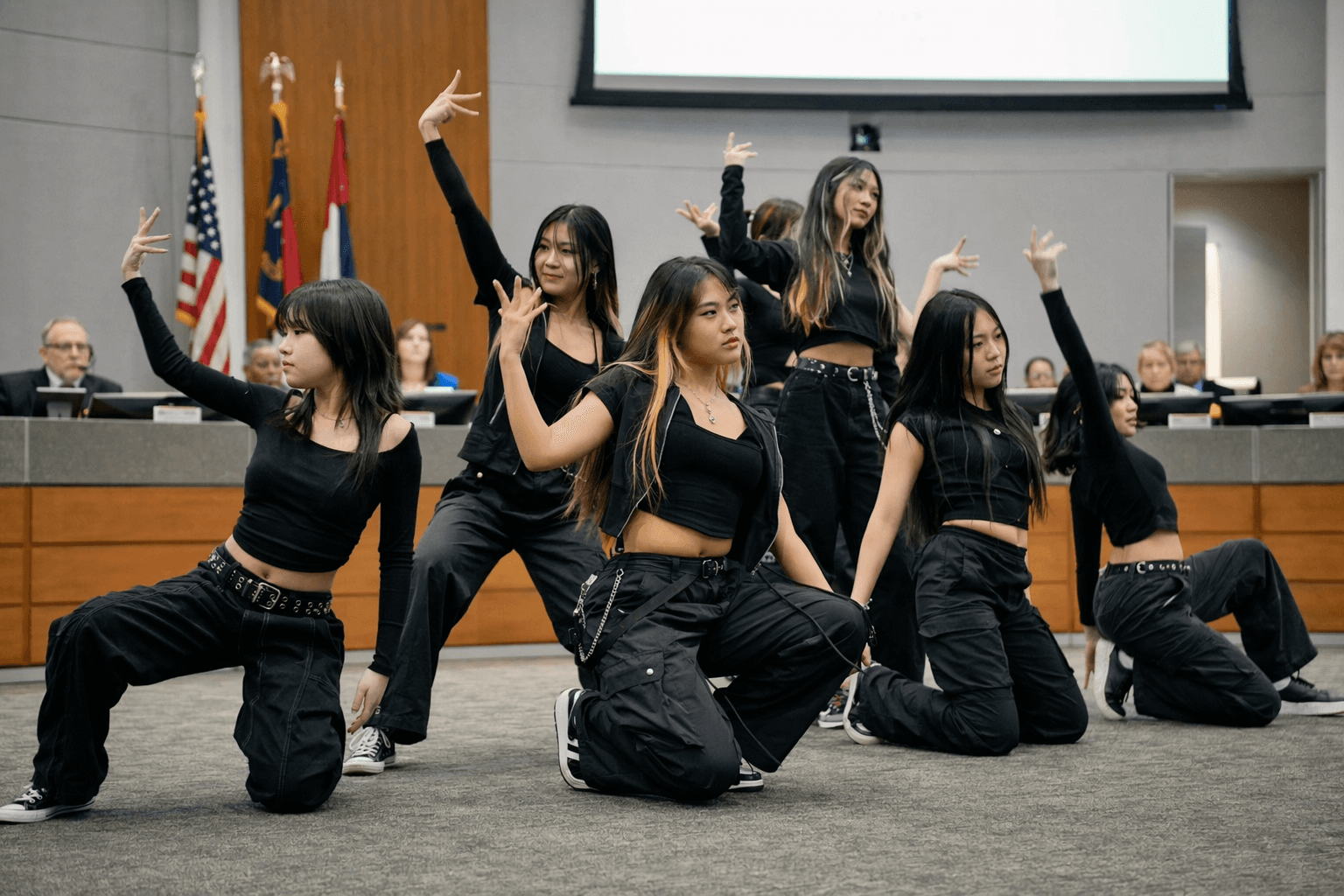
Wake County board marks AAPI month with Green Hope K-pop performance
Green Hope’s K-pop dancers lit up a Wake County board celebration, but the bigger story is how the Cary school is turning AAPI month into curriculum, student research, and belonging.

Green Hope High School’s K-pop dance club brought Asian American and Pacific Islander Heritage Month to life for Wake County school leaders, but the performance pointed to a much larger shift on the Cary campus: AAPI recognition at Green Hope has moved beyond ceremony and into classrooms, student research, and curriculum.
At the school on Carpenter Upchurch Road, where Asian students make up a large share of the enrollment, teacher Colin Richardson has watched the campus change in plain numbers. Richardson, a 2006 Green Hope graduate and the 2024 North Carolina History Teacher of the Year, said Asian students made up about 6% of the school when he graduated, about 20% when he returned, and 38% by 2025.
That demographic change has shaped what students study and how they see themselves in school. In spring 2025, Green Hope students took part in an Asian American oral-history project, recording interviews and creating posters and artwork for an April 28 lobby display. The project helped set the stage for Green Hope to pilot an Asian American studies elective for Wake County Public Schools in the fall of 2025, giving the school a formal way to teach history that reflects the students walking its halls.
The school’s work comes as AAPI communities have become a larger force across Wake County and North Carolina. WUNC reported that since 2010 the Asian population of North Carolina has grown by 68%, and that Asian residents in Cary now make up more than 20% of the town’s population. That local growth has made Green Hope a visible example of how schools are adapting when student demographics shift faster than curricula often do.
The political backdrop has also changed. Gov. Josh Stein proclaimed May 2026 as Asian American, Native Hawaiian and Pacific Islander Heritage Month in North Carolina, noting that the state has had members of those communities since the mid-19th century and that the 2026 General Assembly has the most AANHPI lawmakers in state history. The Federal Asian Pacific American Council set this year’s theme as “Power in Unity: Strengthening Communities Together.”
For Wake County schools, the question now is not whether to recognize AAPI students in May, but whether classrooms, electives and student-led projects keep pace the rest of the year. Green Hope’s answer has been to make representation visible, teach local history, and build space where more students can see their communities reflected in school.
Know something we missed? Have a correction or additional information?
Submit a Tip