Wake County Data Centers Strain Water Supply, Spark Community Concerns
A proposed Apex data center would have consumed up to 1 million gallons of water daily, equal to one-fifth of the town's entire water supply, prompting a community coalition and a council moratorium push.
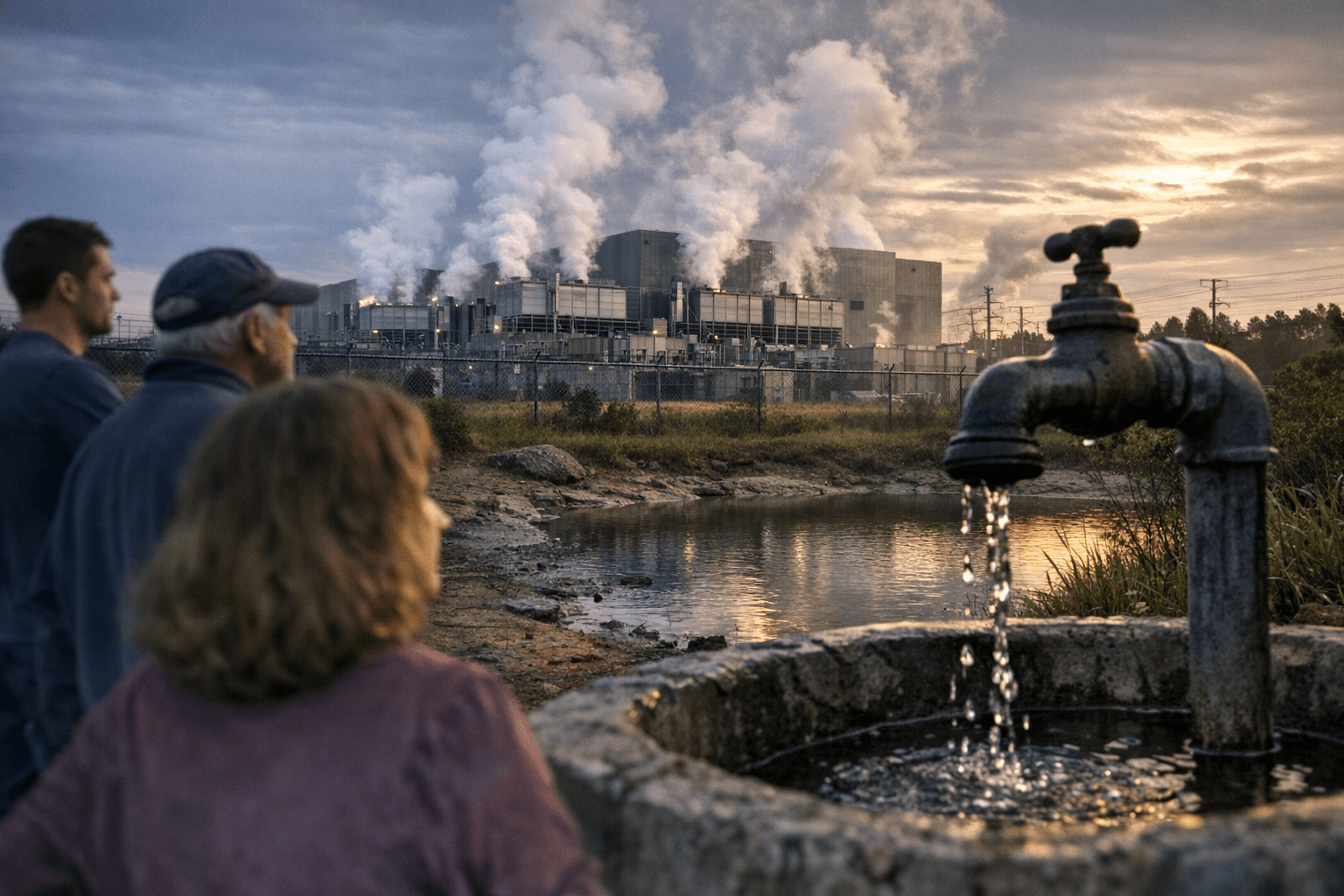
When Natelli Investments LLC filed plans in September 2025 to build a 250-megawatt data center on a 190-acre farm off Old U.S. Highway 1 in New Hill, many residents of western Wake County learned for the first time how much water a single AI-era facility could drain from their shared supply. The proposed New Hill Digital Campus, on Shearon Harris Road near Duke Energy's nuclear plant, would have pulled up to one million gallons of water per day from the Western Wake Regional Water Reclamation Facility for cooling purposes. One-third of that water, according to the developer's own filings, was expected to evaporate into the surrounding air.
Jonathan Jacobs, Apex's water resources director, put that volume in terms Wake County residents could feel: one million gallons a day equals roughly one-fifth of Apex's average daily water use across the entire town. Spread across a typical household consuming about 300 gallons daily, the same draw would supply water to more than 3,300 homes.
The numbers galvanized neighbors. Residents formed the Protect Wake County Coalition, a volunteer group that rallied more than 100 people in October 2025 and gathered over 2,000 petition signatures opposing the project. Michelle Hoffner O'Connor, a biologist and clinical scientist who co-led the coalition, told the Apex Town Council in March that she questioned whether town staff and officials had the technical expertise needed to write rules that would genuinely protect residents from future proposals.
Natelli Investments withdrew its annexation and rezoning applications on March 5, 2026, citing the town's ongoing deliberations over zoning changes that would be necessary before a data center could proceed. Michael Natelli, president of Natelli Holdings, said the company would revisit the project if Apex later revised its rules to explicitly allow data center development.
Five days after the withdrawal, Apex Town Council voted unanimously to direct staff to draft a formal one-year moratorium on any further data center applications, permits, or construction. Mayor Pro Tem Terry Mahaffey, who proposed the measure, said the pause would give Apex time to update its Unified Development Ordinance before another proposal arrived.
The debate over water is unfolding against a broader infrastructure problem that planners did not fully anticipate. Wake County is growing by roughly 25,000 people per year, and Raleigh alone delivers about 52 million gallons of drinking water daily to households. The county's 50-year One Water Plan, developed collaboratively by 12 municipalities over three years, was nearly finalized when data center demand emerged as a new variable. "Data centers wasn't even on the radar when we started this plan a few years ago," a county planner involved in the effort told WUNC News in February. The planner added that multiple municipalities were already asking questions about how to evaluate proposals before they arrived at the permitting stage.
Data centers now account for about 80 percent of Duke Energy's projected growth in energy demand, according to Gov. Josh Stein's North Carolina Energy Policy Task Force, a figure that underscores how rapidly the industry's footprint is expanding beyond any single town's planning horizon.
Chatham County, immediately to the west of Wake, approved its own one-year moratorium on data center permitting in February 2026, citing water and energy use as primary concerns. With Apex now moving toward similar restrictions, the question for the broader Triangle is whether neighboring municipalities can coordinate fast enough to prevent the infrastructure gaps from widening before the next proposal clears a planning board.
This article was produced by Prism’s automated news system from verified source data, official records, and press releases, then run through automated quality and moderation checks before publishing. The system is built and supervised by the people who set the standards it runs under. Read our full AI policy.
Did this article answer your question?