Wake County sex offender faces federal immigration fraud charge
A Wake County man already convicted of child-sex offenses was indicted in federal court after allegedly denying those crimes on a TPS application. The case now raises questions about oversight, registration and interagency checks.
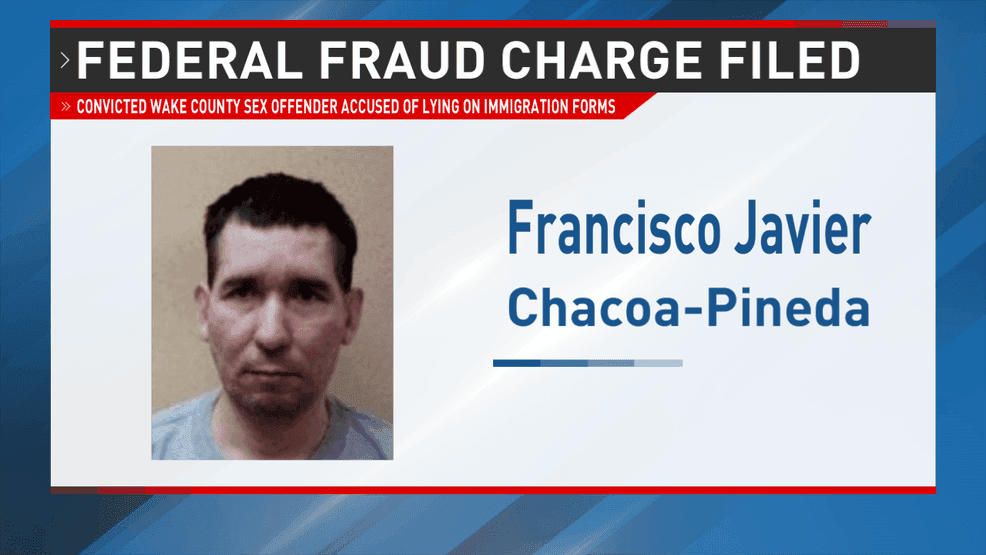
Federal prosecutors have added a new immigration-fraud case against Francisco Javier Chacoa-Pineda, a 50-year-old Wake County man already convicted in state court of sexually exploiting a child and taking indecent liberties with a child. The indictment, returned June 2 in the Eastern District of North Carolina, says Chacoa-Pineda falsely answered questions on a temporary protected status application that he had never been convicted of a crime and had never engaged in sexual conduct with a person who was forced or threatened.
The federal filing says Chacoa-Pineda submitted the application to U.S. Citizenship and Immigration Services on April 24, 2024, after the conduct that led to his state case had already occurred. Prosecutors say he later confessed to committing the crimes against a 13-year-old victim in January and April 2024. If convicted on the federal charge, he faces a maximum penalty of more than 10 years in prison.
Wake County juries returned two indictments against Chacoa-Pineda on Nov. 18, 2024, one charging three counts of taking indecent liberties with a child and the other charging three counts of first-degree sexual exploitation of a minor. A North Carolina state jury convicted him on March 18, 2026, of one count of first-degree sexual exploitation of a minor and three counts of taking indecent liberties with a child. A state judge then sentenced him to up to 11.5 years in prison and ordered him to register as a sex offender.
The new federal case extends scrutiny beyond the original child-sex charges and into the way immigration forms are reviewed. It also underscores how a local sex-offender case can move across multiple systems at once: county courts, state prison, federal prosecutors and immigration authorities. Wake County law requires each sheriff’s office to maintain the county sex-offender registry, a responsibility that places registration and monitoring squarely in local hands.

ICE said the case is being investigated as part of Operation False Haven, a Raleigh-based initiative launched in November 2019 to target child molesters and other egregious felons who fraudulently obtained immigration benefits. ICE says the operation has produced 56 criminal cases, 26 civil cases, 21 convictions, 15 judicial revocations of citizenship and seven judicial removal orders.
The timing also comes as Venezuela’s TPS landscape has shifted. USCIS says the 2023 Venezuela designation was terminated effective Oct. 3, 2025, after the Supreme Court allowed the change to take immediate effect, and the separate 2021 termination became effective Nov. 7, 2025. Against that backdrop, Chacoa-Pineda’s case shows how false answers on immigration forms can trigger a second prosecution long after the underlying offenses were committed.
This article was produced by Prism’s automated news system from verified source data, official records, and press releases, then run through automated quality and moderation checks before publishing. The system is built and supervised by the people who set the standards it runs under. Read our full AI policy.
Know something we missed? Have a correction or additional information?
Submit a Tip