Wake County Tax Loophole on Affordable Housing Threatens Local Revenue
Wake County's tax administrator calls a "rent-a-nonprofit" property tax scheme the biggest threat to local revenue he's ever seen, with exemptions nearly doubling since 2020.

Wake County Tax Administrator Marcus Kinrade issued a stark warning to county commissioners recently: a state law designed to help nonprofits provide affordable housing is being systematically exploited by for-profit apartment owners, and the fiscal damage is accelerating.
The mechanism, which one longtime affordable-housing developer calls a "rent-a-nonprofit structure," allows for-profit apartment complex owners to hand over fractions of ownership to nonprofits, thereby qualifying for property tax exemptions intended for genuine nonprofit housing providers. The result is a shrinking tax base across Wake County and, even more acutely, within Raleigh city limits.
"This is a huge leak in your tax base, and the City of Raleigh's also," Kinrade told commissioners. "Most of these things are occurring in the city, so it's affecting them even worse than it's affecting the county."
The numbers behind Kinrade's alarm are significant. Exemptions in Wake County have nearly doubled, rising from 66 in 2020 to 136 in 2025. Those exemptions for low- and moderate-income housing now account for a projected $776 million reduction in taxable property value, which Kinrade said translates to the equivalent of $4 million in lost revenue. In more extreme cases elsewhere, similar arrangements have produced reductions in property tax value for cities and counties of tens of millions of dollars.
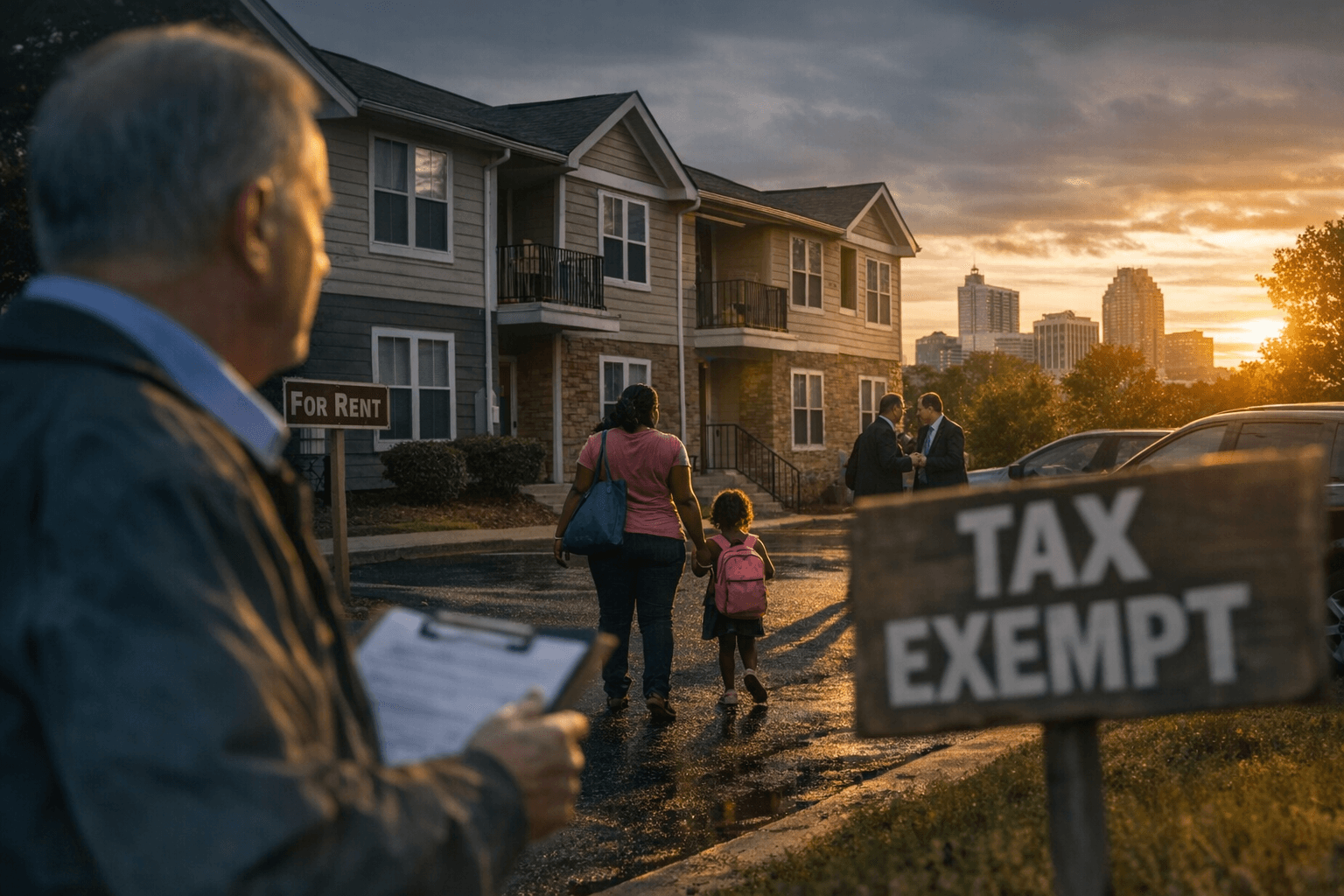
Kinrade did not mince words about the trajectory. "This is, in my opinion, the biggest threat to the revenue stream in this county that I could ever imagine," he said.
The practical consequences extend well beyond budget spreadsheets. Lower tax values reduce the revenue available to fund Wake County schools, libraries, public safety, and health and human services. That squeeze ultimately forces local governments to choose between cutting services and raising taxes on residents who own property through conventional, fully taxable arrangements.
The loophole exploits a state law that grants property tax exemptions to nonprofits providing affordable housing to low- and moderate-income residents. Critics of the practice argue that the intent of that statute is being circumvented when the primary economic interest in a property remains with a for-profit owner who has transferred only a fractional stake to a nonprofit partner. Whether North Carolina's existing oversight mechanisms are sufficient to detect or deter the practice remains an open question, and no legislative fix has been publicly announced.
This article was produced by Prism’s automated news system from verified source data, official records, and press releases, then run through automated quality and moderation checks before publishing. The system is built and supervised by the people who set the standards it runs under. Read our full AI policy.
Did this article answer your question?