Wake Forest Economist Weighs Raleigh, Charlotte Bids for MLB Franchise
Wake Forest economist Todd McFall puts the Raleigh MLB stadium price at $2 billion and calls public subsidies inevitable, with a named owner the biggest edge over Charlotte.

A $2 billion stadium price tag, a yet-to-open formal bid process, and an unresolved public-subsidy question are the defining obstacles standing between Wake County and major league baseball, according to Wake Forest economics professor Todd McFall.
"It would be naive and fanciful to think it will only cost a billion dollars, because steel, wood, concrete and labor have all gotten more expensive," McFall said in a Wake Forest University News Q&A published in October 2025. "We should be anticipating a ticket price in the $2 billion range for the construction." His next sentence carried direct implications for Wake County taxpayers: "It's inevitable that there will be public funding from state and local governments." Those subsidies, McFall explained, both reduce financial risk for a prospective owner and signal to MLB leadership that the region is prepared to compete against four or five other bidding municipalities.
McFall, who has studied sports economics for two decades and has been widely quoted on topics ranging from NASCAR rebranding to the lopsidedness of baseball's World Series, frames the expansion decision around three make-or-break criteria: political will to provide tax relief and stadium construction support, infrastructure capable of reliably moving fans to a ballpark, and a labor market with enough disposable income to fill 81 home dates every season. By those measures, he considers both North Carolina cities viable. "Charlotte and Raleigh are both big enough to support MLB," he said.
The decisive variable in his analysis is ownership. Charlotte's rapid ascent as a financial hub makes it exceptionally attractive for corporate sponsorships and luxury-box sales. But McFall said he has "a harder time figuring out who the interested investor in Charlotte is right now." Raleigh-Durham enters that comparison with a named candidate: Carolina Hurricanes owner Tom Dundon, who is already leading a $1.1 billion redevelopment around PNC Arena that pairs $300 million in public investment with $800 million in private funding for an 80-acre mixed-use entertainment district. McFall called Dundon a "top-shelf" operator who "seems ready to lead the way."
Feasibility data from an analysis by MLBRaleigh reinforces the Triangle's competitive position. Among ten frequently mentioned expansion cities, Raleigh ranked second in forecasted population growth and third in distance from an existing MLB team, a proxy for uncontested market territory. Charlotte ranked third in media market size. Both North Carolina cities placed in the top half of the overall rankings, with one unspecified exception. The metro population figures illustrate why: the Charlotte area at 2.37 million already exceeds the current markets for the Cardinals, Reds, Guardians, Royals, Pirates and Brewers; the Raleigh area at 1.66 million surpasses Milwaukee's market.
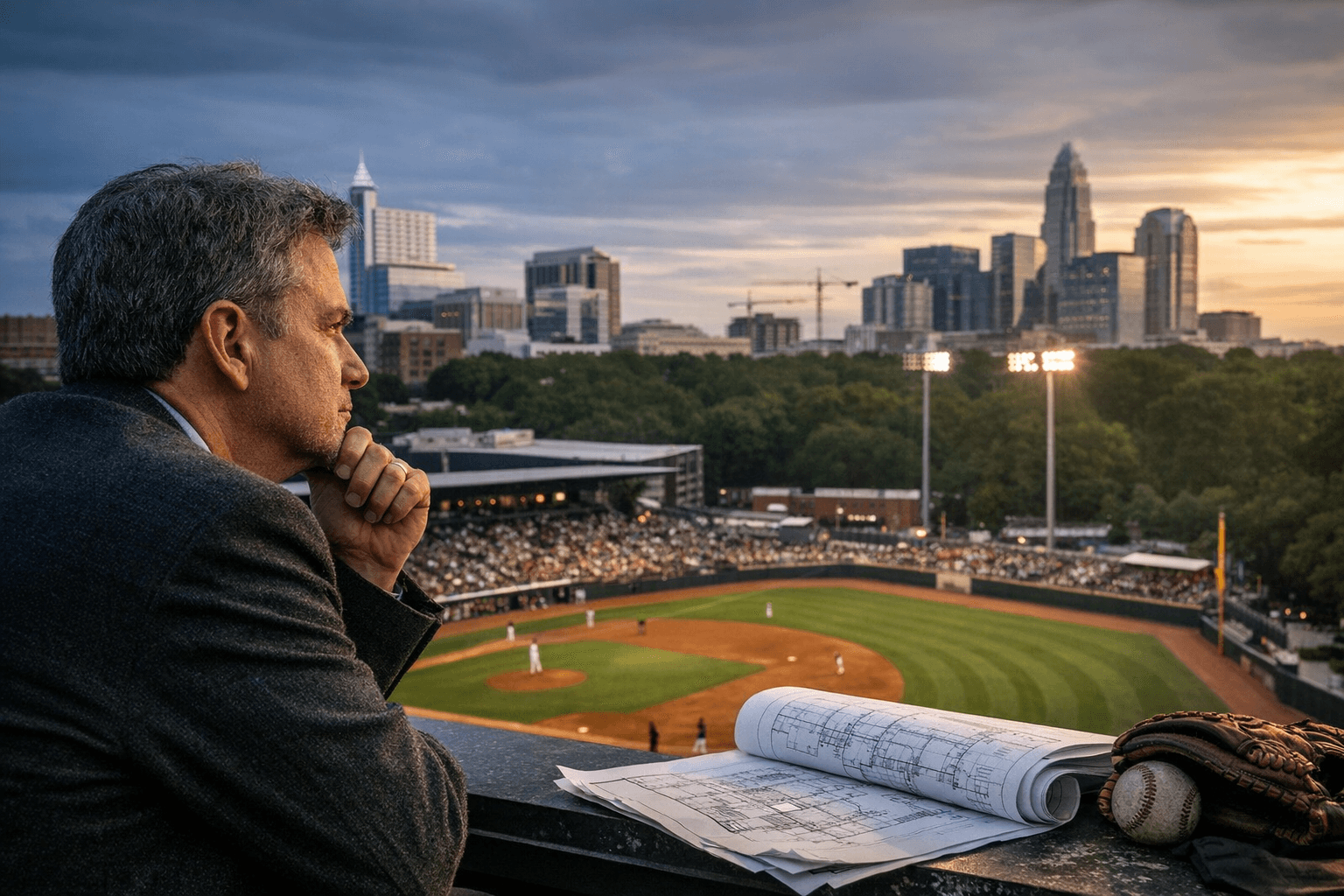
The projected payoff for Wake County, on paper, is $345.6 million in annual economic output during an MLB season, 2,532 jobs and $118.6 million in labor income, according to the MLBRaleigh analysis. Those figures count only spending by households outside Wake County; the methodology explicitly excludes local residents' stadium attendance on the premise that their dollars are redirected from other entertainment rather than representing net-new activity.
McFall noted those gains are front-loaded. "The economic impact will be large to begin and then drop off fairly consistently over time," he said, adding that Charlotte faces a steeper fade given entrenched competition for corporate sponsorship dollars from the Panthers and the Hornets.
MLB's formal request-for-proposal process is expected to open in the second quarter of 2026, with franchise owners likely voting on expansion candidates by late 2027 and new teams potentially taking the field as early as 2028. For context, between 70 and 80 percent of the new Las Vegas stadium being built for the Athletics is financed by the team's ownership group, a benchmark that reflects what the league increasingly expects from prospective cities. For Wake County, that benchmark and McFall's $2 billion estimate define the floor of the conversation, not the ceiling.
This article was produced by Prism’s automated news system from verified source data, official records, and press releases, then run through automated quality and moderation checks before publishing. The system is built and supervised by the people who set the standards it runs under. Read our full AI policy.
Did this article answer your question?

