Border Wall Blasts Damage Sacred Yumano Monolith at Cuchumá Mountain
Dynamite blasts for border wall construction struck a 35-meter carved monolith at Cuchumá Mountain, a millennia-old ceremonial site sacred to Yumano tribes including the Yuma, Cucapah, and Mojave peoples.
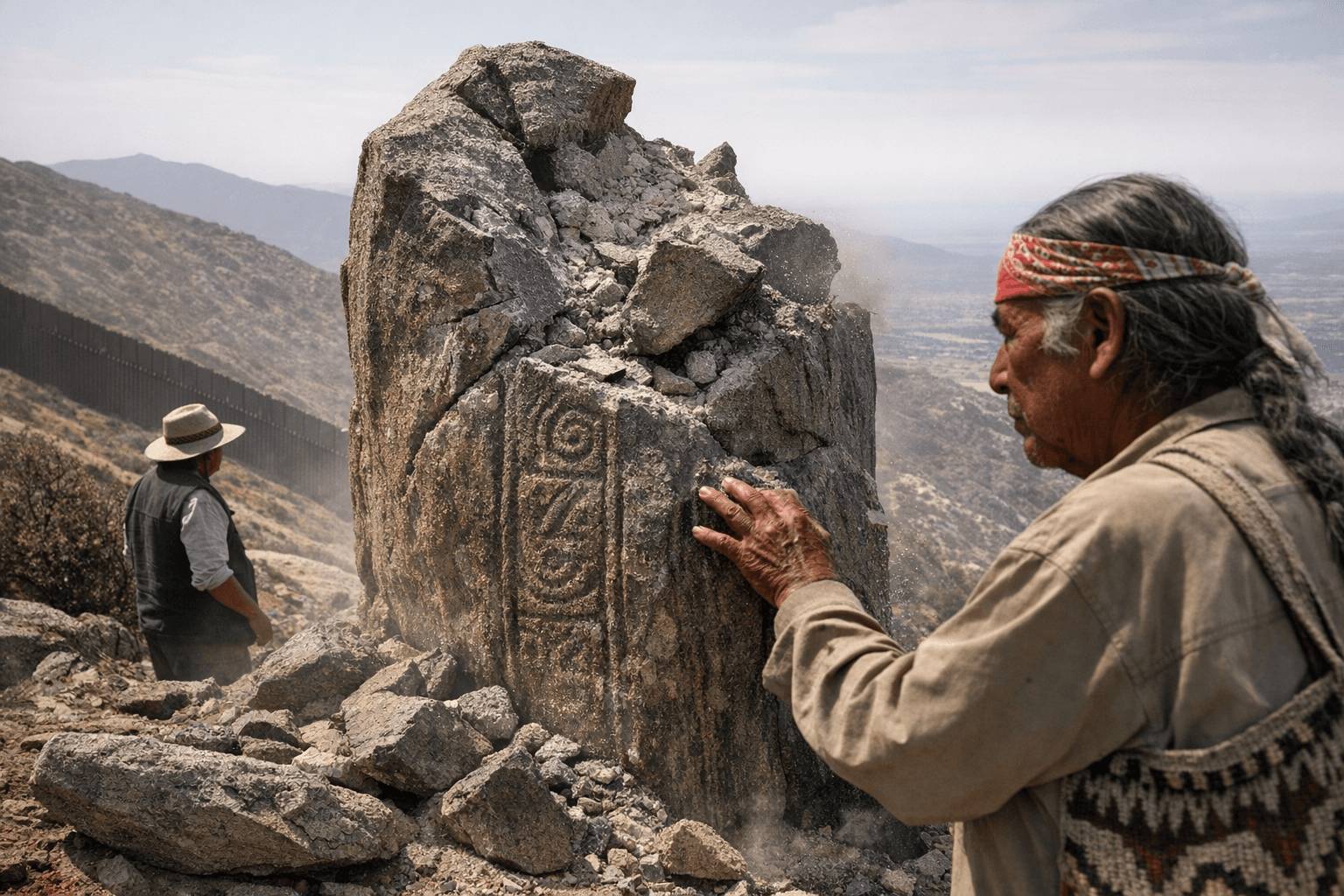
Dynamite detonations tied to U.S. border wall construction struck the slopes of Cuchumá Mountain near Tecate Peak in eastern San Diego County last weekend, damaging a 35-meter carved monolith that stands as the largest sacred formation on the mountain and a spiritual anchor for Yumano peoples across the region, including tribes with deep roots in Yuma County.
Residents of the Valle de la Lechuza community in Baja California reported hearing the explosions the weekend of April 5 as U.S. construction crews worked to extend the border wall through terrain that has served as a ceremonial site for thousands of years. The affected area, known locally as Tecatito on the California side near the Campo reservation, sits precisely where the international boundary bisects a mountain that Yumano peoples never recognized as divided.
The full extent of the damage to the monolith is not yet determined. What the blasting has already disturbed extends beyond carved rock. The zone encompasses active cemeteries, ritual gathering points, and the traditional initiation site for shamans. Researcher Everardo Garduño has documented at least 71 distinct ritual and funerary elements across the mountain, a concentration reflecting uninterrupted ceremonial use spanning millennia.
For the Yuma, Cucapah, Mojave, Halyiikwamai, Alakwisa, and Kamai peoples of the broader Yumano cultural family, Cuchumá is not a historical artifact. The mountain, rising to roughly 3,500 meters, functions as a living ceremonial landscape. Miguel Olmos Aguilera, a social anthropologist and researcher at the Colegio de la Frontera Norte, said Kumiai community members reported directly to him that the construction is obstructing access and destroying their ceremonial grounds. He described the Kumiai as a binational culture, noting that they had historically been able to cross the mountain despite the 19th-century border division, and said that access now appears to have been permanently severed.
The Quechan Indian Tribe at Fort Yuma and the Cocopah Indian Tribe, both federally recognized Yumano nations with deep ties to Yuma County, belong to the same ancestral cultural network as the communities most directly affected. When a carved monolith embedded in a sacred mountain is fractured by explosive force, the loss carries a dimension that no restoration effort can fully address. These formations are geographic expressions of spiritual practice that derive their meaning from a specific, irreplaceable place in the landscape.
Several federal statutes were designed to prevent exactly this outcome. The National Historic Preservation Act of 1966, the Archaeological Resources Protection Act of 1979, and the American Indian Religious Freedom Act of 1978 all impose consultation and protection requirements for sites of this character. This is not the first alarm along this corridor. Kumeyaay-led protests temporarily halted U.S. Army Corps of Engineers dynamite work near the Campo reservation in 2020, signaling that federal agencies had long-standing notice of the area's cultural significance before this month's blasting.
U.S. Customs and Border Protection had not issued any statement addressing the damage to the Cuchumá monolith as of this report. Tribal members and heritage advocates are demanding an immediate investigation, a halt to further blasting at the site, and restored ceremonial access for indigenous communities. With the current border wall expansion advancing at a pace that has outrun federal review processes at multiple sites across the Southwest, the fate of Cuchumá Mountain will test whether any regulatory floor exists for sacred indigenous ground in the path of the project.
This article was produced by Prism’s automated news system from verified source data, official records, and press releases, then run through automated quality and moderation checks before publishing. The system is built and supervised by the people who set the standards it runs under. Read our full AI policy.
Did this article answer your question?