Yuma agriculture depends on H-2A workers to keep harvests moving
Yuma’s winter lettuce economy runs on H-2A crews, and any labor disruption would hit harvest timing, grower margins, and grocery shelves far beyond Arizona.
The labor behind Yuma’s winter harvest
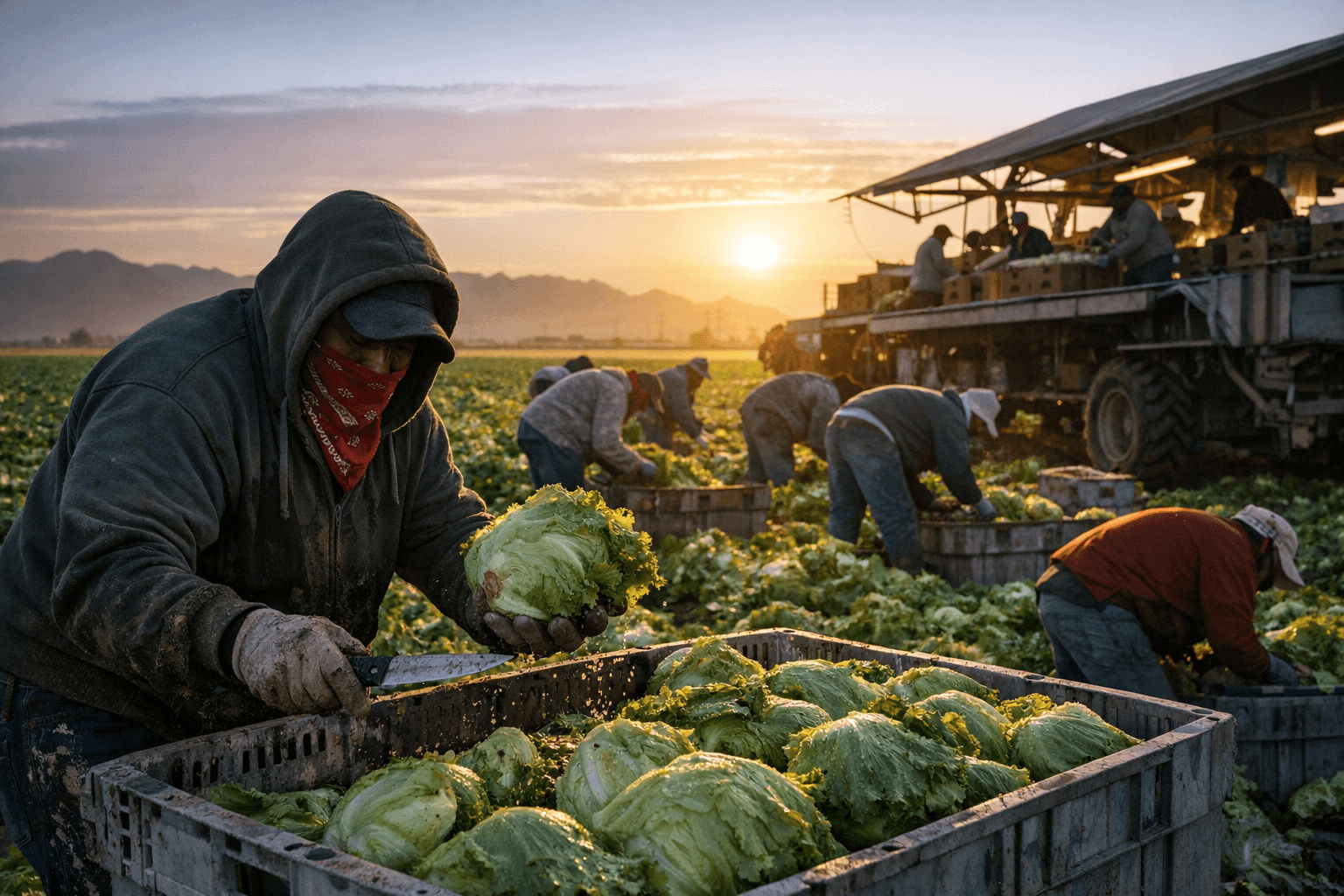
Yuma’s winter lettuce fields move fast because the market does not wait. More than 91% of North America’s winter leafy greens now come from farms around Yuma, and that production depends on a labor system built for speed, precision, and repeat performance. In a county that grows more than 175 crops and produced $1.3 billion in direct agricultural sales in 2022, one missed harvest window can quickly become a lost shipment, a weaker price, and a thinner margin.
That is why the H-2A workforce is not a side issue in Yuma. It is the operating system behind the harvest, especially for lettuce, baby greens, cauliflower, broccoli, herbs, root vegetables, and kale grown in the desert winter. When crews do not arrive on time, crops do not pause. They mature, quality slips, and the whole supply chain feels it.
Why growers say the program is hard to replace
At Amigo Farms, Valentin Sierra says H-2A workers are difficult to replace because many return year after year already knowing the company’s rules, safety practices, and production expectations. Some have been with the company for about 20 years, giving managers the kind of continuity that is rare in a labor market built around seasonal peaks. That familiarity matters when crews must move quickly and safely through long harvest days.
The H-2A program, created in 1986, was designed as a temporary seasonal labor pathway for employers facing shortages of domestic workers. In Yuma, though, it has become a central part of how farms operate, not a stopgap. The U.S. Department of Agriculture’s Economic Research Service says certified H-2A positions grew by more than 200% from 2010 to 2019, showing how rapidly the program expanded as farm labor became harder to secure in the United States.
Yuma County is now one of the country’s major H-2A hubs. The American Immigration Council says the county is among those with the highest numbers of certified H-2A workers in the nation, a reflection of how closely the region’s harvest calendar is tied to imported labor.
The scale of Yuma agriculture goes far beyond the field
The economic stakes are much larger than a single season or a single crop. The University of Arizona Cooperative Extension found that Yuma’s agriculture and agribusiness generated $4.4 billion in sales to the Arizona state economy in 2022, including multiplier effects. The same analysis found $3.9 billion in sales to the Yuma County economy alone, from on-farm agriculture, support services, input suppliers, and university-linked research and Extension. The region’s fresh produce value chain also generated an estimated $3.2 billion in gross consumer retail spending nationally.
That is why Yuma is often described as the winter vegetable capital of the world. Local agriculture is not just large, it is dominant. Visit Yuma says agriculture is the county’s number one business and a more than $4 billion industry each year, which helps explain why labor availability is treated as an economic issue, not only an immigration issue.
What the wages and rules mean for farms
The economics of H-2A labor are shaped by federal wage rules that can move year to year. The reporting cited a wage floor of $17.51 an hour for H-2A workers, while the Department of Labor’s adverse effect wage table now lists an average AEWR of $17.74 per hour for surety-bond calculations effective January 1, 2025, and notes that the table was last updated January 20, 2026. The gap between the United States and Mexico remains part of the labor equation, because workers travel long distances for pay that can still make financial sense compared with opportunities at home.
The Department of Labor says H-2A employers must follow wage and working-condition protections, which adds compliance costs on top of pay, housing, transportation, and recruiting expenses. For growers, that means labor is not only essential, it is expensive and highly regulated. The system can work, but only if farms can secure workers, process paperwork, and keep up with changing wage rates.
What breaks if the labor pipeline is disrupted
The first thing to break is timing. Yuma’s winter crops are harvested to hit narrow windows when quality is highest and distribution contracts are fixed. If labor falls short, fields can sit too long, produce can over-ripen, and growers may lose the premium they counted on when they planted.
Then comes the margin pressure. Late harvests can reduce packout, increase waste, and force crews to work longer to catch up, all of which raises costs. In a business where harvest speed determines freshness, the difference between on-time and delayed picking can ripple all the way to the grocery store, where tighter supply can lift prices and reduce availability.
The national reach of Yuma’s farms makes that risk larger than a county-level problem. If the region supplies more than 91% of North America’s winter leafy greens, then a labor disruption in Yuma can affect produce aisles well beyond Arizona. The same desert fields that anchor local payrolls also help feed retail demand across the country.
Why Yuma’s system is hard to unwind
John Boelts has described Yuma as a unique agricultural place unlike anywhere else in the country, and that uniqueness is exactly the point. The county’s advantage comes from a tightly linked system of climate, water management, crop timing, and labor availability. Remove one part, and the whole model becomes less efficient.
That is the policy vulnerability at the center of the H-2A debate. The program has become indispensable to a region that feeds winter produce markets nationwide, yet it remains a temporary labor system built around annual paperwork, wage adjustments, and cross-border recruitment. Yuma agriculture now depends on that arrangement to keep harvests moving, protect farm revenues, and keep produce flowing to American tables when much of the country cannot grow it locally.
This article was produced by Prism’s automated news system from verified source data, official records, and press releases, then run through automated quality and moderation checks before publishing. The system is built and supervised by the people who set the standards it runs under. Read our full AI policy.
Did this article answer your question?