Yuma Neighborhood Report Finds 51% of Households Low-to-Moderate Income
A Neighborhood Revitalization Strategy found that 51% of Yuma households are low-to-moderate income, with a 16% poverty rate compounding pressure in a housing market where home values have surged 44% since 2018.

More than half of all households in Yuma meet the federal definition of low-to-moderate income, according to a Neighborhood Revitalization Strategy cited in local reporting, a figure that lands in stark relief against a housing market where typical home values have climbed 44% in six years.
The strategy found that about 51% of Yuma households qualify as low-to-moderate income, with a poverty rate of 16% and an unemployment rate of roughly 6%. Those three numbers together describe a community where a majority of residents are navigating rising housing costs from a financially constrained starting point.
Yuma County's population has grown steadily, reaching 217,978 in 2024 and ranking sixth most populous among Arizona's 15 counties. The county's 76,903 households represent a 6.1% increase since 2018, the 12th fastest household growth rate in the state. That growth has collided directly with a constrained housing supply and accelerating prices.

The Zillow Home Value Index, which measures typical home values and market changes across a region, put the typical Yuma County home at $270,317 in 2024, a 44% increase since 2018 after adjusting for inflation. That ranks Yuma 11th highest in home value and fourth highest in value increase among all Arizona counties, according to the Morrison Institute's Arizona Research Center for Housing Equity and Sustainability (ARCHES) Yuma County profile, part of its 2025 State of Housing in Arizona report.
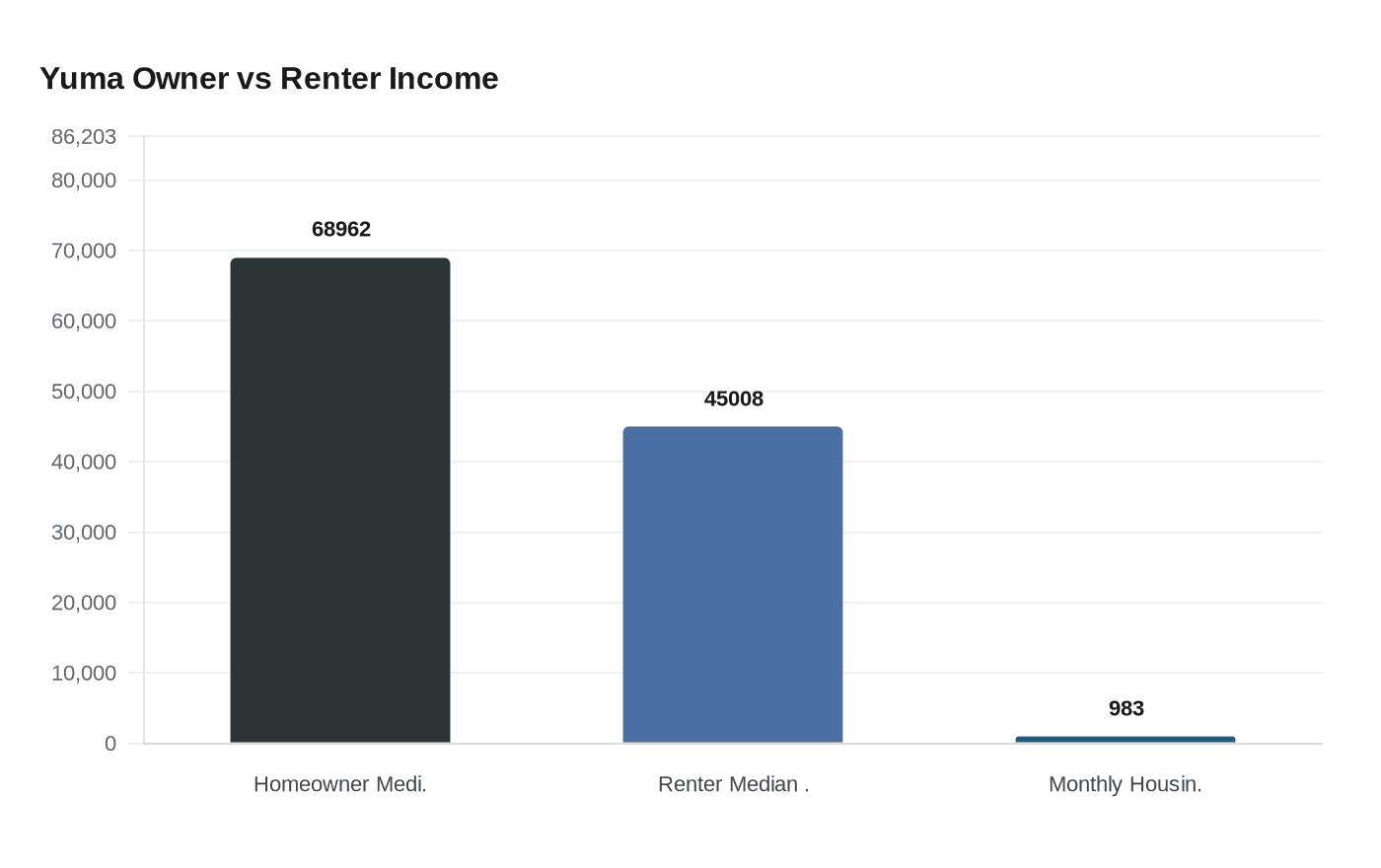
The income gap between owners and renters sharpens the picture. The median household income in Yuma County was $60,417 according to the 2019-2023 American Community Survey five-year estimates, ranking eighth highest in the state. But that countywide figure masks a wide split: homeowners carried a median income of $68,962, while renters earned a median of $45,008. The same renters faced a median monthly housing cost of $983 in 2023, the eighth highest among Arizona counties. Overall median monthly housing costs, including utilities, were $909 that year, also eighth statewide. Yuma also ranked eighth among Arizona counties for overall cost burden, meaning the share of residents spending a disproportionate portion of income on housing.
The City of Yuma adopted an Affordable Housing Action Plan in September 2025 as a roadmap to address rising housing costs, preserve existing affordable homes, and create new housing opportunities, with three stated goals: building and preserving affordable housing, increasing education and awareness, and expanding financing options.
On the supply side, the county counted 93,924 total homes in the 2019-2023 ACS estimates, 58% of them single-family homes. Of the 1,399 homes permitted in 2024, 85% were single-family. The housing stock has grown by only 2.4% since 2018, and 18% of all units were classified as vacant. Nearly three in five homes, 59%, were built after 1990. The eviction rate stood at 33.4 per 10,000 people, 11th highest in the state.
The City of Yuma has estimated that nearly one-third of renter households need a unit costing less than $500 per month, but only 15% of all rentals are priced in that range, a mismatch that the 51% low-to-moderate income finding makes even more consequential. The homeownership rate of 70%, ranked 10th in the state, suggests a majority of Yuma households do own rather than rent, but the low-to-moderate income share indicates that ownership, where it exists, comes with thin financial margins when housing costs rise at their current pace.
This article was produced by Prism’s automated news system from verified source data, official records, and press releases, then run through automated quality and moderation checks before publishing. The system is built and supervised by the people who set the standards it runs under. Read our full AI policy.
Did this article answer your question?