$100,000 in a 3-month CD could earn more than you expect
A three-month CD on $100,000 can clear four figures at today’s top rates, but the real decision is whether you can spare the liquidity for 90 days.
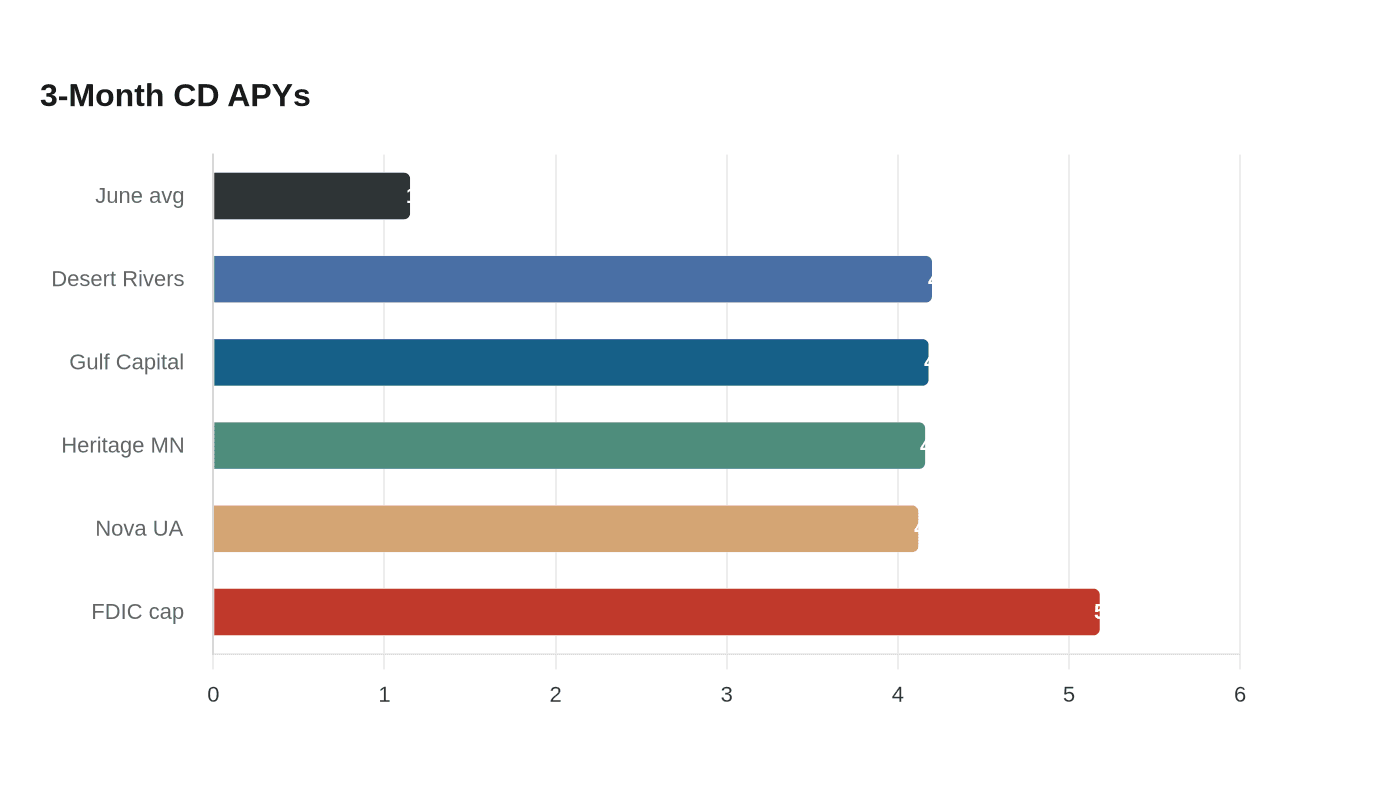
At the best posted July 9 offers, a $100,000 three-month CD can generate just over $1,000 in interest before maturity. The right call hinges on whether you can leave the cash untouched, whether your savings rate is lower, and whether you think short-term rates are heading up or down.
The math on $100,000
The Federal Deposit Insurance Corporation’s June 2026 national average for a 3-month CD was 1.15% APY, while the FDIC’s rate-cap table put the national cap at 5.18% APY. The market was already offering far better deals than the average: MonitorBankRates.com listed Desert Rivers Federal Credit Union at 4.20% APY, Gulf Capital Bank at 4.18%, Heritage Bank Minnesota at 4.16%, and Nova UA Federal Credit Union at 4.12%. On a $100,000 balance, the June national average works out to about $286.27 over three months, while the top advertised range produces roughly $1,014.46 to $1,033.86, with Heritage Bank Minnesota landing near $1,024.16.
A saver who lands one of the stronger 4% offers is looking at roughly $748 more in three months than the national average CD would pay on the same $100,000 deposit. Even the FDIC’s 5.18% cap, which is a ceiling rather than a typical offer, would produce about $1,270.58 over the term, showing how much room exists between the middle of the market and the top end.
When the CD beats a savings account
A 3-month CD wins when the money can sit still for 90 days and your savings account is paying less than the CD. CD rates can change at the institution’s discretion without notice, and a substantial penalty may apply if you pull the money out early. If you need the cash for taxes, a home closing, tuition, or a business expense, the penalty can erase the yield advantage quickly.
A $100,000 deposit is comfortably inside the FDIC’s standard insurance limit of at least $250,000 at each FDIC-insured bank, per depositor, per ownership category, so the issue is not whether the principal can be insured in ordinary circumstances. The real trade-off is liquidity: a savings account lets you move immediately, while a CD pays for certainty with a time commitment.
Why Treasurys matter, and what they signal
Short-term Treasurys sit close to the CD decision because the FDIC’s cap formula is tied to Treasury yields. The FDIC’s national rate cap is generally the higher of the national rate plus 75 basis points or 120% of the comparable Treasury yield plus 75 basis points, and the national rate itself is a weighted average of rates paid by insured depository institutions and credit unions. That means CD pricing is not floating in isolation; it moves with the broader short-rate environment.
Right now, the Treasury market gives savers a live comparison point. The Federal Reserve’s July 8, 2026 H.15 release showed 3-month Treasury bills around 3.73% on the secondary market and 3-month Treasury constant maturity yields around 3.86%. At those levels, a $100,000 3-month Treasury position would earn roughly $919.73 to $951.34 over the term, which leaves the best CDs with a small but real yield edge.
If you think short-term rates are about to rise, a three-month CD or Treasury lets you revisit the decision quickly and reset at a higher yield later. If you think rates are more likely to drift lower, locking a 4% plus CD today is a way to protect return without taking duration risk.
What the rate history says about the economy
Short-term CD rates climbed since the start of 2025, but they remain far below the early 1980s, when yields rose above 10%, and far above the ultra-low backdrop of November 2021, when the average 3-month CD yielded just 0.05%; the historical figures are from Jack Caporal’s tracker at The Motley Fool. The June 2026 average of 1.15% leaves the middle of the market still muted, even as the best offers have moved into the 4% range.
Short-term deposit rates are no longer stuck at near-zero levels, which means cash is finally earning a meaningful return again, but they also show that banks are still selective about what they pay the average depositor.
If your money can sit untouched for three months, a top CD around 4.1% to 4.2% can beat a lower-yield savings account and edge a Treasury bill, while keeping the duration short enough to reassess quickly. If you need immediate access or expect rates to jump soon, the extra yield may not justify the lockup.
This article was produced by Prism’s automated news system from verified source data, official records, and press releases, then run through automated quality and moderation checks before publishing. The system is built and supervised by the people who set the standards it runs under. Read our full AI policy.
Did this article answer your question?