1994 World Cup turned soccer into a U.S. sensation
One summer in 1994 packed U.S. stadiums, launched MLS, and gave American soccer a mass audience it had never had before.
Before the boom
Soccer had spent years on the margins of the U.S. sports conversation, but the 1994 World Cup changed the scale of the conversation overnight. When the United States hosted the tournament for the first time, it was not just managing a global event, it was testing whether Americans would show up in force for the world’s game. The answer came in numbers that still define the sport’s American origin story: 3,587,538 total spectators, an average crowd of 68,991, and stadiums filled to about 96 percent capacity across a 52-match tournament.
That mattered because the event was not a small proof of concept. FIFA’s own retrospective framing says the 1994 tournament helped ignite passion for football among American fans, while U.S. Soccer calls it the highest attended event in FIFA history and a demonstration that the country could stage a major international event and embrace the world’s most popular sport. With 24 teams, 52 matches, 141 goals, and nine host venues spread across the country, USA 1994 was built to look and feel like a national event, not a niche import.
The month that changed the baseline
The tournament’s power came from the combination of spectacle and legitimacy. FIFA’s archival film, *Two Billion Hearts*, says the event and its headlining players catapulted soccer into the hearts of Americans, a telling phrase because the roster of global names gave the competition cultural reach far beyond the field. Diego Maradona, Gheorghe Hagi, Dennis Bergkamp, Hristo Stoichkov, Roberto Baggio, Romário, Bebeto, and Claudio Taffarel were part of the month-long showcase that made the sport feel less foreign and more unavoidable on American television.
The U.S. men’s national team delivered the signature domestic moment. On June 22, 1994, the Americans beat Colombia 2-1 at the Rose Bowl in Pasadena, a result FIFA describes as the country’s first World Cup victory in 44 years. That upset carried extra force because Colombia entered as one of the favorites, with a reputation built on a 28-match unbeaten run and star power led by Carlos Valderrama, while the U.S. squad was still trying to persuade the country it belonged on the world stage. Earnie Stewart’s goal and Eric Wynalda’s reflection years later captured the emotional shift: the Americans were no longer just participating, they were winning on a stage the public had not expected them to command.
How the tournament became an institution
The clearest structural change came two years later. Major League Soccer began play in 1996 after the United States hosted the 1994 World Cup, and the league says it was founded in the wake of that tournament. In other words, the World Cup did not simply produce a surge of emotion, it helped create the professional outlet that could hold some of that demand in place. MLS launched with 10 teams and has since grown into a 30-club league, a reminder that the post-1994 bet on soccer as a lasting American property was not a one-off marketing campaign but a long institutional project.
The infrastructure legacy was just as important. U.S. Soccer says World Cup USA 1994 left behind a surplus of about $50 million, more than double original projections, which was contributed to the U.S. Soccer Foundation. The federation also says the tournament led to improved training facilities and renovated stadiums in World Cup communities, upgraded to meet FIFA standards. That is the kind of legacy that changes a sports landscape quietly, because it gives coaches, players, and municipalities physical places to build on the attention the tournament created.
Youth soccer and the television audience
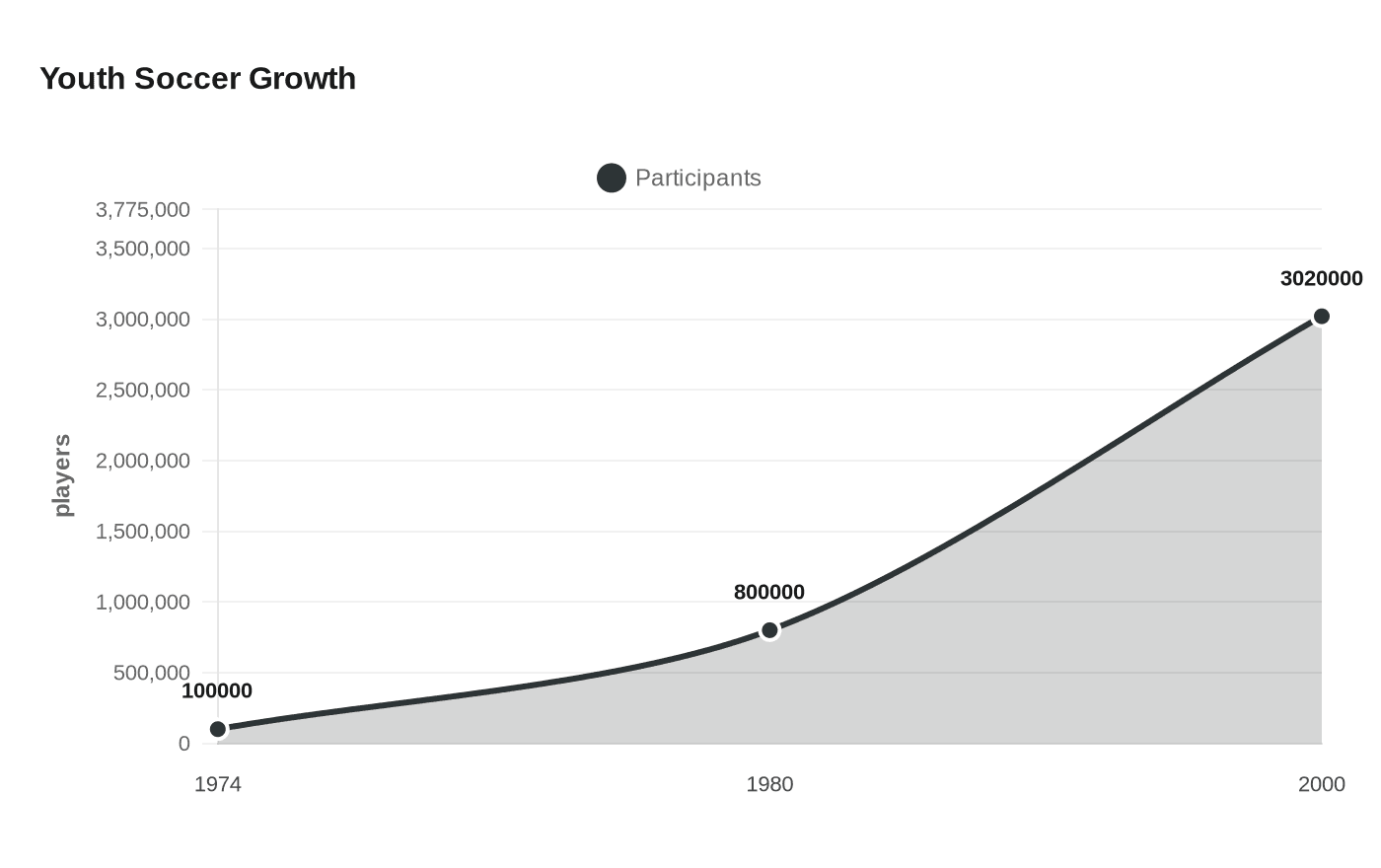
The tournament did not invent youth soccer, but it helped normalize it as a serious American pathway. Pew Research Center has documented how participation in US Youth Soccer grew from about 100,000 in 1974 to 800,000 in 1980 and 3.02 million in 2000, and it notes that younger adults’ interest in soccer likely relates in part to higher participation rates than their parents’ generation. Read alongside FIFA’s claim that 1994 ignited passion among American fans, the pattern is clear: the World Cup helped turn soccer from a spectator curiosity into a family sport with a generational base.
Television gave that shift a national amplifier. U.S. Soccer says the U.S. team’s run to the round of 16 boosted already high ratings, and about 11 million Americans watched the USA-Brazil match on July 4, an all-time high for soccer in the United States. That figure matters because it showed broadcasters, advertisers, and sports editors that soccer could draw a serious audience when the event and the story were large enough. The sport did not become mainstream because of one match, but the tournament proved that it could command mainstream attention.
Why 1994 still sits at the center of the story
Three decades later, U.S. Soccer still treats 1994 as the proof point. FIFA’s archival coverage continues to describe the tournament as the moment that laid groundwork for the sport’s development in the United States, and MLS itself traces its origin to the post-1994 effort to capitalize on expected growth. That is why the World Cup’s legacy is so visible in today’s sports landscape: the packed stadiums, the youth leagues, the soccer-specific buildings, and the expanding media ecosystem all trace back to one summer when the country finally met the sport at full scale.
This article was produced by Prism’s automated news system from verified source data, official records, and press releases, then run through automated quality and moderation checks before publishing. The system is built and supervised by the people who set the standards it runs under. Read our full AI policy.
Did this article answer your question?
.jpg&w=1920&q=75)