2026 midterms set to become costliest U.S. ad cycle ever
AdImpact lifted its 2026 political ad forecast to $11.6 billion, with Senate fights in Ohio, Texas and Maine absorbing a growing share of the money.

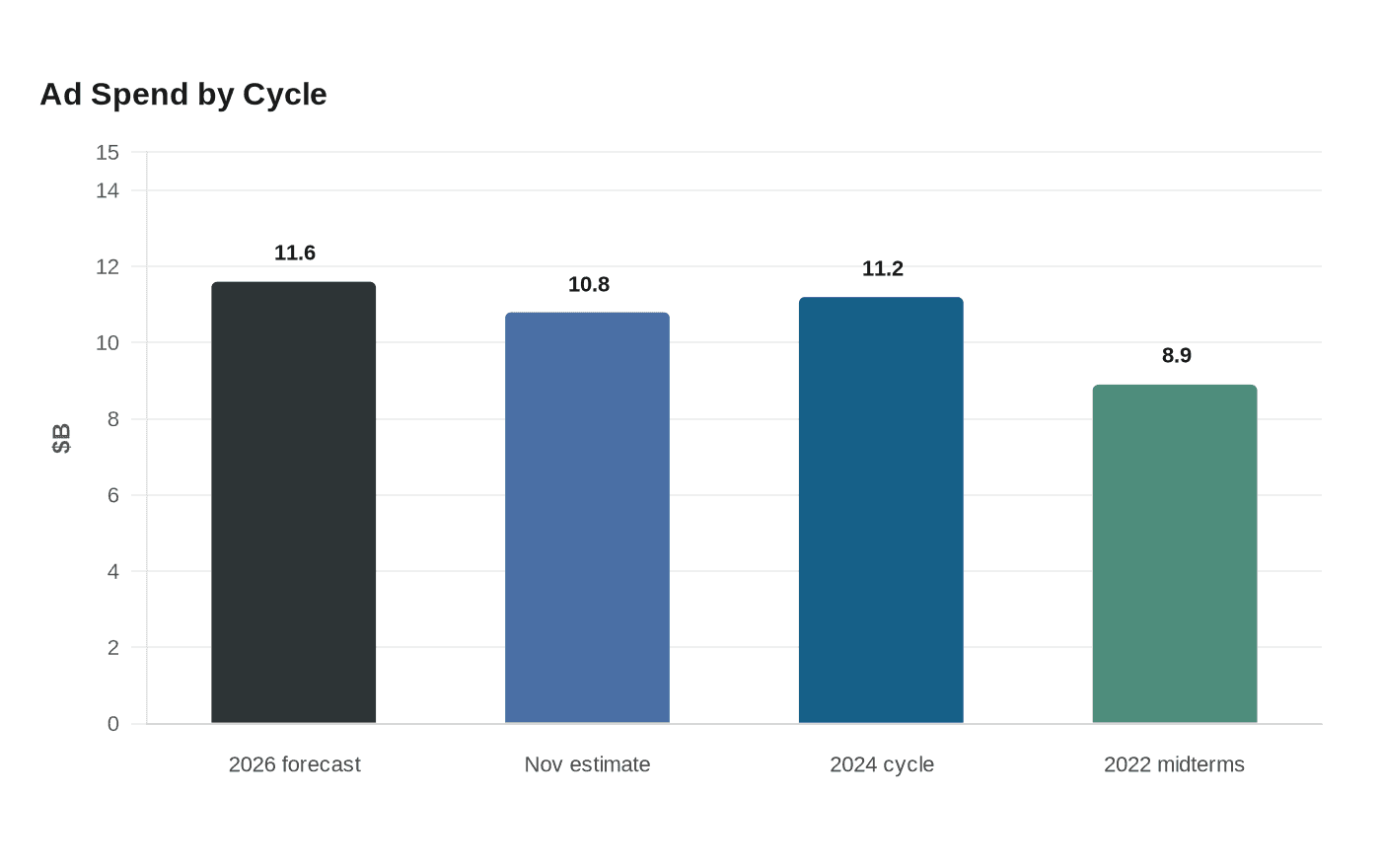
Political advertisers are racing toward a record-shattering $11.6 billion cycle, and the money is concentrating in a handful of Senate contests that could decide control of Congress. AdImpact raised its 2026 forecast by 7% from a November estimate of $10.8 billion, pushing the midterm total above the $11.2 billion spent in the 2024 presidential cycle and well past the $8.9 billion logged in the 2022 midterms.
The surge is already visible in the speed of spending. One recent report put political ad spending at $4 billion by June 1, a pace that suggests campaigns and outside groups are locking in air time far earlier than in past cycles. AdImpact has said Senate contests alone could draw about $3.4 billion in media buys, and another estimate showed $2.9 billion of that spending concentrated in just 10 races.
That concentration points to a narrower, more expensive battlefield. Ohio, Texas and Maine are shaping up as the biggest magnets for advertising dollars, while California, North Carolina, Michigan, Alaska and Iowa are also emerging as major markets. Broadcast television remains the largest single medium, but connected TV and streaming are growing quickly, adding another layer of cost as campaigns chase voters across more screens.
Ohio illustrates how expensive this kind of race can become. Democrat Sherrod Brown won the party’s primary and is challenging Republican Senator Jon Husted, who was appointed in January 2025 after J.D. Vance became vice president. Brown’s return to the ballot has turned the seat into one of the cycle’s most consequential fights, with spending expected to climb sharply as both parties treat the contest as a possible hinge point for Senate control.
Texas is poised to be another financial sinkhole. Attorney General Ken Paxton defeated Senator John Cornyn in a bruising Republican primary and now faces Democrat James Talarico, a matchup that could make the race one of the costliest in the state’s history. Maine is also set for a heavy barrage, with Democrat Graham Platner challenging Senator Susan Collins in a race that will likely attract relentless persuasion and attack advertising.
The broader political backdrop is doing just as much work as the individual contests. Republicans are defending narrow majorities in both chambers while facing low approval ratings for Donald Trump and voter frustration over living costs and gasoline prices. Trump’s approval rating was near the lowest of his political career as of June 8, intensifying the sense among donors and strategists that the fight for power will be decided by a few marginal points in a few saturated states.
This article was produced by Prism’s automated news system from verified source data, official records, and press releases, then run through automated quality and moderation checks before publishing. The system is built and supervised by the people who set the standards it runs under. Read our full AI policy.
Did this article answer your question?

