ABC News Live Covers LA Immigration Protests, National Guard Deployment
Marines made their first temporary detentions in LA as ABCNL's 24/7 stream tested how fast disputed troop counts become established fact.
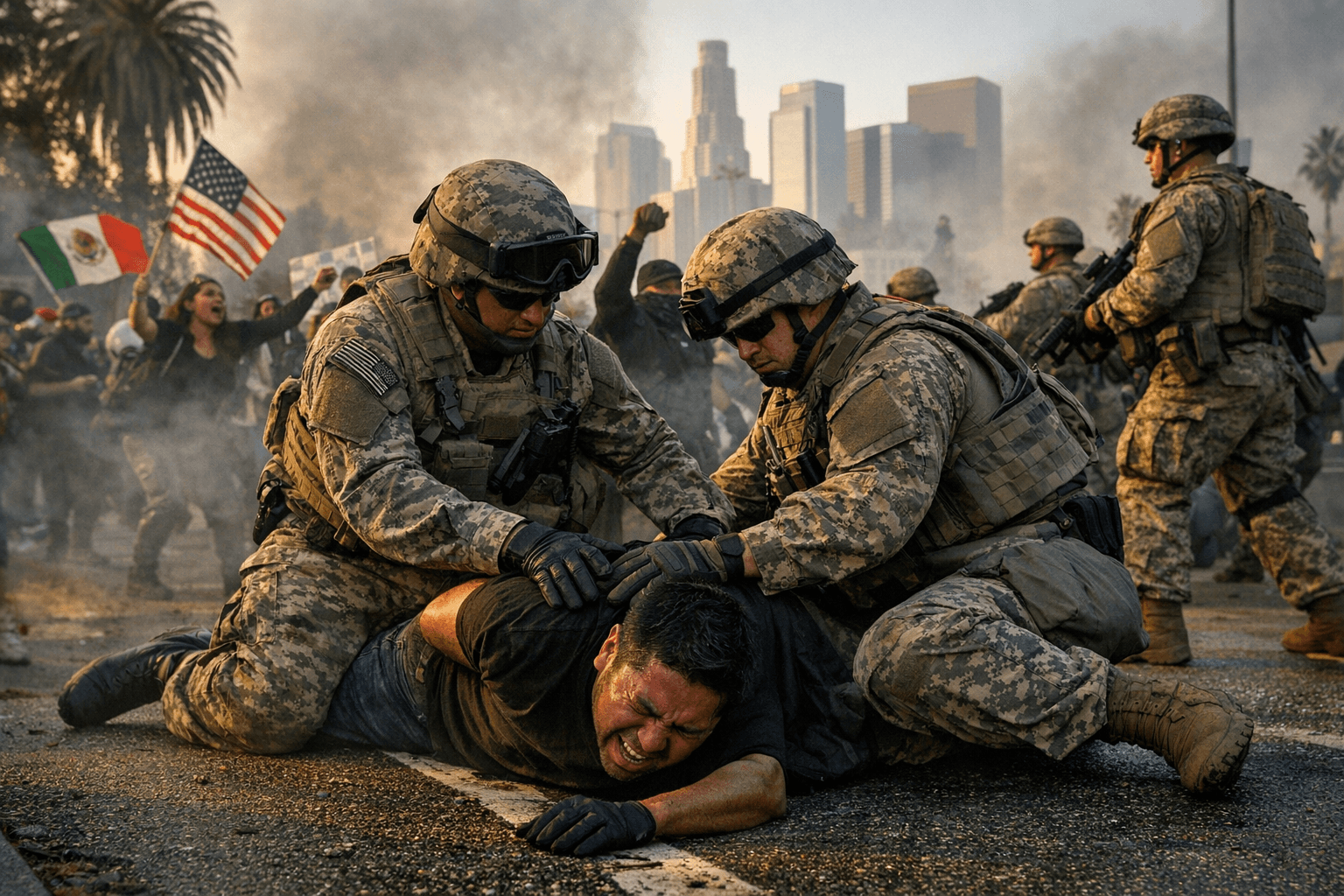
When Marines made their first temporary detentions outside the Wilshire Federal Building in Los Angeles, the moment landed not primarily on broadcast television but in the rolling scroll of ABC News Live, the network's free 24/7 streaming channel that had been tracking the city's upheaval since the first wave of ICE raids ignited protests days earlier.
The story ABCNL anchored through much of June 2025 began with Immigration and Customs Enforcement operations that rapidly escalated into sustained civil demonstrations across Los Angeles. By June 9, protests had extended into a third consecutive day. President Trump activated approximately 2,000 National Guard troops, with Marines subsequently deployed alongside them. California Governor Gavin Newsom and Los Angeles Mayor Karen Bass both called the military deployment unnecessary and warned publicly that it risked escalating rather than defusing the violence.
The troop presence eventually grew to roughly 4,000 federalized National Guardsmen and 700 Marines. A commander of the deployed forces confirmed that National Guard soldiers had been trained specifically to accompany ICE agents during enforcement operations, while officials emphasized that troops would not participate directly in law enforcement activities. Marines ultimately made the first temporary detentions at the Wilshire Federal Building on June 13. Newsom simultaneously filed a lawsuit against the Trump administration over the federal immigration enforcement posture in California, and the city of Glendale ended a longstanding agreement to house federal immigration detainees that dated to 2007. Protests spread well beyond Los Angeles to New York City, San Francisco, Boston, and Austin, Texas.
ABCNL's coverage illustrated precisely the pressures that define modern streaming news. ABC News published a detailed timeline tracing how the ICE raids in downtown Los Angeles became a flashpoint for days of protests in America's second-largest city. Anchors on ABCNL Prime with Linsey Davis worked through live updates that evolved by the hour. Early in the story, the discrepancy between official government claims and on-the-ground reality was stark: the Trump administration said 2,000 troops had been activated, while Newsom's office told ABC News that roughly 300 were actually present when the National Guard first arrived that Sunday, far fewer than the 2,000 the administration had announced.
That gap between official announcement and verifiable fact is exactly where 24/7 streaming channels face their sharpest challenge. The format rewards speed; the audience expects continuous updates; and numbers cited in the early hours of a breaking story, even contested ones, tend to crystallize into the accepted narrative before correction cycles can catch up. ABCNL's timeline reporting and sourcing discipline offered one model for managing that pressure, anchoring claims to named officials rather than amplifying unconfirmed figures.
The channel has been built to carry this kind of continuous civic load. Launched initially on July 24, 2004, as ABCNN to cover the Democratic and Republican National Conventions, it relaunched as ABCNL following the surge in streaming news consumption that accompanied the 2016 election cycle. Today the channel streams free via ABCNews.com, the ABC News mobile app on iOS and Android, and connected TV platforms including Hulu. For viewers evaluating the reliability of live coverage in real time, the most useful signals are consistent across any outlet: named sources over anonymous ones, specific attribution for troop counts or casualty figures, and a clear editorial distinction between what journalists have witnessed firsthand and what arrived through official statements.
The Pentagon eventually confirmed it was pulling 2,000 of the National Guard members back from Los Angeles, a reversal that received far less streaming real estate than the original deployment order. That asymmetry, between the drama of escalation and the quieter news of de-escalation, is among the structural biases that 24/7 live coverage most reliably produces.
Know something we missed? Have a correction or additional information?
Submit a Tip

