Adani Plans ₹90,000 Crore Market Borrowing, Eyes ₹1.5 Trillion Capex
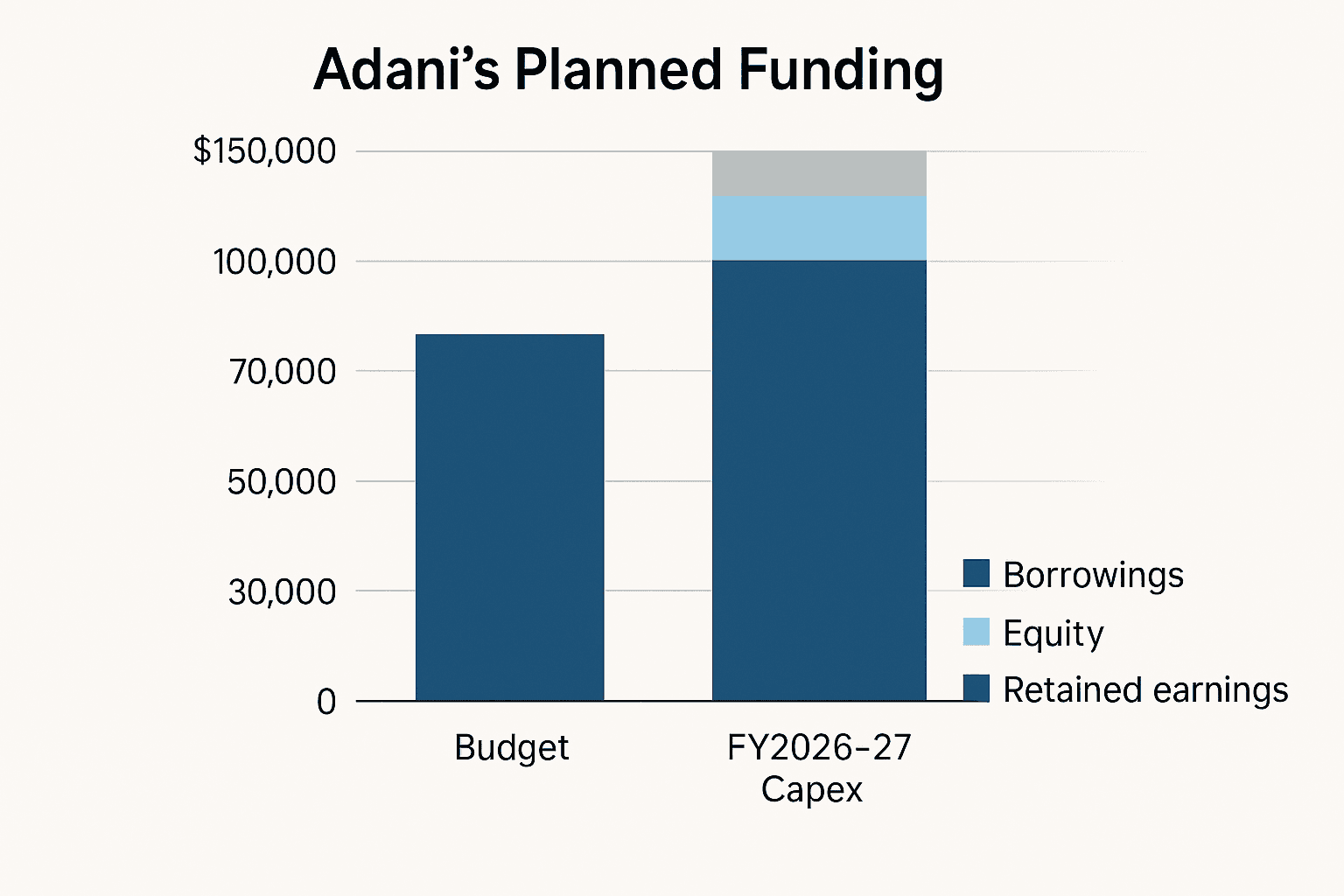
Adani Group told investors it will seek roughly ₹90,000 crore in market borrowings in fiscal 2026 27 to help fund an annual capital expenditure program of about ₹1.5 trillion across power, logistics, airports and data centres. The financing plan combines long duration debt, equity and retained earnings, and signals continued appetite for strategic asset acquisitions while testing investor demand in India s debt markets.

Adani Group said it would raise roughly ₹90,000 crore from the market in fiscal 2026 27, equivalent to about $10.8 billion depending on foreign exchange, to help finance an annual capital expenditure program of about ₹1.5 trillion. The company disclosed the plan to investors and participants at an India debt capital markets summit on November 28, 2025, and said the funding mix would include long duration debt, equity and retained earnings.
Taken together, the proposed market borrowings would cover roughly 60 percent of the targeted capex for the year, leaving the balance to be financed internally or through equity issuance. Executives at the summit also flagged continued interest in strategic asset acquisitions, indicating that some of the funding will be available to support growth by purchase as well as new project development. The company s chief financial officer Jugeshinder Singh outlined the broad contours of the programme at the event.
The size and structure of the plan are notable for their scale and for the emphasis on long dated liabilities. Large issuances of long duration debt tend to appeal to pension funds, insurance companies and other institutional investors that have long dated liabilities and seek yield above sovereign paper. For Adani, locking in long dated funding helps match financing costs with the long life and revenue profile of infrastructure assets from power plants to airports.

Market participants will watch how quickly the group taps bond and loan markets and at what spreads deals are priced. A substantial supply of corporate debt from a single conglomerate can test capacity in primary markets and exert upward pressure on yields if investor appetite is limited. Conversely, successful placements at attractive terms would reflect deepening institutional demand for India s infrastructure story and support the company s expansion timetable.
The fundraising announcement follows a period in which Adani companies accessed capital markets to shore up balance sheets and to fund growth. The new plan underscores a longer term trend in India where large private infrastructure investors increasingly rely on a mix of market borrowing and equity to sustain multi year capex programs while leveraging favourable macro fundamentals such as high nominal growth and institutional savings.
Policy makers and credit analysts will be alert to the impact on corporate leverage and on the wider credit cycle. If executed prudently, the programme could accelerate the completion of projects that provide economic capacity and jobs, while preserving access to long tenure finance. If market conditions harden or project execution slips, leverage pressures could prompt closer scrutiny from ratings agencies and lenders.
For now, investors will judge the plan on execution speed, pricing and the balance between new investment and acquisition. The coming months will show whether the debt markets can absorb one of the largest single year financing programmes announced by an Indian conglomerate in recent cycles.
This article was produced by Prism’s automated news system from verified source data, official records, and press releases, then run through automated quality and moderation checks before publishing. The system is built and supervised by the people who set the standards it runs under. Read our full AI policy.
Did this article answer your question?

