Adaptive neuromodulation improves Parkinsonian gait by targeting the right circuits
Adaptive brain stimulation matched to walking patterns cut falls in Parkinson’s, pointing to implants that respond in real time.
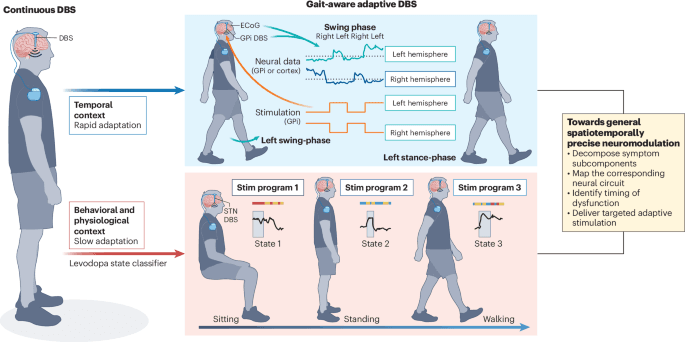
A randomized crossover trial of five people with Parkinson’s disease found gait-phase-synchronized stimulation was feasible, safe and reduced falls compared with continuous therapy, in patients whose freezing of gait can make walking through a doorway or turning a corner suddenly impossible. Two Nature Medicine studies published June 15 showed adaptive deep brain stimulation can improve Parkinsonian gait by matching stimulation to the right circuit at the right moment.
At the University of California, San Francisco, an investigational DBS system detected neural signals linked to each step and adjusted stimulation within fractions of a second. The UCSF study enrolled five people with Parkinson’s disease who had already undergone DBS surgery. Doris D. Wang, MD, PhD, was senior author, and Kenneth H. Louie, PhD, was first author on the work, which used neural decoding algorithms grounded in locomotor physiology to guide stimulation as people walked.

Deep brain stimulation is already an established treatment for Parkinson’s motor symptoms, including tremor, stiffness, slowness, dyskinesia and medication-related fluctuations. The U.S. Food and Drug Administration approved DBS for tremor in 1997 and later approved it for Parkinson’s motor symptoms in the subthalamic nucleus and globus pallidus interna in 2002. Gait, though, has remained one of the hardest symptoms to treat because it is dynamic, changing with medication status, posture, walking context and disease stage.
Freezing of gait is a temporary, involuntary inability to move that often appears during transitions such as turning or walking through doorways. Parkinson’s Foundation materials put the annual fall rate at about 38% among people living with Parkinson’s.
Adaptive neuromodulation depends on brain surgery, careful patient selection and systems that can sense and respond to symptoms in real time. UCSF also launched a clinical trial in January 2026 to test whether adaptive DBS can decrease or prevent freezing of gait, with a projected end around August 2029.
This article was produced by Prism’s automated news system from verified source data, official records, and press releases, then run through automated quality and moderation checks before publishing. The system is built and supervised by the people who set the standards it runs under. Read our full AI policy.
Did this article answer your question?