AI design and sustainability drive 2026 custom jewelry, $42B bespoke thesis
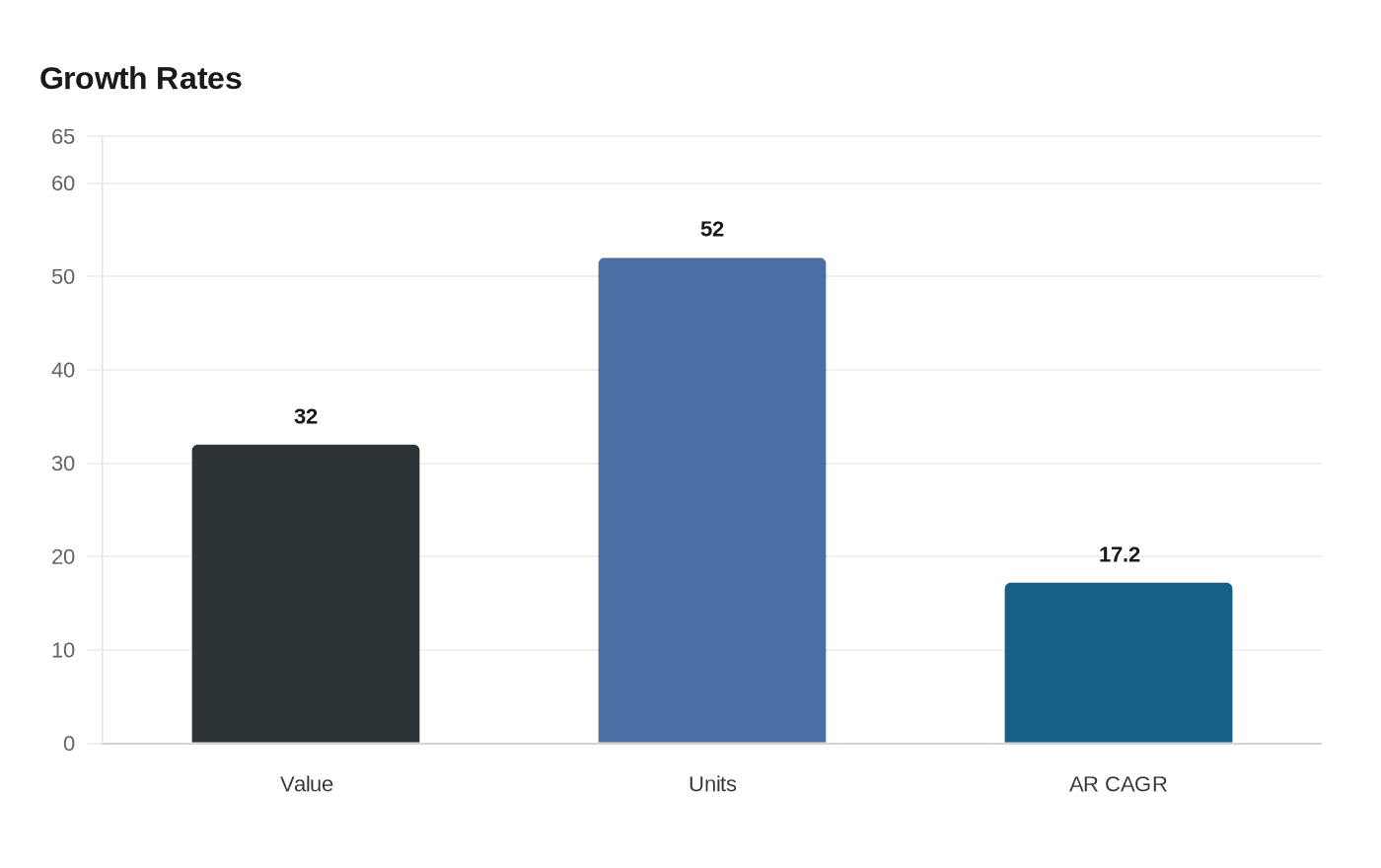
Pandora reported a 32% rise in lab-grown diamond value and 52% more unit sales in 2024, as AI design tools and AR try-on technology accelerate bespoke jewelry demand.

Pandora’s 2024 results — a 32% increase in lab-grown diamond value alongside a 52% jump in unit sales while cutting its carbon footprint — crystallize why bespoke jewelry is accelerating in 2026 and why a "$42B bespoke" thesis is now circulating among industry strategists. The immediate takeaway is that AI design, sustainability, and immersive retail tech are compressing timelines and opening custom work to more buyers.
Design tools are central. Industry platforms say AI design tools compress concept-to-CAD timelines and lower design costs, turning what used to be weeks of back-and-forth into rapid iterations. "Artificial intelligence is reshaping jewelry design by making creativity faster, more personal, and more sustainable," a Style3D AI briefing states, and Style3D adds that "AI supports sustainability by predicting demand accurately and optimizing material usage."
Sustainability has moved from marketing to material choices. Major brands including Pandora, Tiffany & Co., and LVMH are adopting lab-grown diamonds produced using renewable energy and recycled metals as part of sustainability strategies, and vendors report that recycled gold and lab-grown gemstones now feature heavily in custom commissions. On the retail floor, Jeff White of Jeff White Custom Jewelry in Las Vegas and Summerlin notes that "lab-grown diamonds remain a top choice for engagement rings and custom jewelry" and that clients increasingly prefer ethically sourced metals and personalized gemstones such as morganite, sapphire, and spinel.
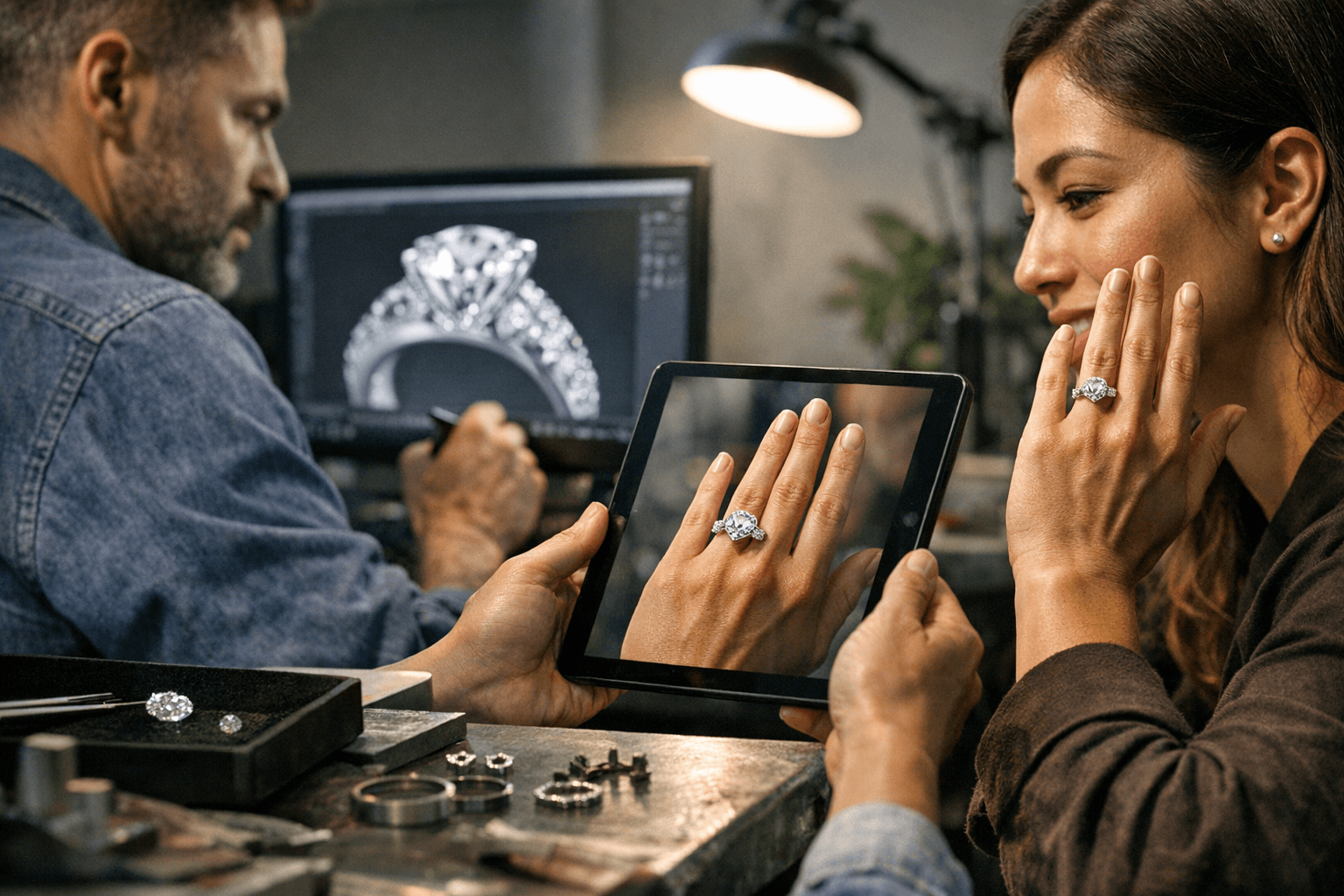
Augmented reality and virtual try-on are changing purchase behavior. The jewelry AR app market was valued at approximately $1.24 billion in 2024 and is projected to reach $4.11 billion by 2033, a CAGR of 17.2% according to market projections cited in industry materials. Trade commentary notes that consumers increasingly trust digital visualization for high-value purchases and that AR try-on "build[s] purchase confidence and help[s] reduce returns."
Production and craft workflows are evolving but not being replaced. Parametric CAD, high-resolution 3D printing, and additive manufacturing now routinely reduce sprues and wasted wax and allow design libraries to be reused across sizes and stones. Industry summits highlighted how AI can "free time and budget for tracing origins and energy transitions by streamlining concept generation and marketing." At the same time vendors caution that "AI enhances efficiency, but human creativity, storytelling, and craftsmanship remain essential to meaningful jewelry design."
Aesthetic and retail patterns are clear in 2026. Trade observers point to gender-fluid silhouettes such as chunky chains and bold rings sitting alongside elevated minimalism with refined proportion, vivid enamel and multi-gem clusters, and a continued mining of Art Deco and Victorian references. On the ground in Las Vegas and Summerlin, Jeff White reports demand for custom restorations and repair services alongside new commissions, with provenance and repairability now asked "as readily as they ask about carat weight."
For brands and startups the commercial case is tangible. Industry materials argue that AI-driven prototyping lowers upfront costs and lets smaller designers compete with larger houses, while corporate clients use AI previews for cufflinks and branded coins to speed approvals. J&M Jewelry frames the advantage succinctly as "Speed + Precision: Faster turnarounds with fewer revisions. Unmatched Personalization: Every detail, from gemstone placement to engraving, is unique. Accessibility: High-quality custom designs are now within reach for more customers worldwide."
Practical comparison checklist for anyone commissioning custom work: confirm expected concept-to-CAD turnaround, ask whether lab-grown diamonds are sourced using renewable energy or recycled metals, request provenance and repairability policies, and test AR or 3D previews before committing. Shareable nugget: Pandora reported a 32% increase in lab-grown diamond value and a 52% increase in unit sales in 2024. Have you ordered custom jewelry or used an AR try-on? Tell us what you paid and how long it took.
Know something we missed? Have a correction or additional information?
Submit a Tip