AI Design and Sustainability Propel Personalized Jewelry Market to $42B in 2026
Prism News cites a $42B market thesis as AI design tools and sustainability measures push bespoke and personalized jewelry into mainstream demand in 2026.
Prism News’ Feb 21, 2026 briefing frames the market shift plainly: “two structural forces — AI-driven design tools and sustainability demands — are accelerating bespoke and personalized jewelry sales in 2026,” and the briefing cites a market thesis valuing the bespoke/custom sector at $42 billion. That headline figure anchors a wave of vendor claims and technical studies published across 2026 showing generative design moving from experiment to infrastructure.
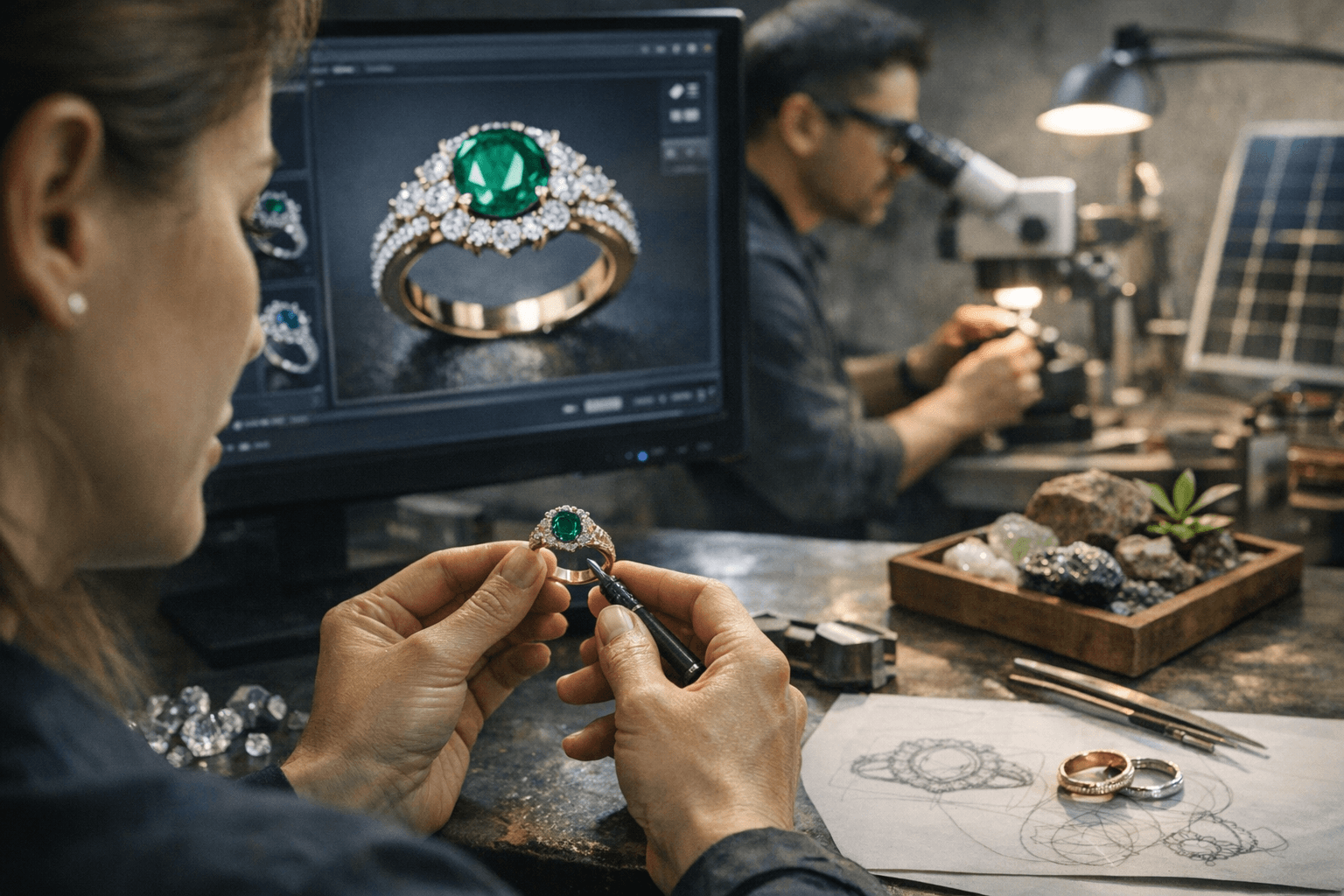
Design platforms and vendors are explicit about capabilities. Studio Diatech’s Jan 5, 2026 post, “From Sketch to Showroom: Streamlining Jewelry Ideation with AI Generation and Editing,” outlines workflows that generate designs from text, sketches, images, or CAD and then refine them for showroom-ready approvals. Style3D AI’s analysis by CC argues that “the most successful creators in 2026 will be those who blend human vision with AI-driven efficiency,” while J&M Jewelry lists an “AI Jewelry Designer & Custom Design Services” offering to show how commercial vendors are packaging those tools.
Consumer-facing features described by Jandmjewelry and others are concrete. Jandmjewelry asks readers to “Imagine logging into an online jewelry studio, uploading a photo of your hand or neckline, and instantly seeing how different designs would look on you,” pointing to virtual try-on, real-time renderings, and tailored recommendations as routine UX in 2026. Corporate use cases are in play as well: Jandmjewelry shows that “brands can input their logos or slogans and see instant previews of cufflinks, pendants, or branded coins—accelerating the approval process and ensuring every gift aligns with company identity.”
Small studios and independents stand to gain economically, according to vendor material aggregated in industry briefings. Feelstylejewelry emphasizes hybrid workflows where “AI supports personalization, sustainability, and data-driven decisions, while human designers remain at the center of creativity and trust-building.” Feelstylejewelry adds that “Even when working with a professional jeweler, AI facilitates collaboration. Clients can provide preferences and see AI-generated proposals before the jeweler begins manual work,” which lowers the barrier to entry by cutting CAD training time and accelerating prototyping.
Sustainability is baked into the technical agenda. Mvraki describes tools that let teams “simulate the environmental consequences of designs while they are still on screen, compare scenarios, and adjust geometry, settings, or materials to drive down impact without trial-and-error on the bench.” Mvraki also summarizes a recent peer-reviewed study that “trained an artificial neural network to predict key environmental metrics—carbon footprint, water usage, and recyclability potential—based on material type and design configuration,” reporting strong carbon prediction and showing that streamlined, modular pieces have lower impacts than complex ones. Jandmjewelry pairs those tools with market shifts toward lab-grown diamonds and gemstones in 2026 and Platform materials strategies favor recycled metals, traceable sourcing, and weight-efficient forms as gold price volatility bites.
On the factory floor and in marketing, the change is practical: Studio Diatech lists asset-transformation tasks such as background removal and upscaling, Mvraki cites additive manufacturing and laser-welded micro-adjustments, and vendors promise faster CAD approvals. Studio Diatech further notes that “according to industry projections from firms like Gartner and McKinsey, generative AI adoption across creative and design-led businesses has crossed the early-majority threshold by 2026, with design teams reporting measurable gains in speed, consistency, and creative output,” a framing that positions AI as mainstream infrastructure in jewelry design.
Prism News’s $42B thesis and the vendor examples together make a clear case: 2026 is the year personalized jewelry is being reshaped by AI tools and sustainability metrics while human designers retain creative authority. Have you commissioned or bought an AI-assisted custom piece in 2026? Tell us what you paid and how the process felt.
Know something we missed? Have a correction or additional information?
Submit a Tip