AI labs hire philosophers, writers and social scientists for alignment tasks
AI labs are hiring philosophers and social scientists because the hardest problems now are judgment, safety, and behavior, not just code.
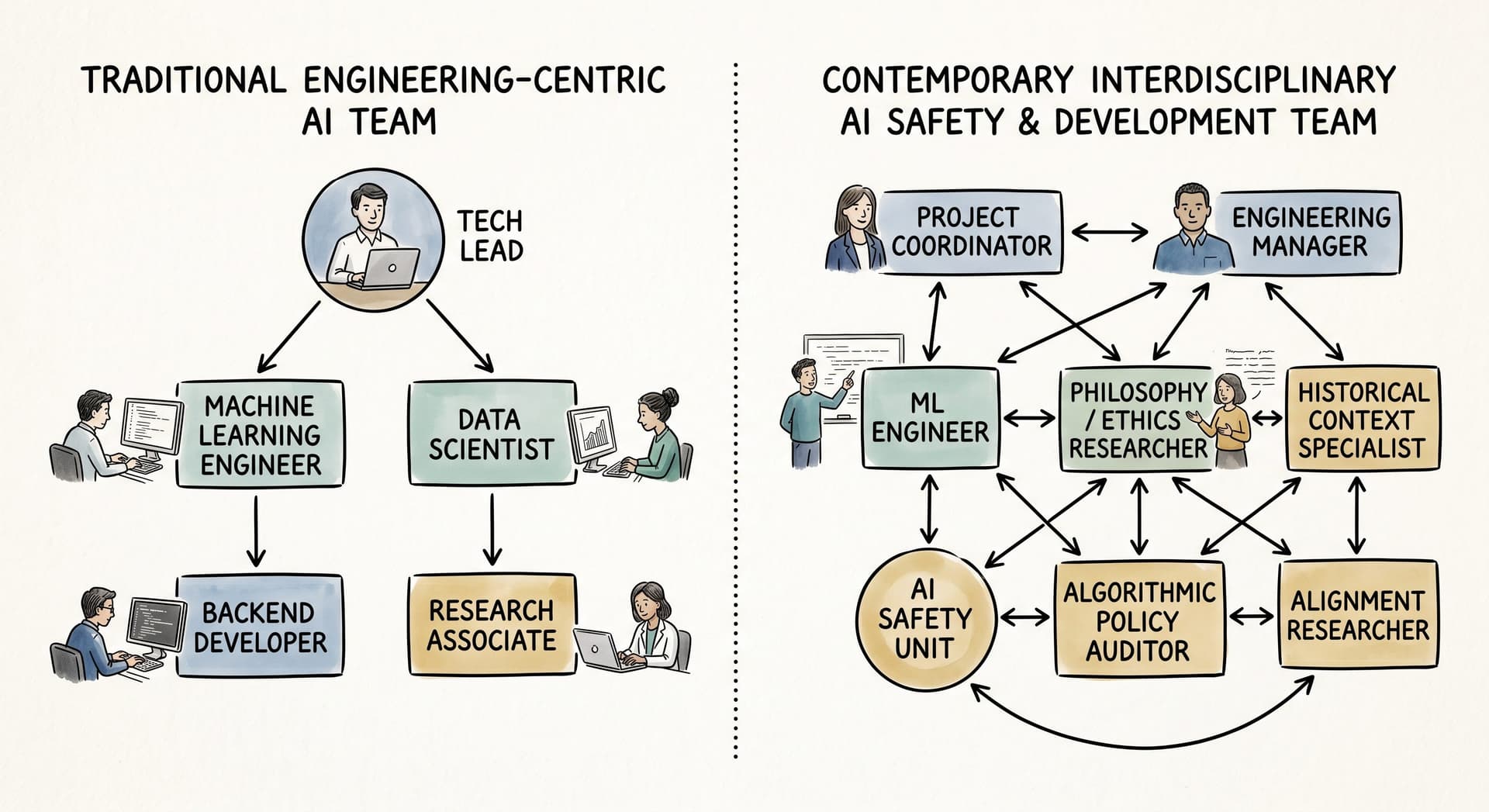
OpenAI has posted an “Agent Post-training Personality” role that explicitly asks workers to make agents thoughtful, clear, perceptive, proactive, and easy to work with. AI labs are also recruiting philosophers, social scientists, and writers to decide how systems should behave when the technical answer is not the only answer. The shift is showing up in job descriptions, research agendas, and the people now shaping model conduct at companies that once sold themselves mainly as engineering powerhouses.
Why the hiring mix has changed
The core logic is simple: as frontier systems get more capable, the hardest questions move from syntax to standards. OpenAI seeks talented people with diverse perspectives and backgrounds and says building safe, beneficial AI requires a wide range of disciplines. Anthropic focuses on reliable, interpretable, steerable systems, while Google DeepMind has published research on AI consciousness and says artificial general intelligence could drive major scientific, economic, and social transformation.
That is a different labor market from the one that dominated the last decade of tech hiring. The old injunction was to learn to code. The new frontier labs are asking people to reason about ethics, values, consciousness, social consequences, and behavioral tradeoffs.
Where the influence is most visible
Anthropic offers the clearest example of this change becoming operational rather than rhetorical. The company says Amanda Askell is the primary author of Claude’s Constitution, the document that directly shapes Claude’s behavior. The work is not limited to abstract debate about what a chatbot should value. It reaches into the rules that guide outputs, refusals, tone, and judgment calls.
That phrasing treats personality as an engineering target, not a cosmetic layer. Once a lab is hiring for “easy to work with,” it is no longer only optimizing latency or benchmark scores. It is trying to shape how the product feels, and more importantly, how it behaves under ambiguity.
The same pattern appears in the wider ecosystem. Humanities and social-science hiring has reached Anthropic, Google DeepMind, Meta, and OpenAI. The common thread is alignment work, the catch-all term for making model behavior safer, more predictable, and more in line with human expectations.
Alignment now covers more than safety slogans
Alignment has become the umbrella under which several distinct tasks now sit. One is governance, which asks who gets to set rules and why. Another is model welfare, which asks whether AI systems could deserve moral consideration at all. Anthropic is exploring that question directly and says there is no scientific consensus on whether current or future systems could be conscious.
The question is no longer only whether a model can answer accurately or refuse dangerous prompts. It is also whether the system’s treatment, training, or internal organization could matter in moral terms. Google DeepMind has published work on AI consciousness, bringing technical research together with questions that once lived almost entirely in philosophy departments.
The practical effect is that labs need people who can translate between worlds. They need researchers who can work across machine learning, ethics, social science, and product behavior. They also need people who can explain why one type of agent should sound decisive while another should sound cautious, why some failures are dangerous and others merely annoying, and where a model should defer rather than improvise.
The labor market helps explain why philosophers look attractive
The hiring trend is also being pulled by the labor market. The Federal Reserve Bank of New York’s analysis of recent college graduates puts the unemployment rate for that group at about 5.7 percent in the first quarter of 2026, while underemployment was 41.5 percent. Its major-level data add another twist: philosophy majors had a 5.1 percent unemployment rate in the 2024 data underlying the report, compared with 7.0 percent for computer science majors.
Those numbers do not mean philosophy has “beaten” computer science in any broad economic sense. But they do puncture the old assumption that philosophy is an impractical major and computer science is the safe one. In a labor market where graduate underemployment remains elevated, the ability to reason through tradeoffs, write clearly, and operate across disciplines can be marketable precisely because it is hard to automate and hard to find.
The New York Fed’s college labor market feature has tracked employment data for recent graduates in the United States going back to 1990, which gives the current moment a longer baseline. Against that history, the latest readings show that prestige technical skills are no longer the sole route into elite AI jobs.
What this means for the next wave of AI products
AI firms are discovering that technical performance and social legitimacy now rise or fall together. A model that is brilliant but erratic can be commercially fragile; a model that is cautious but clumsy can be hard to use; a model that is persuasive in the wrong direction can create safety, reputational, and regulatory risk.
When Amanda Askell helps write Claude’s Constitution, or when OpenAI asks a specialist to design an agent personality that is thoughtful and clear, the work reaches into how the system acts in the market. Those choices affect enterprise adoption, consumer trust, and the boundaries companies set for themselves before regulators force the issue.
Critics still have a point when they warn about ethics-washing. A philosopher on the payroll does not guarantee real power, and a humane-sounding job title does not prove that a lab has surrendered control to moral specialists. Some of this hiring may be optics, a way to signal seriousness about safety without changing who ultimately owns the product roadmap.
This article was produced by Prism’s automated news system from verified source data, official records, and press releases, then run through automated quality and moderation checks before publishing. The system is built and supervised by the people who set the standards it runs under. Read our full AI policy.
Did this article answer your question?