AI predicts internal defects, ties powder and process to metal AM performance
KIMS led by Dr. Jeong Min Park built an explainable AI that links pore size, non-circularity, and spatial distribution from LPBF micrographs to mechanical properties, aiming for defect-aware process design.
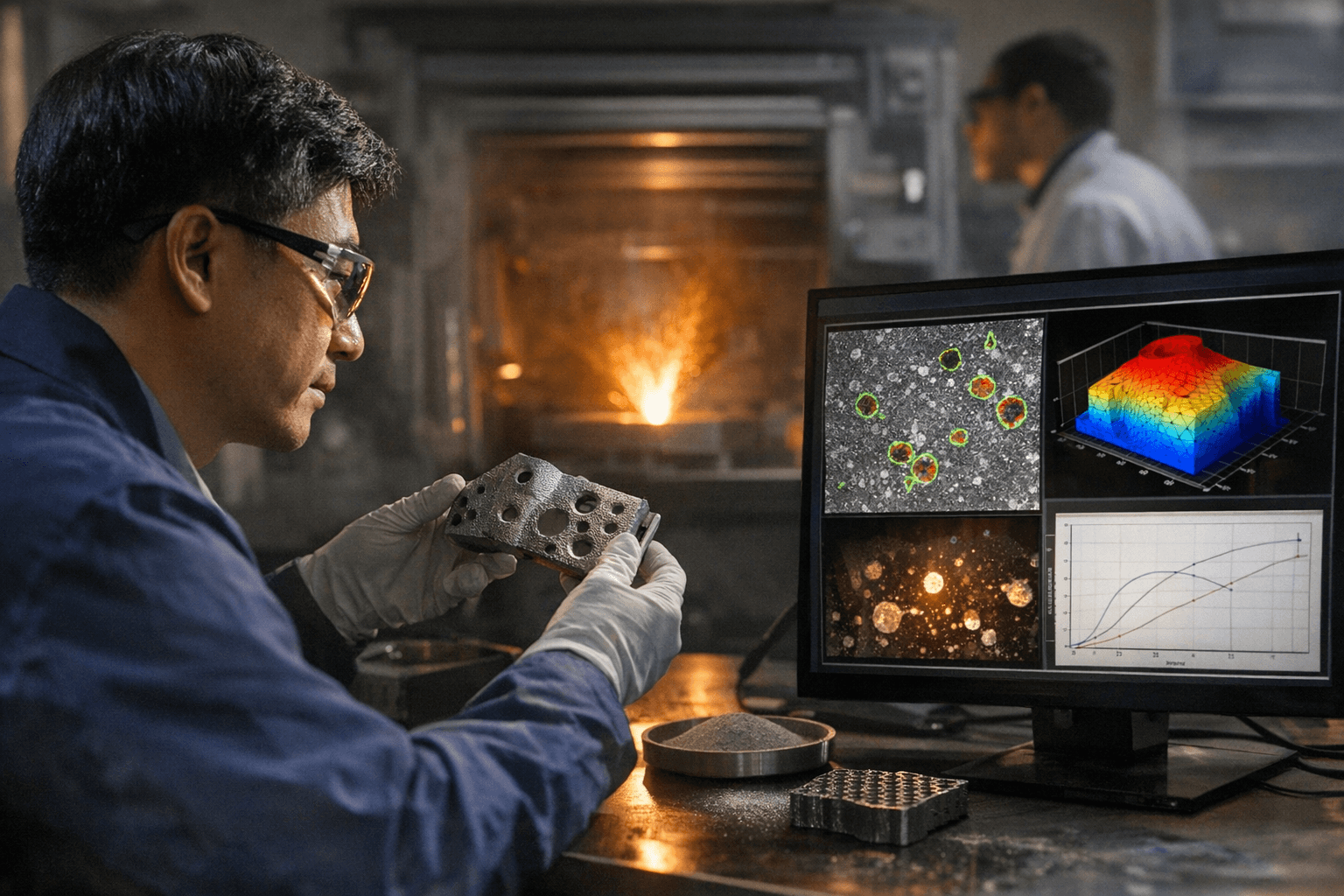
The team led by Dr. Jeong Min Park at the Korea Institute of Materials Science (KIMS), with collaborators Dr. Jaemin Wang and Prof. Dierk Raabe from the Max Planck Institute, developed an Explainable AI framework that predicts internal defects in laser powder bed fusion parts and ties those defects to mechanical performance. KIMS frames the model as a tool for defect-aware process design and quality management with the stated goal of improving reliability for mass production in industrial settings.
KIMS described the model as able to analyze microstructural images and "automatically analyzes pore size, non-circularity, and spatial distribution, and directly correlates these factors with mechanical properties, enabling a quantitative explanation of how defects influence actual performance. In particular, the model is designed to explain why defects increase and performance deteriorates under certain process conditions, distinguishing it from conventional "black-box" AI models whose [...]" The work emphasizes morphology over simple defect counting, focusing on how shape and spatial patterns of pores affect tensile and integrity outcomes.
Independent but related work benchmarks the in-situ imaging and CNN approaches used across the field. An Accscience study using the EOSTATE PowderBed system produced a manually labeled, pre-processed layer-wise image dataset and applied transfer learning to ResNet50, EfficientNetV2B0, YOLOv5, and Faster R-CNN. That study reported that "ResNet50 and EfficientNetV2B0 achieved over 99% accuracy in defect classification, while YOLOv5 outperformed Faster region-based-CNN in defect detection and localization. However, lower average precision values in object detection tasks were attributed to variability in defect scales and annotation quality."
The KIMS approach fits alongside physics-informed and probabilistic methods already in the literature. The PMC review notes that "Zhu et al. developed a defect prediction model by simulating fluid dynamics and interlayer fluid changes in the molten pool" and explored Physics-Informed Neural Networks to predict melt flow velocity, pressure distribution, and temperature fields. The review also records Snell et al. noting that "insufficient energy input leads to incomplete melting of the metal powder, thereby generating lack-of-fusion (LF) defects, whereas excessive energy input causes over-penetration of the molten material, resulting in the formation of keyhole-induced (KH) defects."
Practical caveats remain. Accscience recommends expanding datasets and refining annotation protocols to raise detection average precision, and the extracts provided for the KIMS announcement do not include numerical validation metrics, dataset sizes, or the specific network architectures used in the Explainable AI. Bioengineer described the work as "poised to redefine the future of metal additive manufacturing" and framed it as having the potential to transform quality assurance for aerospace and other high-value sectors.
If KIMS releases model architectures, labeled datasets, and mechanical correlation statistics, the field would gain a morphology-driven pathway from powder and process parameters to predicted part performance. For now, the KIMS claim establishes explainability and a morphology-to-mechanics mapping as a new focal point for industrial LPBF quality control.
Know something we missed? Have a correction or additional information?
Submit a Tip