AI study suggests El Greco painted The Baptism of Christ himself
An AI scan of El Greco’s The Baptism of Christ points to the master’s own hand, challenging the long-held belief that his son and workshop finished much of it.
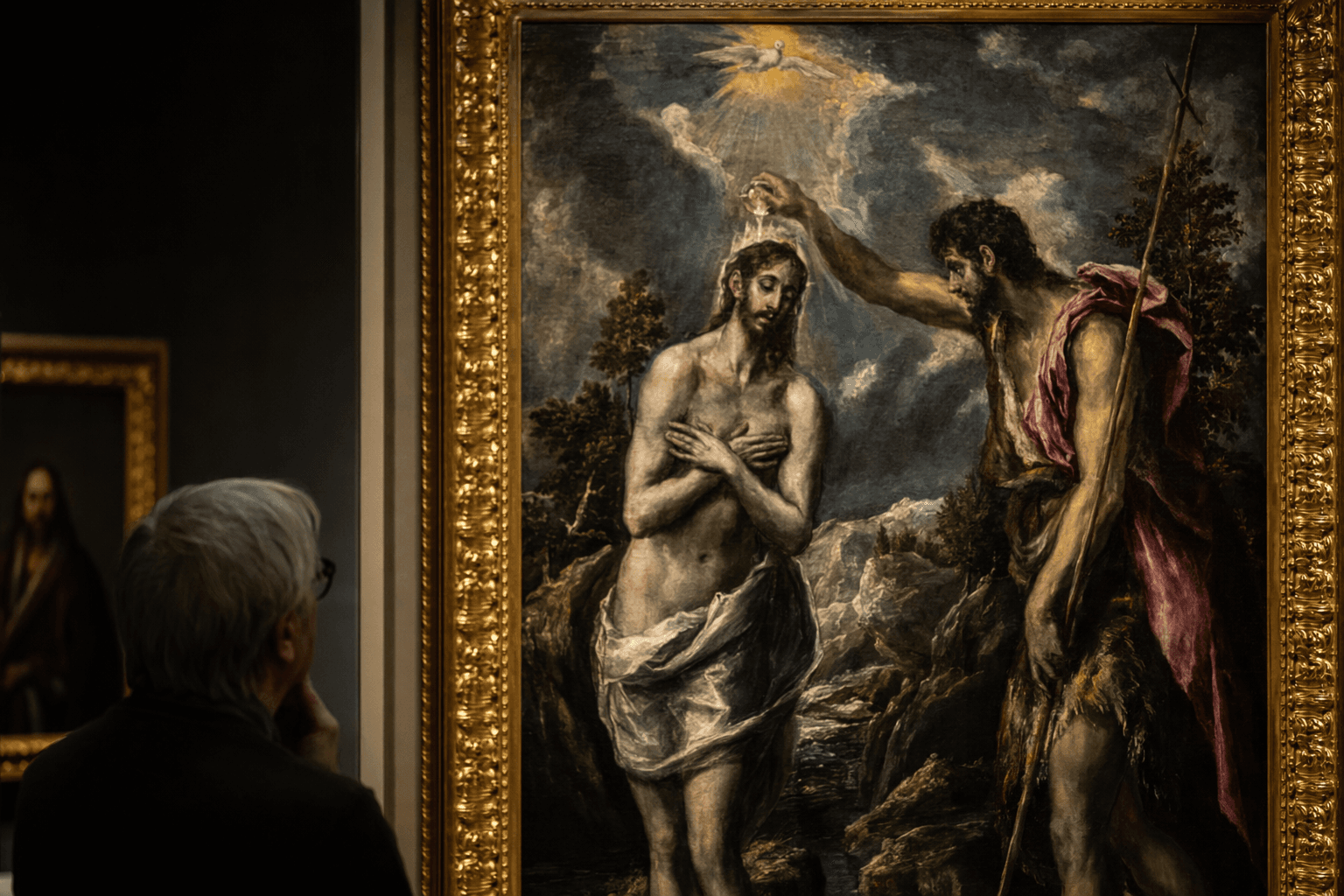
For generations, The Baptism of Christ sat at the center of a quiet attribution fight. The oil painting, dated to about 1608 to 1614 and fixed as the altarpiece in Hospital Tavera in Toledo in 1624, was long believed by many scholars to have been largely completed by El Greco’s son, Jorge Manuel Theotokópoulos, with help from workshop assistants.
Now a new study has pushed that debate in a different direction. Researchers from Case Western Reserve University used an AI system called PATCH, short for pairwise assignment training for classifying heterogeneity, to examine paint texture at a microscopic scale through high-resolution 3D imaging. The method mapped surface features centimeter by centimeter, allowing the team to compare how different sections of a painting were built up and whether they shared a common underlying structure.

The model was trained first on 25 paintings by nine student artists before being applied to works by El Greco. One of those was Christ on the Cross, an undisputed El Greco painting, which PATCH found consistent with a single hand. When the system was applied to The Baptism of Christ, it suggested that much of the painting also shared an underlying connection pointing to El Greco himself rather than multiple painters.
That finding does not close the case entirely. The researchers said some differences in the lower part of The Baptism of Christ could still reflect later hands. But they also argued that other apparent irregularities may be better explained by El Greco experimenting with style, switching brushes, or showing the effects of age and declining motor skills near the end of his life. In other words, the AI did not replace judgment from art history; it sharpened the questions that historians must still answer.
The study, published in Science Advances on April 17, 2026, has been presented as a tool for art authentication and forgery detection. Its authors described PATCH as a complement to traditional art-historical methods, not a replacement for them. That distinction matters. AI can reveal patterns invisible to the eye and test long-standing assumptions with new precision, but the meaning of those patterns still depends on human expertise, historical context, and the stubborn ambiguity that defines old master painting.
This article was produced by Prism’s automated news system from verified source data, official records, and press releases, then run through automated quality and moderation checks before publishing. The system is built and supervised by the people who set the standards it runs under. Read our full AI policy.
Did this article answer your question?