AI visibility lags in luxury real estate despite widespread agent adoption
Luxury agents are using AI daily, but AI search still barely sees them. That gap could reward the firms that build authority now.

The contradiction at the center
Luxury real estate is full of AI adopters, yet it ranks last where discovery now matters most: inside AI-generated answers. A joint report from 5WPR and Haute Residence says the category has an AI Overview trigger rate of just 0.14 percent, the lowest of any major U.S. industry, even as 82 percent of agents now use AI daily.
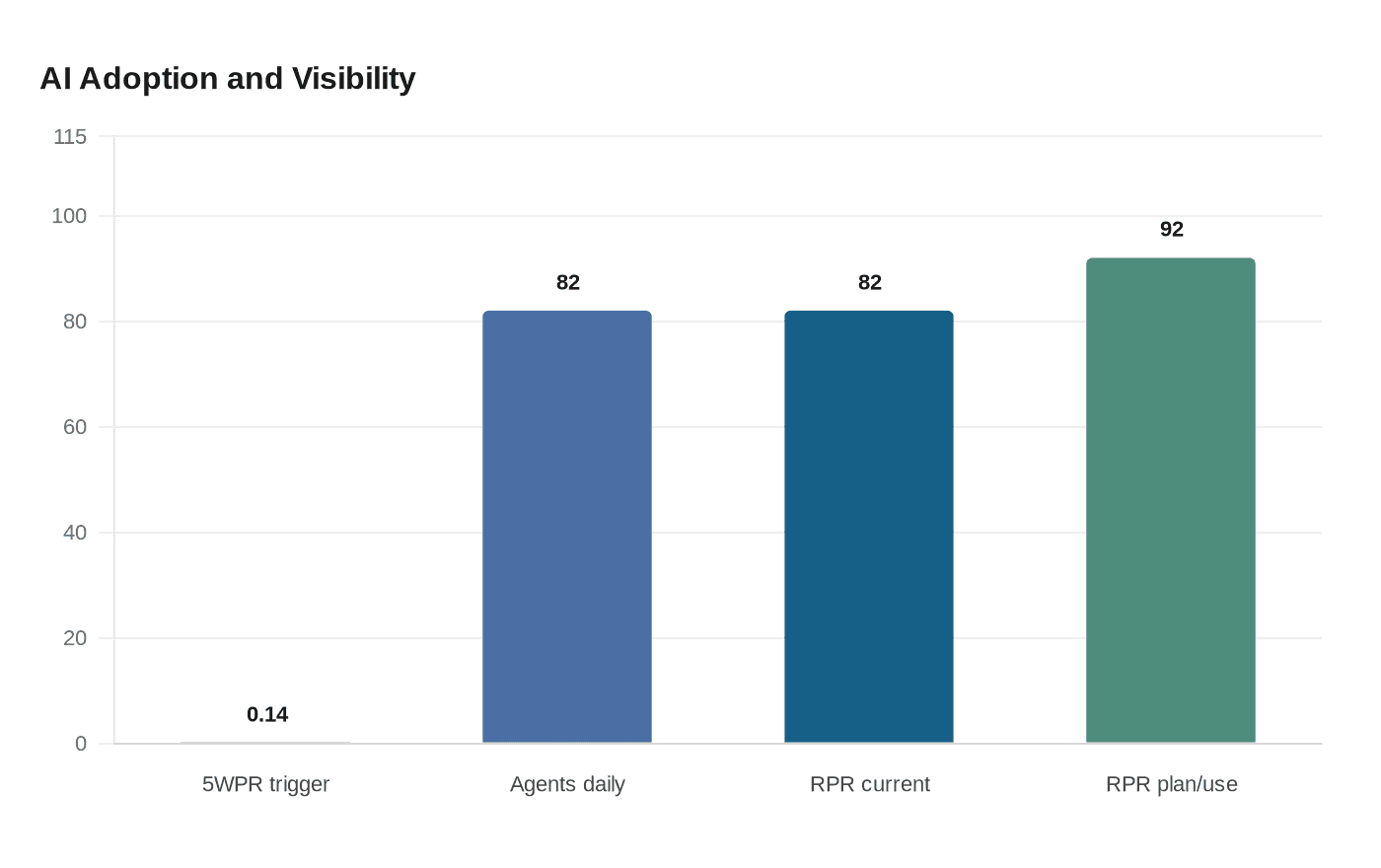
That mismatch is the story. Inside brokerages and teams, AI has become routine. Outside those workflows, however, the category still struggles to surface in the systems buyers are increasingly using to research homes, neighborhoods, and agents. The report frames that gap as a warning and an opening, because the firms that solve visibility first can build an advantage before the market gets crowded.
Why the category is so hard for machines to see
The report’s core insight is that AI systems are not rewarding activity, they are rewarding authority. Buyer research in ChatGPT, Claude, Perplexity, and Google AI Mode is still being answered from a thin corpus of content that those systems treat as trustworthy, which means luxury real estate is competing with a small set of pages that are often not the richest or most current.
That is where the structural weakness shows up. Real estate content is fragmented across listing portals, brokerage websites, agent pages, local neighborhood guides, and social feeds, while luxury inventory is especially scattered and highly local. Add weak schema, inconsistent metadata, and a heavy dependence on third-party platforms, and the result is a category that may be technologically busy but still hard for machines to interpret cleanly.
The report also argues that the next 24 months are a critical window. In a market with high transaction values and fierce competition, brokerages and agents that invest in generative engine optimization now may secure a durable visibility edge later, before more firms start optimizing for the same prompts and answer engines.
The consumer products are already here
The product side of the industry has moved quickly. Zillow said in October 2025 that it became the only real estate app available in ChatGPT, Redfin rolled out Ask Redfin and conversational search as part of a broader AI set that also includes Buying Power, and Realtor.com announced its own app in ChatGPT on March 30, 2026. Google’s AI Mode also began rolling out broadly in U.S. Search during Google I/O 2025.
That timeline matters because it shows how quickly the consumer front end has changed. The category is no longer waiting for a single platform to “introduce” AI to real estate. Instead, major brands are racing to place their own interfaces inside the tools buyers already use, from search to chat to conversational listing exploration.
Still, the report suggests that product launches alone do not guarantee discoverability. A chatbot app can make a brand feel modern, but if the underlying content ecosystem is thin, scattered, or poorly structured, the system will still struggle to rank that brand as the best answer when a buyer asks about luxury inventory, high-end neighborhoods, or the best agent to call.
Agents are already using AI, and the surveys show how deep that habit runs
The adoption numbers are not speculative. RPR’s February 2026 survey of 225 agents found that 82 percent currently use AI in their business, and 92 percent are either already using AI or planning to. The National Association of REALTORS® said in its September 18, 2025 Technology Survey that AI has moved firmly into day-to-day real estate workflows.
That same NAR survey found that 59 percent of REALTORS® use some emerging technology but are still learning, and 33 percent said AI has had a moderately positive impact on their business. Earlier 2026 reporting also pointed to the most common use cases, which are writing and marketing tasks, alongside persistent concerns about training and accuracy.
Taken together, those numbers explain the paradox. Agents are already leaning on AI to draft copy, shape campaigns, and speed up workflows, but many still have not translated that internal efficiency into outward search authority. In other words, the profession is learning how to use AI before it has fully learned how to be found by AI.
What this means for marketing in luxury real estate
The practical takeaway is not to wait for the platforms to fix visibility. The firms most likely to win in AI search will be the ones that publish content machines can understand, trust, and reuse. That starts with listing pages that are complete, consistent, and updated quickly, but it cannot stop there.
A stronger AI visibility strategy usually includes:
- Rich neighborhood and market pages that answer the questions luxury buyers actually ask
- Structured data on listings, agents, offices, and local expertise so machines can parse the page
- Clean, consistent property descriptions across brokerage sites and syndication channels
- Content that goes beyond listings, including school, lifestyle, commute, design, and amenity context
- Brand pages that clearly connect agents to specialties, markets, and notable sales history
This is where luxury real estate has the most to gain. The category already trades on trust, local knowledge, and relationships, which are exactly the signals AI systems want to interpret. If that expertise stays buried inside fragmented pages and platform-dependent listings, the systems will keep overlooking it.
The deeper lesson from the report is that digital maturity and AI visibility are not the same thing. Real estate may be using AI heavily, but until it organizes its content in ways machines can reliably read, the industry will keep underperforming in discovery. The firms that close that gap first will not just look innovative, they will become the names buyers see when the conversation starts.
Sources:
Know something we missed? Have a correction or additional information?
Submit a Tip