Akai MPC Returns to Its Roots With a New Standalone Sampler
Akai's new $399 MPC Sample portable sampler launches today, ditching touchscreens and virtual synths to revisit the compact, battery-powered simplicity of the MPC60 and MPC3000.
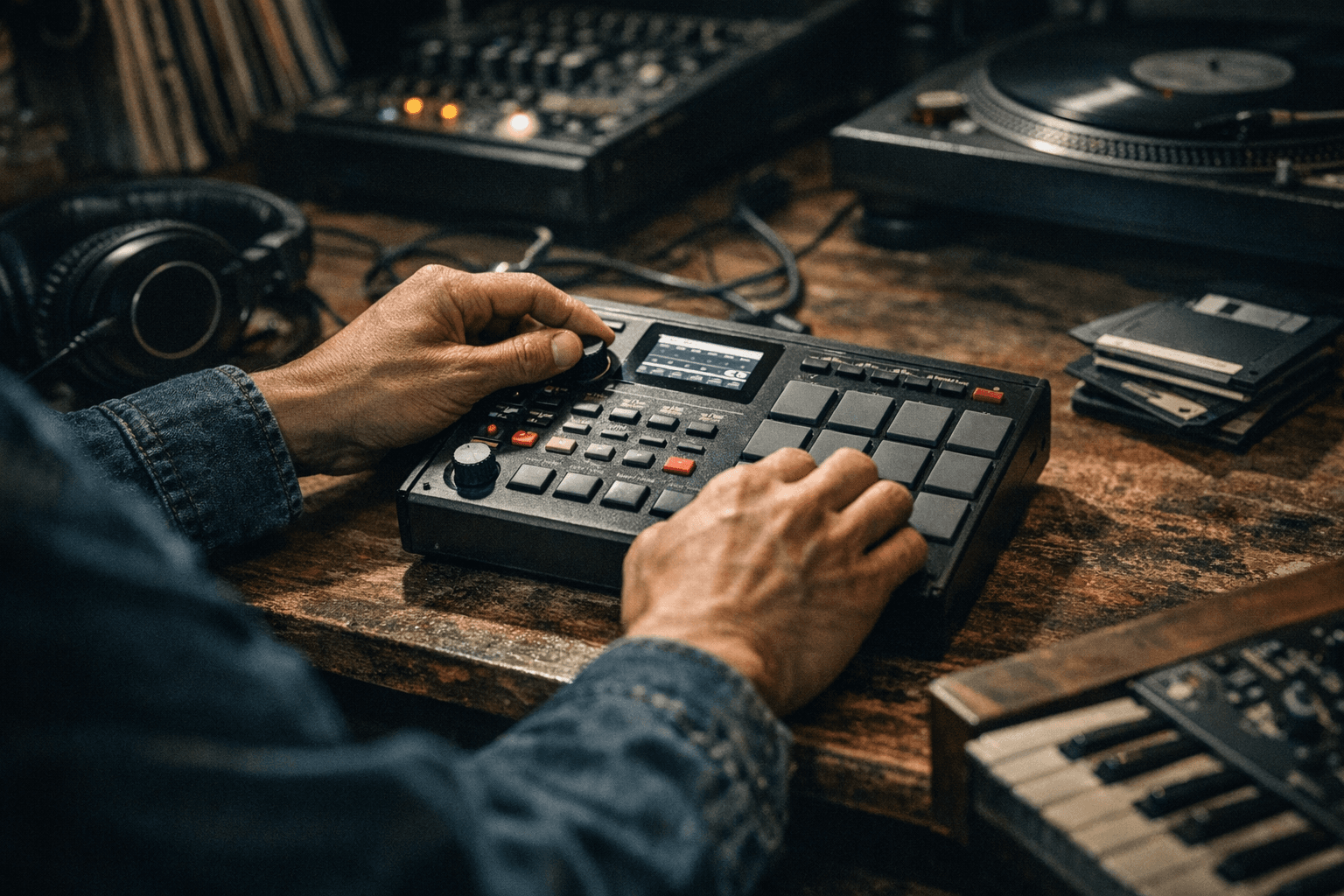
Akai Professional unveiled the MPC Sample, a compact standalone sampler designed to bring the company's iconic MPC workflow to a more accessible and portable format, inspired by classic machines like the MPC60. The device, priced at $399, represents a deliberate turn away from the feature-bloated direction the MPC line has taken over the past decade.
Modern MPCs like the flagship MPC XL have evolved into sprawling production centers. The MPC XL is a standalone production system that combines software synthesizers, samplers, and sequencers with integrated plugin instruments and high computing power enabling hybrid workflows between DAW-based software synthesizers and self-sufficient production setups. The MPC Sample is the opposite of that. Akai makes a point of emphasizing that no computer or DAW is required: the sampler, sequencer, and beat tools work completely standalone.
The device includes a sampler engine, sequencer, built-in microphone, speaker, and over 100 effect kits. Connectivity covers USB-C, microSD, stereo line input and output on 6.35mm jacks, MIDI in/out on TRS connectors, and a sync output. Power comes from USB-C or a built-in rechargeable battery. The effects engine is notably deep for a device at this price point: it offers granulation, ring modulation, Lo-Fi, delay, reverb, chorus, flanger, phaser, and more, totaling over 100 effect kits.
The form factor positions MPC Sample squarely against the Roland SP-404MK2 and Teenage Engineering EP-133 KO II, compact battery-powered devices designed for sampling and beat-making without the friction of a full studio setup. It's a crowded market. At NAMM 2026, Casio also unveiled a new sampler going in the same direction as the SP-404MK2.
For nearly 40 years, MPCs have shaped the sound and culture of modern music production, and the MPC Sample carries this legacy forward by making the art of sampling more accessible and approachable than ever before. At $399, it is positioned well below the MPC One+ and far removed from the complexity of the MPC XL, marking what the company describes as its most accessible standalone sampler to date.
This article was produced by Prism’s automated news system from verified source data, official records, and press releases, then run through automated quality and moderation checks before publishing. The system is built and supervised by the people who set the standards it runs under. Read our full AI policy.
Did this article answer your question?