Amazon launches Bio Discovery AI to speed drug discovery research
Amazon's new Bio Discovery AI promises antibody design in weeks, but the real test is whether software can outrun lab bottlenecks, not just hype.
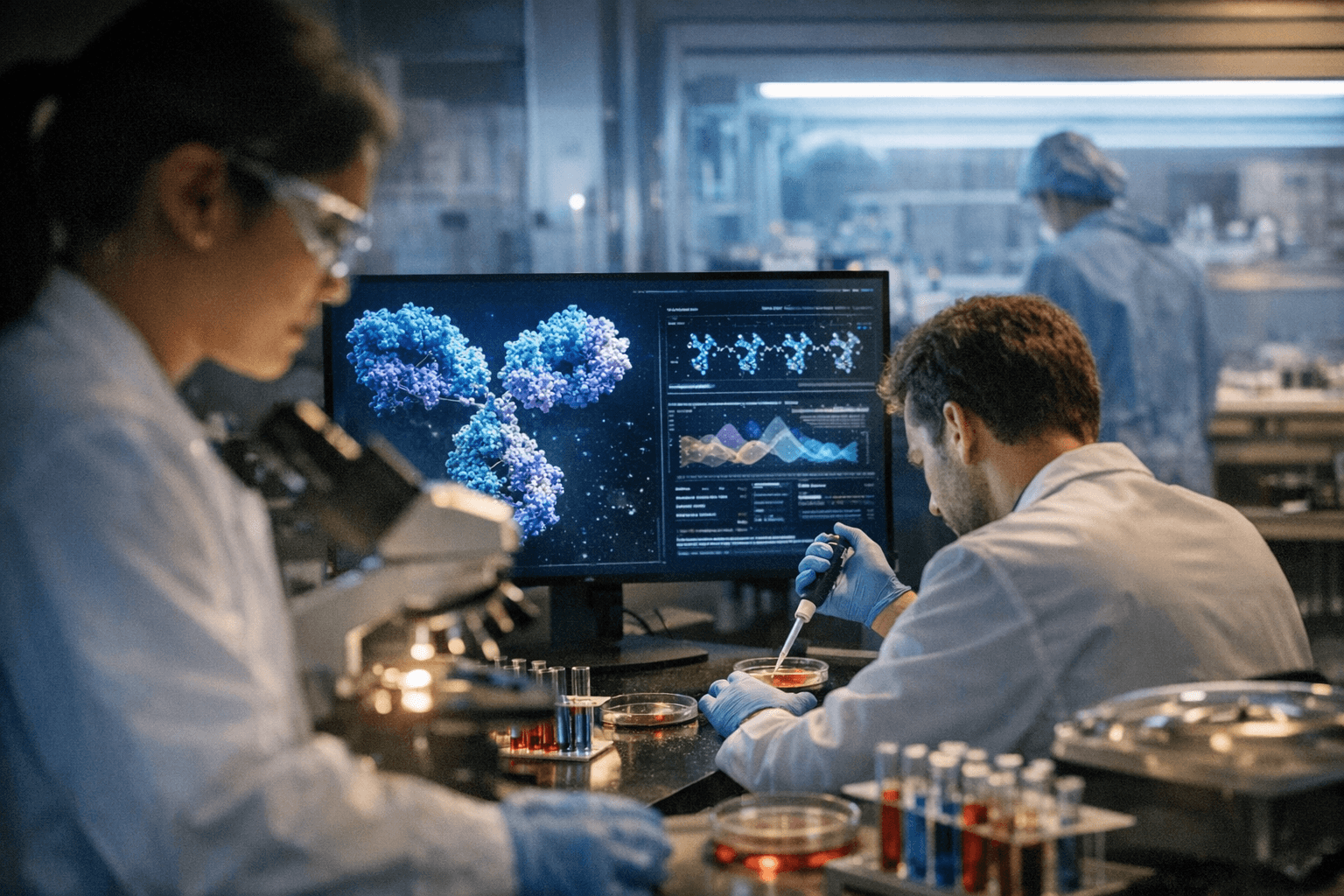
Amazon Web Services has moved its life-sciences pitch from abstract AI promise to a product built for day-to-day discovery work. The company launched Amazon Bio Discovery as a no-code application that lets scientists run early-stage drug discovery workflows, pick from more than 40 AI biology models, upload custom and licensed models, and use an AI agent to choose parameters and interpret results. Amazon says the system is built around a “lab-in-the-loop” cycle that sends shortlisted candidates to integrated partners for synthesis and testing, then routes those results back into the platform for the next round of design.
The clearest business case is antibody development. Amazon’s launch materials say Bio Discovery is aimed especially at antibody therapy discovery and can shorten timelines from months to weeks. AWS says the platform includes built-in benchmarks for real antibody optimization tasks, reusable no-code templates, standardized data processing, and automated experiment tracking. That is the pitch behind much of the AI frenzy in drug development: faster hypothesis generation, broader search across molecular space, and fewer dead-end experiments before a lab ever commits time and money.
Yet the launch also shows where the bottlenecks still sit. Bio Discovery is designed to help with model selection, candidate ranking, and design parameter tuning, but it does not remove the need for experimental validation, specialized biological data, or access to physical lab capacity. Amazon’s own materials make clear that wet-lab partners remain essential. The platform can be powerful for teams without large computational staffs, but drug discovery is still constrained by assay quality, synthesis turnaround, regulatory evidence, and the cost of proving that a promising molecule actually works in living systems.
Amazon is also using the launch to deepen its position as infrastructure provider rather than drugmaker. Only two weeks earlier, AWS and Flagship Pioneering announced a collaboration in which Flagship’s early-stage companies receive cloud credits, technical support, AI capabilities, and go-to-market resources, with AWS as the preferred cloud provider. Bio Discovery fits that strategy, and AWS is already pointing to early adopters and partners including Memorial Sloan Kettering Cancer Center, Voyager Therapeutics, the Broad Institute, and Bayer. AWS-related coverage said one Memorial Sloan Kettering project generated nearly 300,000 novel antibody molecules and sent the top 100,000 to Twist Bioscience for testing, a scale that would be difficult to manage with manual workflows alone.
For public health, the promise is not just speed. If these tools help researchers in cancer, rare disease, and antibody therapeutics identify viable candidates sooner, the payoff could be faster paths to treatment. But the benefits will still depend on who can afford the compute, who has access to high-quality data, and which institutions can plug AI output into real laboratory work. Amazon is betting that the future of drug discovery will be built on cloud software, but the field will still be judged by what reaches the bench, and eventually the patient.
This article was produced by Prism’s automated news system from verified source data, official records, and press releases, then run through automated quality and moderation checks before publishing. The system is built and supervised by the people who set the standards it runs under. Read our full AI policy.
Did this article answer your question?