Amy Stewart’s Tree Collectors explore obsession, healing, and hope
Amy Stewart's tree collecting becomes a story about community, healing, and what Americans choose to preserve. From California fruit trees to Navajo peaches, the book treats trees as living history.
Trees as a way of reading the country
Amy Stewart’s *The Tree Collectors* treats tree obsession as something bigger than a hobby. In the 2024 book, Stewart follows people who design leafy urban spaces, cultivate ancient species, and build private collections that say as much about identity and memory as they do about botany.
That is why the story lands as a national one. Tree collectors are not just accumulating specimens; they are making arguments about what deserves to survive in a changing landscape. Stewart’s publisher says the urge to collect trees springs from “a longing for community, a vision for the future, or a path to healing and reconciliation,” and that framing gives the book its emotional range.
A collection that looks forward
Stewart’s project is built on the idea that planting can be an act of faith in what comes next. She describes planting a tree as “an act of hope,” and that phrase captures the book’s larger logic: trees are slow, stubborn commitments. They outlast trends, weather political cycles, and quietly shape the places where people live.
The book also widens what counts as a collection. Stewart includes her own watercolor portraits, along with side trips to famous tree collections and arboreal glossaries, which gives the subject both intimacy and rigor. The result is part portrait gallery, part field guide, and part cultural history, all anchored in the idea that trees can organize a life around care rather than consumption.
Why tree collecting matters in American life
The appeal of tree collecting is not hard to connect to bigger American pressures. Cities keep growing upward and outward, climate anxiety is becoming part of ordinary conversation, and many people feel a sharpened need to protect something living, durable, and local. Trees answer that need in practical and symbolic ways: they cool streets, shelter neighborhoods, feed families, and mark time in a way few other living things can.
Stewart’s subjects reflect that range. Some are drawn to the design of urban green space, where trees can soften hard infrastructure and make dense places feel humane. Others are motivated by biodiversity, choosing species that carry unusual genetic traits or rare histories. In both cases, the impulse is the same: to preserve more than ornament, and to imagine a future that still has room for rootedness.
Kao Saelee’s orchard at home
One of the people Martha Teichner speaks with in the CBS News Sunday Morning segment is Kao Saelee, who grows tropical fruit trees at his California home. His collection points to a distinctly modern kind of intimacy with plants, one that mixes cultivation, climate, and personal history in a domestic setting.
Saelee’s trees show how collections can be both private and expansive. A home orchard is not only a place to produce fruit. It can also become a space where a person organizes memory, ambition, and care around species that might otherwise seem out of place. In a state defined by agricultural experimentation and environmental strain, that kind of collection feels especially telling.
Reagan Wytsalucy and the return of Navajo peaches
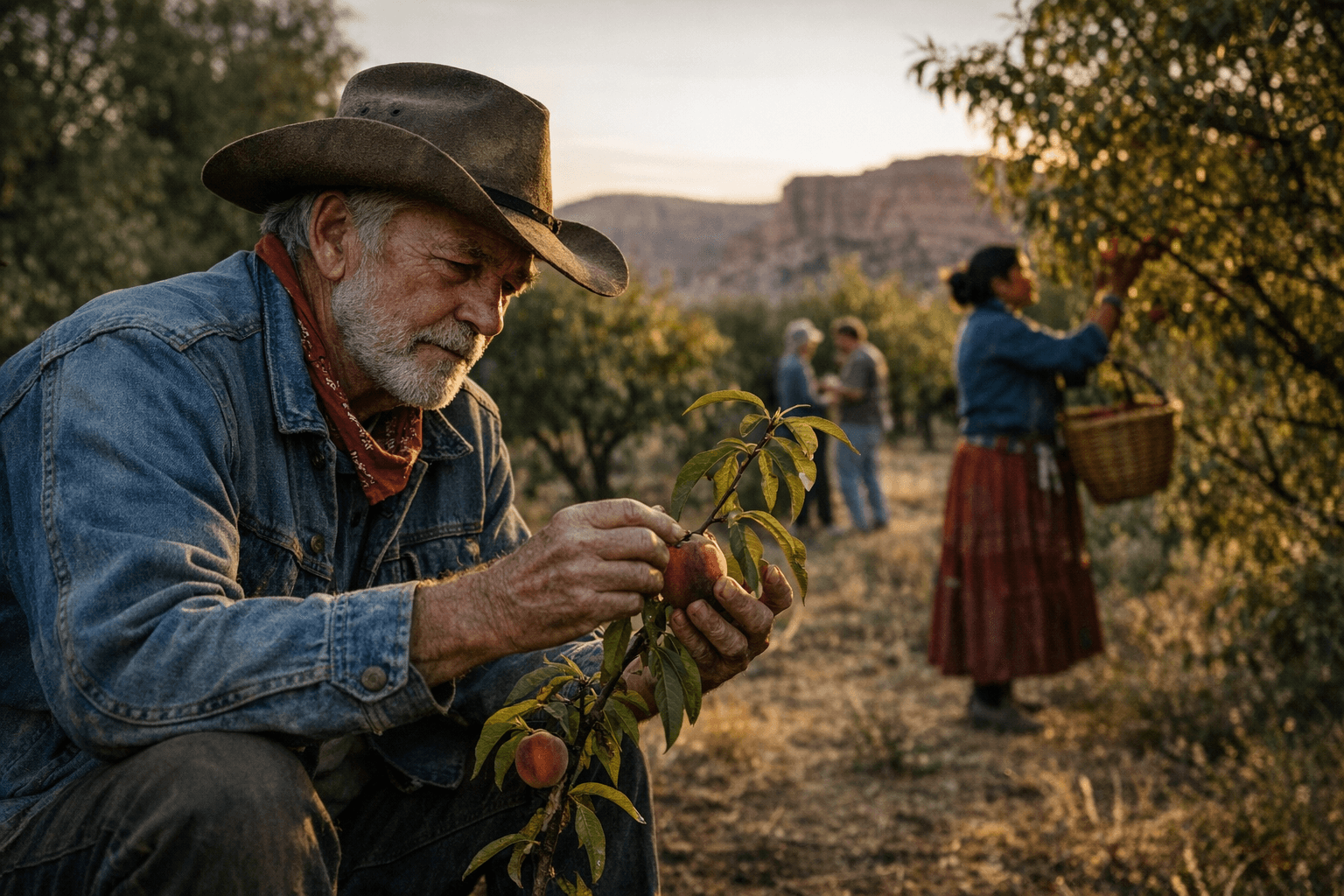
Reagan Wytsalucy’s work gives the book its deepest historical weight. She is working to revive the peach trees of her Navajo ancestors, and the effort is focused on traditional Navajo peaches rather than modern commercial varieties. That distinction matters because the project is not simply about growing fruit, but about restoring a crop with cultural memory attached to it.
Peaches have deep roots in the Southwest United States. They were introduced to Navajo and Pueblo peoples over centuries, became culturally significant in the region, and in Canyon de Chelly the orchards were reportedly first sown in the 1700s by predecessors of the Hopi people and later by Navajos. Those orchards were later targeted for destruction during U.S. military campaigns, including the Long Walk era, which makes Wytsalucy’s work not just agricultural but restorative.
She is collaborating with the National Park Service at Canyon de Chelly National Monument to restore traditional peach horticulture, and she is also helping record oral histories from elders. The Native Memory Project describes her work as restoring native peaches while preserving stories and traditions from tribal elders, which turns an orchard into an archive of survival. In that sense, each tree is part crop, part witness.
What the book preserves
Taken together, Stewart’s book and the CBS News Sunday Morning segment argue that tree collecting is really about stewardship. The collections described by Stewart are tied to community, to the future, and to repair, whether the setting is a California home, an urban neighborhood, or the canyons of the Navajo Nation.
That is the larger meaning of the story. Trees hold biodiversity, but they also hold grief, continuity, and hope. In Stewart’s hands, and in the work of Saelee and Wytsalucy, collecting becomes a way to insist that living history still has a place in America’s changing terrain.
This article was produced by Prism’s automated news system from verified source data, official records, and press releases, then run through automated quality and moderation checks before publishing. The system is built and supervised by the people who set the standards it runs under. Read our full AI policy.
Did this article answer your question?