Analysis of 259 U.S. National Parks Reveals Widespread Transformational Climate Risks
A Conservation Letters analysis of 259 contiguous-U.S. park units finds two-thirds highly exposed to at least one major threat and that 77% are highly vulnerable to transformational climate impacts.
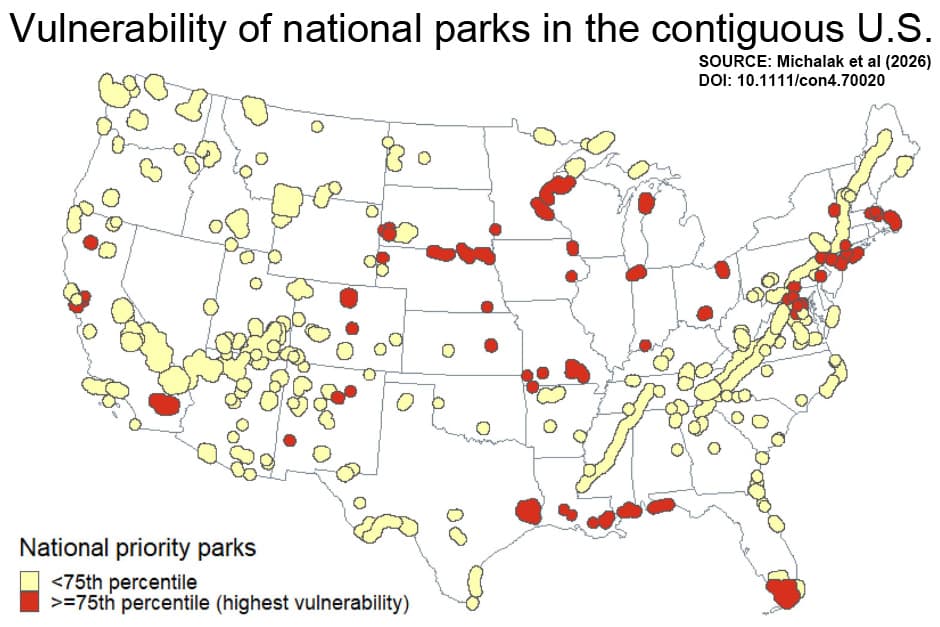
A peer-reviewed analysis by Michalak, Littlefield, Gross, Mozelewski, and Lawler (Conservation Letters, 2026) assessed 259 national park units in the contiguous United States and found stark exposure and vulnerability: “Two-thirds of parks are highly exposed to at least one major threat such as wildfire, drought, pests, or sea-level rise,” and “Overall, 77% rank as highly vulnerable either system-wide or to a specific hazard.” Those headline figures signal widespread risk across the National Park System.
The study measured three dimensions — exposure to climatic change, ecosystem sensitivity, and adaptive capacity — and used that triad to judge where ecological transformation is most likely. “Together these indicate not just how much conditions will shift, but how likely transformation is,” the analysis summary states, framing vulnerability as the likelihood of irreversible ecological change rather than incremental stress.
Vulnerability patterns are uneven. Parks in the Midwest and eastern United States show the highest cumulative risk because fragmented habitats, pollution, and invasive species combine with limited topographic relief to constrain species movement. The analysis notes that species attempting to track shifting climates “must cross farmland, suburbs, or highways - barriers largely absent when the parks were established,” a landscape context that raises the chance of system-wide change in parks from the Midwest to the East.
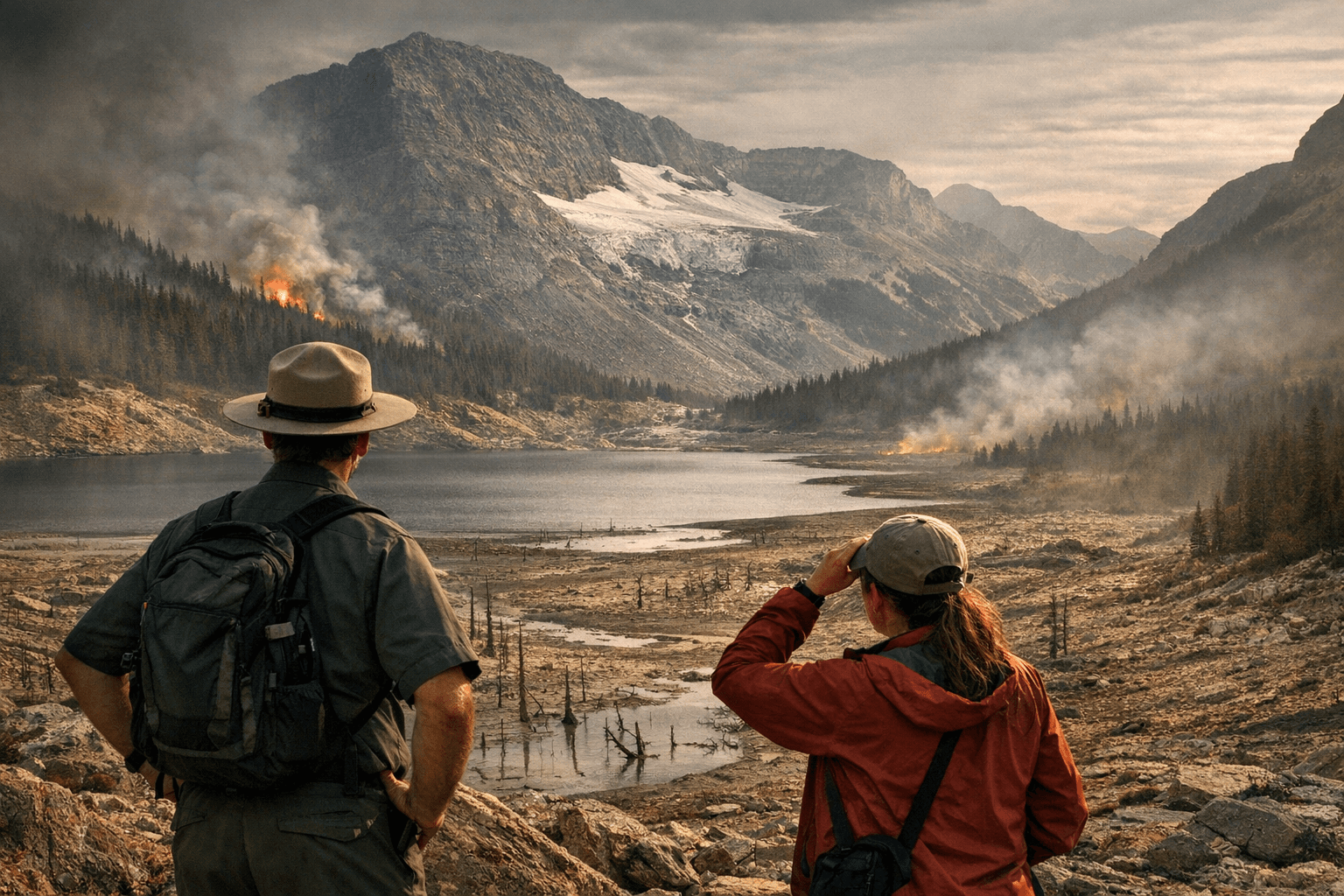
Western parks display a different profile: rugged terrain and elevation gradients create microclimates and refuges that lower aggregate vulnerability, yet many western units face simultaneous severe disturbances. The study flags combinations of “severe fire, prolonged drought, and insect outbreaks” in the West, while coastal parks contend with sea-level rise and storm surge. Inland forests are at risk of long-term transitions from forest to shrubland or grassland, and the analysis warns that “once such transitions occur, returning to previous ecological conditions may be impossible.”
That combination of pervasive risk and regional nuance is forcing a shift in management thinking. “As climate pressures intensify and policy responses weaken, park managers are shifting from preserving historical conditions to managing ongoing transformation. America’s parks may increasingly serve less as static sanctuaries and more as living records of how nature reorganizes under accelerating change,” the analysis framing concludes. One commentator put it bluntly: “The system was built on the assumption of permanence. Visitors may still see familiar landscapes, but the processes shaping them are accelerating. Parks once imagined as places outside history are becoming places where history is unfolding faster than expected.”
Federal work and on-the-ground adaptations are already visible. The National Park Service produced Park-specific Climate Futures reports in 2024 that summarize historical trends and projected changes in temperature, precipitation, drought, invasive species, and phenology for parks across the contiguous U.S., and the NPS Climate Change Response Strategy underpins park-level planning. Grand Canyon National Park is cited as implementing visitor protections for rising heat risks by providing water filling stations, shade structures, emergency preparedness, and visitor warnings.
Advocacy groups have amplified the study’s urgency. The SEEC Institute and the Coalition to Protect America’s National Parks published a July 15, 2025 press release titled “America’s Best Idea in Peril: Climate Change and the Future of Our National Parks,” and Emily Thompson, Executive Director of the Coalition, warned that “The climate crisis is not coming - it is here. And our national parks are on the front lines.” Thompson added, “This report makes it clear that the time to debate is past. To save our parks and public lands we must act now, before it is too late.”
The analysis to consult directly is Michalak, J. L., C. E. Littlefield, J. E. Gross, T. G. Mozelewski, and J. J. Lawler. 2026. “Relative Vulnerability of US National Parks to Cumulative and Transformational Climate Impacts.” Conservation Letters 19, no. 1: e70020.
Know something we missed? Have a correction or additional information?
Submit a Tip