Anthropic identifies 10 US jobs most exposed to AI
Anthropic's analysis lists 10 occupations and exposure percentages, showing where AI could speed up tasks and the gap between potential and current use.

Anthropic, maker of the Claude chatbot, released research that "says it has built an early warning system to track which U.S. jobs are most exposed to artificial intelligence," according to CBS News (updated March 6, 2026, 3:47 PM EST; edited by Aimee Picchi). The firm measured exposure by comparing AI’s ability to perform specific tasks with how common those tasks are across occupations: "A job's 'exposure' is based on the percentage of its tasks that artificial intelligence could potentially speed up or help perform," Anthropic researchers and CBS explain.
1. Computer programmers 75%
Anthropic places computer programmers at 75% exposure, the highest on the list. The report highlights a stark capability versus usage gap for computer and math workers: "For computer and math workers, large language models are theoretically capable of handling 94% of their tasks. Yet Claude currently covers only 33% of those tasks in observed professional use." That split suggests near-term automation pressure in coding workflows, paired with substantial room for adoption-driven disruption as firms integrate LLMs into development pipelines.

2. Customer service representatives 70%
Customer service reps register 70% exposure because many interactions and responses are taskizable and routinized. Anthropic’s metric flags conversational AI as able to accelerate or perform a large share of complaint handling, scripted troubleshooting, and first-line triage. The practical implication for firms: measured productivity gains now, potential role redesign later as chatbots fill higher volumes of standard inquiries.
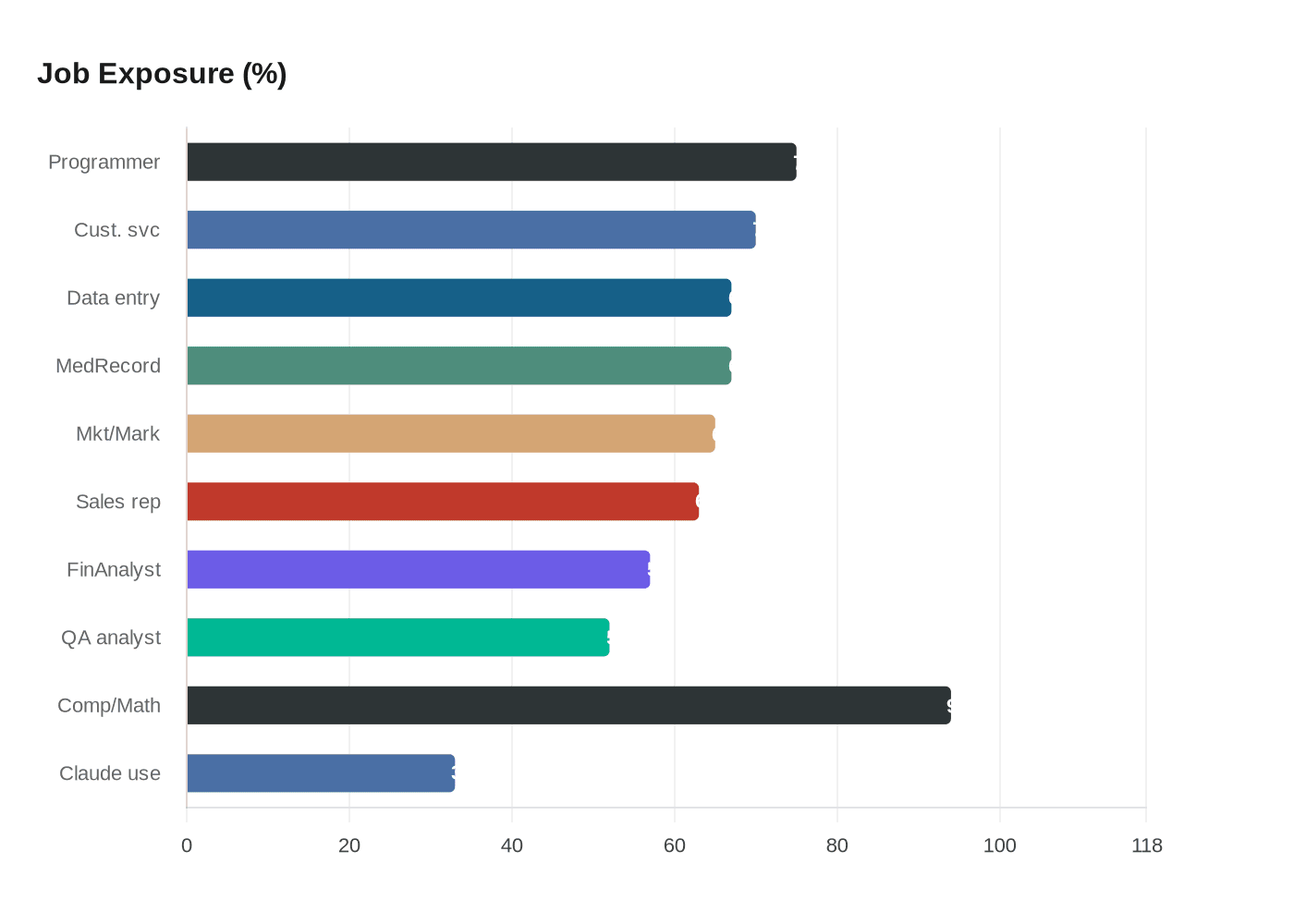
3. Data entry keyers 67%
Data entry keyers score 67% exposure because the core duties are structured and repetitive, making them amenable to automation. Anthropic’s task-level approach shows these positions have a high percentage of tasks that AI could "speed up or help perform," which is why data entry ranks near the top. The labor-market effect will likely be concentrated displacement of low-complexity, high-volume tasks rather than elimination of downstream data-quality oversight.
4. Medical record specialists 67%
Medical record specialists also register 67% exposure due to standardized documentation and coding work. Anthropic uses task-by-task comparisons to reach this result, signaling that record processing and coding support could be substantially accelerated by LLMs and NLP tools. Health systems face operational trade-offs: faster throughput and potential cost savings versus regulatory, privacy, and accuracy constraints.
5. Market research analysts and marketing specialists 65%
At 65% exposure, market researchers and marketing specialists have many tasks—data synthesis, drafting briefs, summarizing trends—that LLMs can assist with. Anthropic’s model points to significant augmentation potential: AI could compress research cycles and generate first drafts of insights, shifting human roles toward higher-level strategy, interpretation, and validation.
6. Sales representatives 63%
Sales reps come in at 63% exposure because a notable share of prospecting, messaging, and lead qualification can be automated. The report warns that AI could streamline many administrative and outreach tasks; however, complex relationship-building and negotiation remain harder to fully automate. Firms that adopt AI tools may see faster pipelines and altered quota structures.
7. Financial and investment analysts 57%
Financial and investment analysts register 57% exposure as models can automate screening, basic valuation tasks, and portions of report drafting. Anthropic ties these numbers to task prevalence across the occupation, and the finding aligns with the broader theme that higher-paying, graduate-degree-heavy roles are also often highly exposed. Employers should expect workflow acceleration and a shift toward oversight, model governance, and client-facing judgment.
8. Software quality assurance analysts 52%
QA analysts score 52% exposure because test-case generation, regression testing, and issue triage are partly automatable. Anthropic’s task-based exposure metric implies routine QA work is vulnerable to automation, while system-level design of test strategies and judgment calls still require human expertise. Adoption could reduce manual testing budgets and elevate demand for AI-savvy QA leads.
9. Information security analysts 49%
Information security analysts show 49% exposure as many detection, triage, and reporting tasks can be aided by AI. Despite the near-half exposure, anthropic’s framework suggests true security leadership—threat modeling, incident command, risk communication—remains human-centric. The balance means faster alert processing but continued need for skilled analysts to manage complex adversarial dynamics.
10. Computer user support specialists 47%
Computer user support specialists are at 47% exposure, reflecting automation potential in help-desk triage and common troubleshooting scripts. Anthropic’s task-level approach underscores a broader point: roles with many standardized tasks are most exposed. The research also notes industry-wide patterns: "The most AI-exposed group is 16 percentage points more likely to be female, earns 47% more on average, and is nearly four times as likely to hold a graduate degree compared to the least exposed group," as reported by Yahoo Finance and Fortune quoting Anthropic research.
Across the list: methodology, usage gap, and labor signals Anthropic’s headline list is internally consistent across outlets: CBS News, AOL, CFO, Yahoo Finance, and Fortune all report the same ten occupations and identical exposure percentages. The company frames this work as an "early warning system" to identify economic disruptions. Crucially, Anthropic distinguishes what AI can do in theory from what workers actually use it for: the report contrasts the "blue area" of theoretical capability with the "red area" of observed Claude usage, noting that "the red will grow to fill the blue" as adoption deepens. Visual commentary surfaced on social media, with Peter Walker, head of insights at Carta, quipping on X: "A universal truth: most radar charts should just be bar charts."
Wider context and caveats Anthropic also finds macro patterns: exposed professions are projected to grow more slowly through 2034, citing BLS data, and the firm reports that "30% of workers have zero AI exposure" in roles requiring physical presence, such as cooks, mechanics, bartenders, and dishwashers. At present, the researchers say that "so far [AI has had] little measurable impact on the labor market," but they warn that "the technology could eventually have a seismic effect on many professions, from lawyers to sales reps." Policymakers and employers should treat Anthropic’s exposure metric as a directional signal: it quantifies where AI can speed tasks today and where labor-market disruption is most likely as capability and adoption increase.
This article was produced by Prism’s automated news system from verified source data, official records, and press releases, then run through automated quality and moderation checks before publishing. The system is built and supervised by the people who set the standards it runs under. Read our full AI policy.
Did this article answer your question?