Antioch raises $8.5 million to close robotics sim-to-real gap
Antioch’s $8.5 million seed bet that better simulation, not more hardware, will unlock robots in factories, warehouses and homes.
Antioch raised $8.5 million to bet that the hardest problem in robotics is not building the machine, but making it survive the real world. The New York startup, now valued at $60 million, is pitching software that shrinks the sim-to-real gap that has kept many robots trapped in demo videos and controlled labs.
The seed round was led by A* and Category Ventures, with participation from MaC Venture Capital, Abstract, Box Group and Icehouse Ventures. Antioch, founded in May 2025, had already attracted roughly $4.24 million in pre-seed funding by December, a sign that investors see simulation infrastructure as a critical layer for the next wave of physical AI.
Harry Mellsop, Antioch’s CEO and cofounder, previously worked on Tesla’s Autopilot vision team. He is joined by Alex Langshur, Michael Calvey, Collin Schlager and Colton Swingle. Langshur and Calvey helped found Transpose, the security and intelligence startup later acquired by Chainalysis. Schlager worked at Meta Reality Labs, and Swingle worked at Google DeepMind.
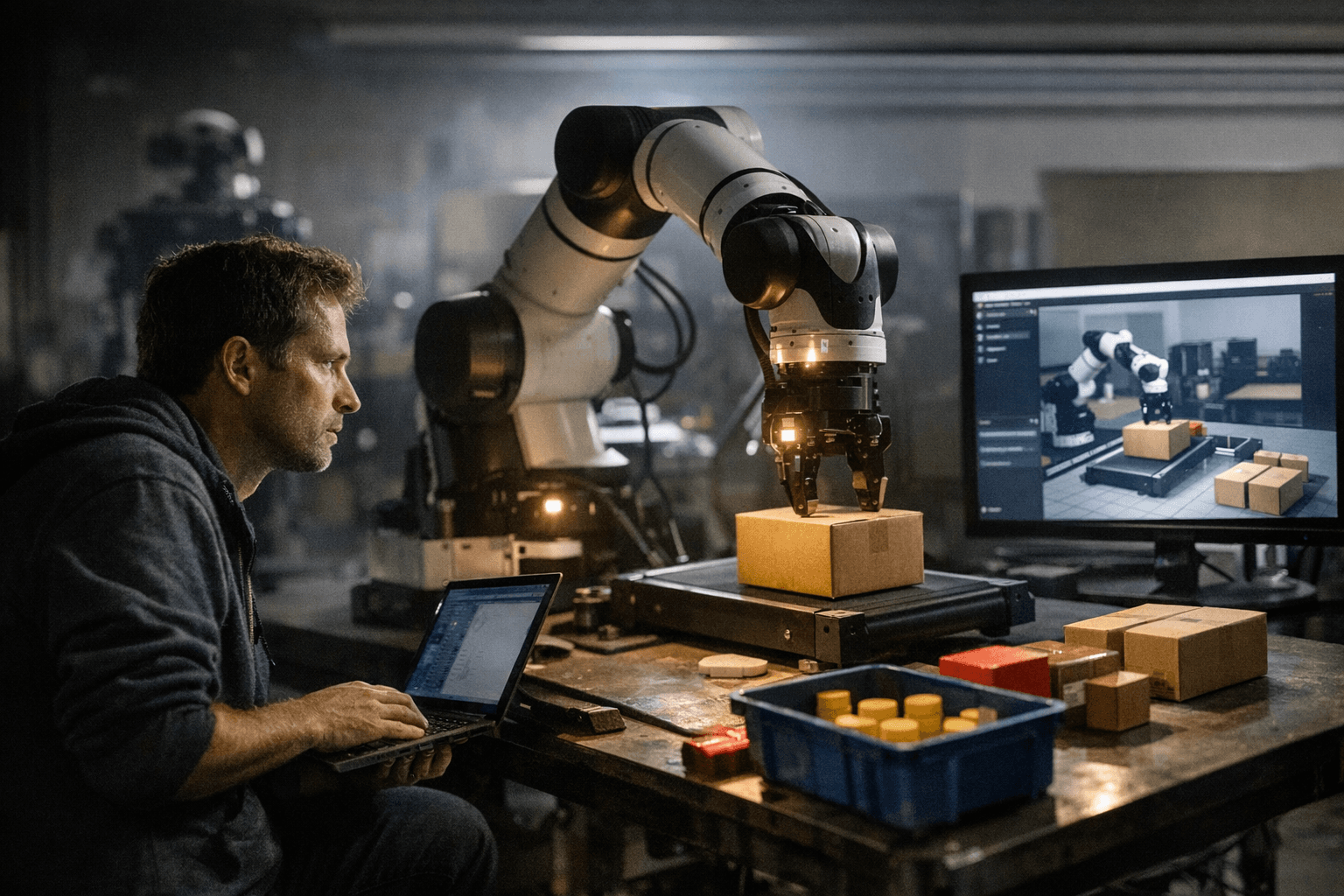
Antioch says its platform brings existing robots into simulation, then runs hundreds of tests in parallel before hardware leaves the lab. Its Ark product containerizes hardware, software and firmware, then connects them to precision-calibrated virtual sensors and actuators. The company says it supports ROS-based and custom systems and is built to help teams develop autonomy at the speed of software.
That pitch matters because robotics still lacks the cheap, scalable testing loop that transformed software development. Coding copilots made it faster to draft, test and revise code. Antioch is trying to do something similar for physical AI, but the economics are harder. Robots face messy warehouses, brittle parts, shifting lighting, unpredictable people and rare failures that are expensive or dangerous to recreate in the real world.
Smaller robotics companies often cannot afford the physical test infrastructure that large autonomy players have built in-house, from mock warehouses to sensor-heavy vehicles and endless real-world trials. Antioch’s argument is that simulation can lower that barrier, letting startups and other teams test more like giants without having to build giant facilities first.
The broader industry is moving the same direction. Waymo has said its Waymo World Model is built on Google DeepMind’s Genie 3 and can simulate rare events that are difficult to capture in reality. Antioch is betting that the same logic can be applied beyond self-driving cars, across robots, drones and other physical AI systems.
The opportunity is large, but so is the limit. Simulation only changes robotics if the virtual world is close enough to the physical one to expose the failures that matter. Antioch’s funding says investors are willing to place that bet on the infrastructure layer that could decide where robots can actually work.
This article was produced by Prism’s automated news system from verified source data, official records, and press releases, then run through automated quality and moderation checks before publishing. The system is built and supervised by the people who set the standards it runs under. Read our full AI policy.
Did this article answer your question?