Apple Turns 50 in a World the Company Helped Create
2.5 billion people now own Apple products, a figure larger than China's entire population, all tracing back to a sidewalk near Cupertino and a bare circuit board in 1975.

2.5 billion people own an Apple product right now. That single number, larger than China's entire population, is the full measure of a company that started with two strangers talking on a sidewalk near Cupertino, California, in 1971, and a device its own inventor described as little more than a circuit board.
A Sidewalk Meeting and a Circuit Board
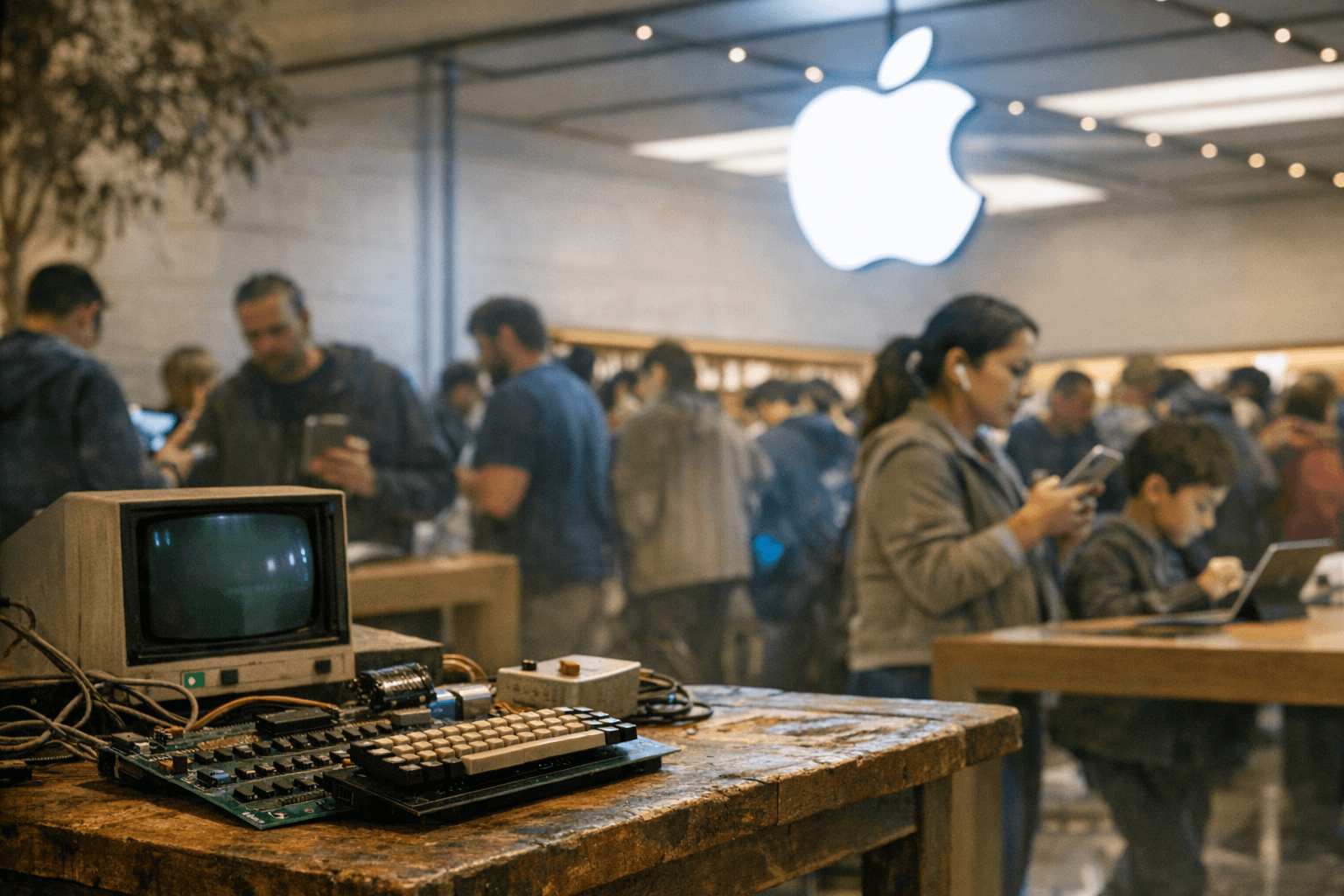
Steve Wozniak was an engineering prodigy. Steve Jobs was, by most accounts, a charismatic, rebellious high-schooler. Their 1971 meeting near Cupertino set in motion one of the most consequential partnerships in the history of technology. Four years later, in 1975, when virtually no one had ever seen a personal computer, Wozniak built one. It was, by his own account, little more than a circuit board. Jobs saw something else: a product someone might actually pay for.
"And who was to know there was gonna be a company in the future?" Wozniak reflected. Jobs evidently knew. On April 1, 1976, Apple Computer Company was officially founded. "Steve Jobs wanted a company, and did it. And I was his resource!" Wozniak laughed, recounting the early years.
From Curiosity to Cultural Force
The decades that followed converted Apple from a niche startup into a company that reshaped daily life. Products that once defined the frontier of consumer computing, from the PowerBook to the iPod Mini, have since crossed over into nostalgia. The iPhone became ubiquitous. The iPad, which launched in 2010 and immediately became another massive hit, altered how people work, read, and communicate.
That expansion carried consequences beyond hardware. Apple's platforms helped fuel the rise of social media, a development that has raised mounting concerns about screen time, mental health, and isolation. The company that once marketed itself as a liberating alternative to corporate conformity now sits at the center of some of the most urgent public debates about how technology affects the people who use it.
The Handoff: Jobs to Cook
As the iPad was rewriting the rules of personal computing in 2010, Steve Jobs was dying. Succumbing to pancreatic cancer, he made one of his final and most consequential decisions: asking Tim Cook to succeed him as CEO.
The instructions Jobs left were sparse and precise. As Cook has recalled: "He called me over to his house, and his advice to me was, 'Never ask what I would do. Just do the right thing.' And I'll never forget that."
Those words became a kind of operating philosophy. For Cook, the right thing translated into a measurable strategic shift: a deepened emphasis on sustainability and inclusiveness, and an aggressive expansion into services. Apple Pay, Apple TV, and Apple Music, once peripheral to a hardware-centered company, now generate over $100 billion a year. Since Cook took over, Apple has roughly tripled in size, and its stock is up 1,600 percent.
The Scale of What Was Built
Apple Computer Company was founded on April Fool's Day, 1976, by two men whose combined assets at the time amounted to little more than enthusiasm and a working circuit board. Today, the company is among the most valuable in the world. The 2.5 billion people who own its products represent not simply a customer base but a global infrastructure of communication, commerce, and culture.
The product arc tells part of that story: from Wozniak's bare circuit board to the PowerBook, from the iPod Mini to the iPhone, from the iPad to a services ecosystem generating more than $100 billion annually. Each chapter in that arc altered something fundamental about how people live. The concerns now shadowing that success, about attention, mental health, and what constant connectivity costs, are inseparable from the company's legacy rather than incidental to it.
"Apple: The First 50 Years"
The milestone has prompted a wave of retrospective coverage, anchored by David Pogue's new book, "Apple: The First 50 Years." Pogue's work traces the line from that 1971 sidewalk encounter to the present, documenting both the extraordinary commercial run and the cultural reverberations Apple set in motion. A CBS News segment tied to the anniversary was produced by John Goodwin and edited by Remington Korper.
To mark the occasion further, Lee Cowan will join Pogue in a live conversation at the 92nd Street Y in New York City on Thursday, April 16, at 8 p.m. Tickets are available for both in-person attendance and streaming access for those who want to engage with the full retrospective.
Fifty years on, Apple occupies an unusual position in history: it helped build the modern world and must now reckon with what that world has become. The circuit board Wozniak assembled in 1975 connected, through decades of iteration and reinvention, to a device in the pocket of roughly one in three people alive today. Whether that legacy is ultimately a triumph, a cautionary tale, or something more complicated is a question the company's next fifty years will have to answer.
Know something we missed? Have a correction or additional information?
Submit a Tip