Apple TV grows from prestige streaming to sports and awards powerhouse
Apple’s small but crowded library is now doing more than prestige drama: live sports, Emmy wins and a stacked 2026 slate are giving it real staying power.

Apple TV+ was built like a boutique label in a market that rewards volume, and that scarcity has become part of its edge. What began as a $4.99-a-month launch in more than 100 countries and regions has grown into a service with weekly originals, live sports and an awards profile that far larger rivals still have to match.
From a lean launch to an all-original identity
Apple unveiled Apple TV+ in March 2019 and set the launch for November 1, 2019. The company paired that debut with a simple pitch: a low monthly price, broad international availability and an introductory year free with the purchase of a new Apple device beginning September 10, 2019. That rollout framed the service as an extension of Apple’s ecosystem from the start, not a standalone library chasing sheer scale.
The strategy has stayed visible in the way Apple describes the product today. Apple now calls Apple TV an all-original streaming service with hundreds of exclusive shows and movies, with new releases every week. That language captures the service’s core advantage and its limit at the same time: it is not trying to outstack Netflix or Disney with volume, but to make a smaller catalog feel curated, consistent and worth returning to.
Prestige became the proof point
Apple’s reputation in streaming has leaned heavily on awards, and the company has made sure those wins are hard to miss. In July 2025, Apple said Apple TV+ had received a record 81 Emmy nominations across 14 titles, a result that reinforced the platform’s standing as a prestige-heavy destination. Apple later said “The Studio” won 13 Emmys and became the most-winning freshman comedy in Emmy history, a milestone that gave the service a fresh headline beyond its earlier drama successes.
That awards story matters because it gives Apple something more durable than taste. The company has highlighted “CODA” as the first streaming title to win Best Picture at the Oscars in 2022, and the film also won Best Supporting Actor for Troy Kotsur and Best Adapted Screenplay for Siân Heder. For a service that has always been smaller than its competitors, those wins do more than decorate the brand; they help define what the platform is for and why subscribers might keep paying for it.
Apple’s prestige profile also helps explain why the service drew comparisons to HBO in streaming’s early years. The analogy was never about size. It was about a narrow slate, a quality-first reputation and the idea that a subscription could be justified by concentration rather than abundance.
Sports turned the app into a broader habit
Apple’s current Apple TV homepage shows how much the service has broadened beyond scripted prestige. The platform now promotes live sports including Friday Night Baseball, MLS and Formula 1, a notable expansion for a service that first made its name through dramas and comedies. That shift matters because sports create repeated, time-sensitive viewing in a way prestige series do not always do on their own.
The move also changes how the service sits inside Apple’s broader product universe. Apple TV is available through the Apple TV app and on the web, which makes it easier for the company to present the service as part of a larger media environment rather than a single app with a narrow niche. With sports on the homepage and originals arriving weekly, Apple is no longer asking viewers to treat the service as a special-occasion platform.
The 2026 slate shows scale without abandoning the brand
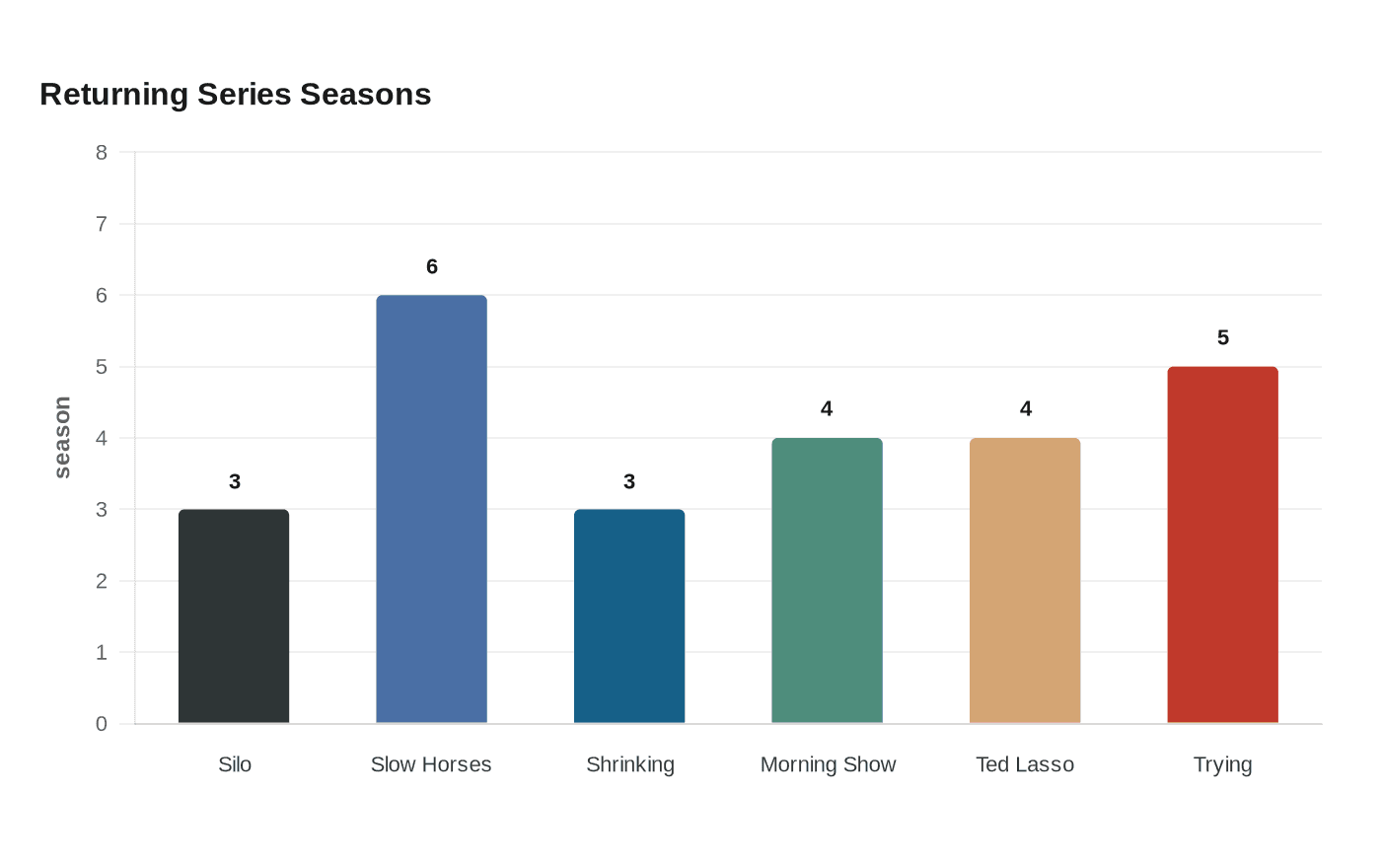
Apple’s 2026 press materials show a busier lineup than the service had in its earliest years, and the titles tell the story clearly. Returning series include “Silo” season 3, “Slow Horses” season 6, “Shrinking” season 3, “The Morning Show” season 4, “Ted Lasso” season 4 and “Trying” season 5. That mix gives Apple a set of recognizable franchises to anchor the schedule while keeping the prestige identity intact.
The value of that lineup is not just that the titles are popular. It is that Apple is no longer relying on a handful of breakout shows to make the case for the subscription. A sixth season of “Slow Horses,” a fourth season of “The Morning Show” and a fourth season of “Ted Lasso” all point to a platform that is now building continuity, not just one-off acclaim.
This is where Apple’s old reputation for scarcity starts to look less like restraint and more like structure. The company still offers far fewer titles than the biggest streaming libraries, but the release cadence is much denser than it was at launch. For a subscriber, that means the service can now function as a recurring destination, not just a place to check in when a marquee series premieres.
Subscriber value is being measured through the wider Apple business
Apple has not publicly broken out Apple TV+ subscriber totals in its earnings filings for 2026, even as those pages show record Services revenue. That leaves outside observers to measure the service indirectly, through lineup depth, awards momentum and the growing role it plays inside Apple’s broader Services business.
That absence of a subscriber total does not make the service less consequential. It makes the other signals more important. Apple TV’s combination of weekly originals, sports rights and award-winning titles suggests a platform that is trying to prove staying power in a crowded market without abandoning the prestige model that made it recognizable in the first place.
This article was produced by Prism’s automated news system from verified source data, official records, and press releases, then run through automated quality and moderation checks before publishing. The system is built and supervised by the people who set the standards it runs under. Read our full AI policy.
Did this article answer your question?