April 19 in History, Lexington, Waco siege, and LSD milestone
April 19 links the Revolution’s first gunfire, the Waco siege’s deadly ending, and Hofmann’s LSD experiment. CBS News’s Almanac uses the date to show how history still shapes power, protest, and policy.
April 19 in memory and public life
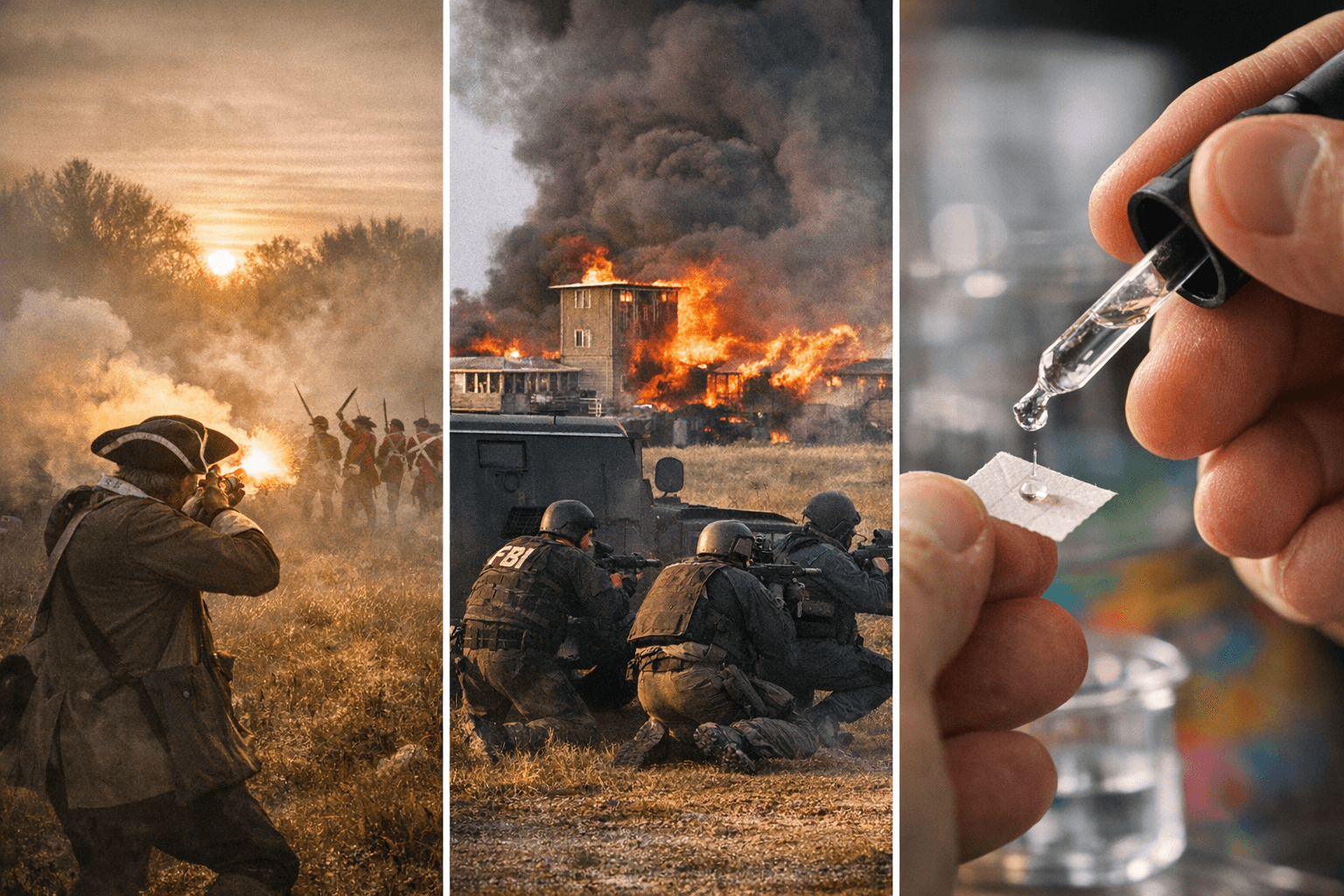
April 19 carries three sharply different lessons about authority, resistance, and consequence. It marks the first clashes at Lexington and Concord, the end of the Waco siege near Waco, Texas, and Albert Hofmann’s intentional LSD experience in Switzerland, a laboratory event later celebrated as Bicycle Day. That range is exactly why CBS News’s Sunday Morning Almanac treats the date as more than a calendar note: it is a compact view of how revolutions begin, how federal standoffs can collapse, and how a scientific experiment can ripple into culture and policy.
The shots that opened the Revolution
The Battles of Lexington and Concord on April 19, 1775, are remembered as the opening skirmishes of the American Revolution. History’s account places the immediate trigger on the previous day, when British troops were ordered to march against the Patriot arsenal at Concord and to capture Samuel Adams and John Hancock. Paul Revere and William Dawes rode to warn the militias, turning a military movement into a civic alarm that helped local resistance mobilize before the Redcoats arrived.
The significance of Lexington and Concord is not only military but institutional. The events showed how quickly disputes over arms, control, and political legitimacy can move from tense rumor to open conflict. For modern readers, that makes April 19 a useful lens for current debates about civil-military relations, local preparedness, and the fragile line between public order and political rupture. The date still carries the weight of a moment when a colonial confrontation became the beginning of a new nation.
That is why this anniversary remains so prominent in American civic memory. Lexington and Concord are not remembered as a single battle with a tidy outcome; they are remembered as the point at which ordinary towns became a theater of history. The lesson is plain: when institutions lose legitimacy, events can move faster than leaders expect.
Waco and the limits of federal power
April 19 also recalls one of the most controversial federal confrontations in recent American history. The Waco siege lasted 51 days before ending on April 19, 1993, when the Branch Davidians’ compound near Waco, Texas, was destroyed in a fire. Britannica describes the episode as a standoff between the Branch Davidians and federal agents, and the date remains inseparable from questions about law enforcement, escalation, and the use of force.
Waco endures because it sits at the intersection of public safety and state power. A long siege tests not only tactics but judgment, communication, and patience. When it ends in fire, the aftermath is judged not just by what happened on the final day, but by the choices that made that ending possible. That is why Waco still matters in conversations about crisis response, federal authority, and whether institutions can resolve armed confrontations without producing a larger tragedy.
Its relevance has not faded because the underlying questions have not faded. How should government respond when a group isolates itself from public authority? What standards should govern escalation? How should investigators, negotiators, and commanders measure success when the loss of life becomes the defining outcome? April 19 keeps those questions in view, not as abstractions, but as consequences attached to a specific place and date.
A laboratory experiment that changed culture
April 19, 1943, adds a very different kind of milestone. In Switzerland, Albert Hofmann intentionally ingested LSD, an episode later celebrated as Bicycle Day. Britannica identifies that moment as the point at which Hofmann experienced the compound in a deliberate setting, giving the date a place in the history of psychoactive science and later public fascination.
This event is often remembered for what followed culturally, but its roots are scientific. Hofmann’s experience began in a laboratory, not a movement, and that matters when the date is used as a marker in present-day debates about drug policy, medical research, and the line between therapeutic investigation and recreational use. LSD’s later cultural life cannot be separated from the original context in which it was observed, tested, and recorded.
The continuing relevance lies in how societies manage compounds that are scientifically significant and socially contentious at the same time. April 19 reminds readers that policy often trails discovery. A laboratory event can become a public debate, then a legal regime, then, decades later, a renewed subject of research interest. That arc makes Hofmann’s April 19 experience more than a curiosity; it is a case study in how science enters public life.
Why this date still matters now
CBS News’s Sunday Morning Almanac uses April 19 as a recurring historical checkpoint, and the selection makes sense. Lexington and Concord speak to the origins of organized resistance and the birth of a revolution. Waco exposes the risks of federal force and the difficulty of resolving armed conflict without catastrophe. Hofmann’s LSD milestone shows how an experiment can alter culture, law, and medicine far beyond the lab in Switzerland.
Taken together, the date offers a compact briefing on American governance and public memory. It links the question of when people decide to resist, the question of how the state responds when challenged, and the question of how society treats scientific breakthroughs once they leave the laboratory. That combination is why April 19 remains more than a date in history. It is a reminder that the most consequential anniversaries are the ones that still illuminate the arguments of the present.
This article was produced by Prism’s automated news system from verified source data, official records, and press releases, then run through automated quality and moderation checks before publishing. The system is built and supervised by the people who set the standards it runs under. Read our full AI policy.
Did this article answer your question?