April's Full Pink Moon Rises April 1, How to See It
The full Pink Moon won't look pink at all — its name comes from a wildflower. Catch it at 10:12 p.m. EDT on April 1, with three planets, the star Spica, and a spring coincidence worth sharing.
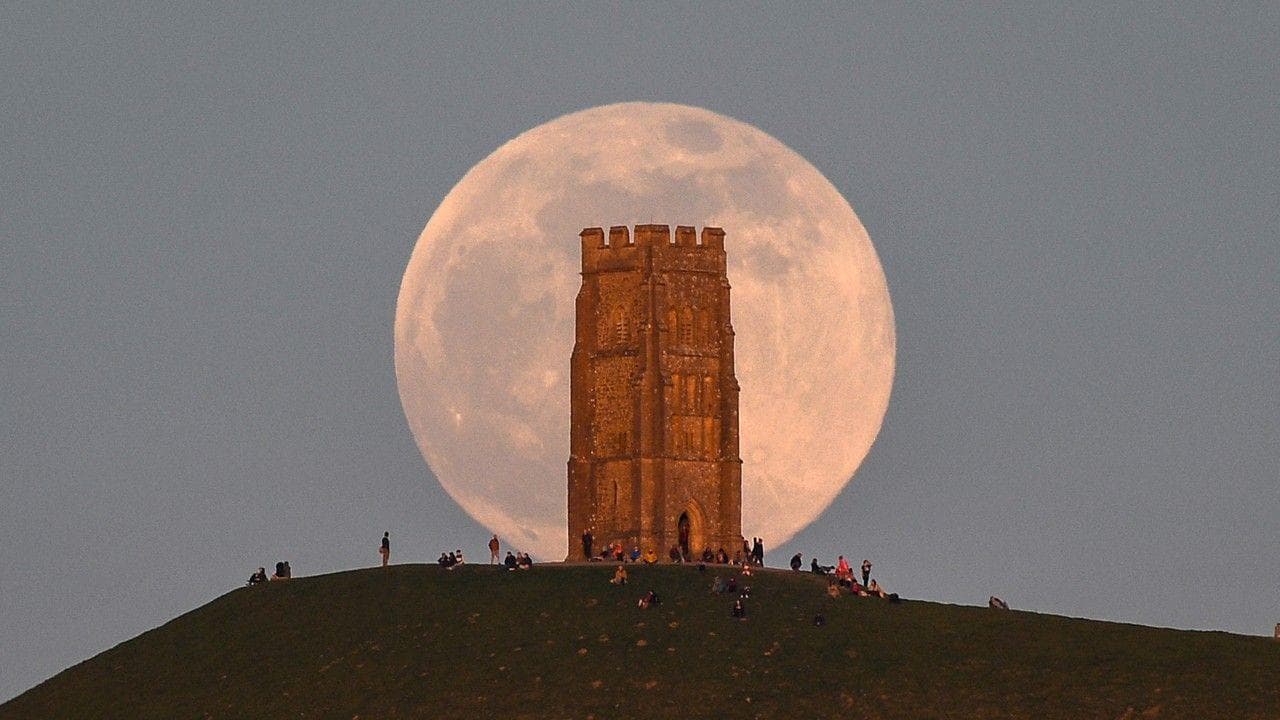
The name on the calendar says April Fools' Day. The Old Farmer's Almanac practically winks at this: "Step outside on Wednesday, April 1, to witness April's Full Pink Moon; we promise, this is no April Fools' joke!" This is not a gimmick. The Pink Moon rising Wednesday night is the most calendrically loaded full Moon of 2026, arriving on the same evening that Passover begins at sunset, just four days before Easter Sunday, and carrying a name most people completely misunderstand.
The Myth-Busting Truth: It Will Not Look Pink
Here is the first thing to share with anyone who sends you a pink-tinted social media graphic: the moon does not change color. As CBS News put it plainly, "the moon won't look pink." The name comes entirely from what blooms on the ground beneath it. According to the Old Farmer's Almanac, this moon "heralded the appearance of the 'moss pink' (Phlox subulata), also called wild ground phlox or creeping phlox, one of the first spring wildflowers" to carpet the ground across North America each April. The moon was named after the flower, not the other way around.
The Pink Moon travels under several aliases depending on culture and tradition. Anglo-Saxons called it the Egg Moon, a reference to spring renewal. Other traditional names include the Sprouting Grass Moon, the Fish Moon, the Paschal Moon, and the Pesach or Passover Moon. It follows this year's Worm Moon and precedes next month's Flower Moon in the seasonal sequence.
Exact Viewing Windows by U.S. Time Zone
Peak illumination occurs at 10:12 p.m. Eastern Daylight Time on April 1, a time confirmed by the Old Farmer's Almanac and independently corroborated by AccuWeather, which reported the moment as 10:11 p.m. EDT. For observers outside the Eastern time zone, the conversions are straightforward:
- Eastern (EDT): 10:12 p.m.
- Central (CDT): 9:12 p.m.
- Mountain (MDT): 8:12 p.m.
- Pacific (PDT): 7:12 p.m.
For skywatchers on the West Coast, that 7:12 p.m. moment arrives while the last daylight is still fading and the moon is just clearing the eastern horizon, making the peak illumination and the dramatic moonrise almost perfectly simultaneous. The moon will look bright and full on both March 31 and April 2 as well, but Wednesday night is the only opportunity to see it positioned near the bright star Spica.
Where to Look and When to Go Outside
The technical peak time matters less than the moment you actually step outside. The most visually striking experience of the Pink Moon happens at moonrise, not when it reaches its highest point overhead. The Old Farmer's Almanac advises: "head to an open area and watch as it rises above the horizon. At this moment, it will appear larger than usual due to the Moon illusion and take on a beautiful golden hue!"
LiveScience is equally specific: the Pink Moon "will rise in the eastern sky as the sun sets across North America." That convergence of moonrise and sunset is the practical cue. Face east, find a spot with a low, unobstructed horizon, and be outside a few minutes before sunset at your location. Parks, hilltops, open fields, and lakefronts all work. Both the Old Farmer's Almanac and LiveScience recommend checking moonrise and moonset times for your specific location or ZIP code before heading out.
The Surprising Science: Why It Looks Enormous
The single most share-worthy fact about the Pink Moon is this: the moon near the horizon will look significantly larger than it does hours later when high in the sky, even though its actual size and distance have not changed at all. This is the Moon illusion, a well-documented perceptual phenomenon in which the brain interprets objects near a visible horizon as dramatically farther away than objects overhead, causing the same object to register as much bigger. Add the warm golden color produced when moonlight passes through a thick slice of Earth's atmosphere at a low angle, and the Pink Moon right at moonrise is one of the most visually arresting moments in the spring sky calendar.
The Celestial Bonus: Spica and Three Planets
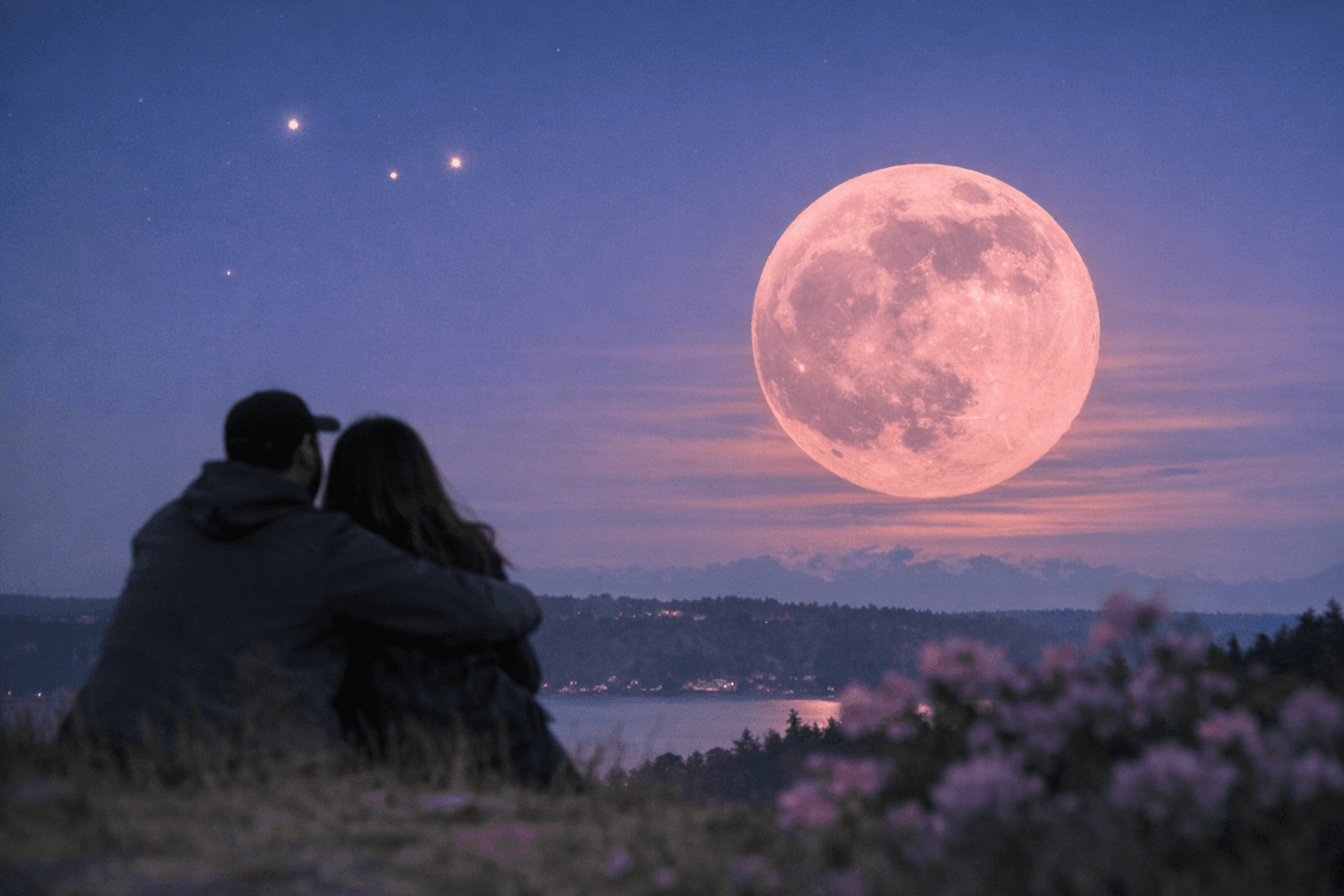
Look just below the Pink Moon on Wednesday night for Spica, the brightest star in the constellation Virgo. According to LiveScience, "only on Wednesday will it appear close to the bright star Spica, offering a double skywatching treat." The following night, April 2, the waning gibbous moon will pass just 1.8 degrees from Spica, an angular proximity measurement provided by AstroPixels.
The planetary lineup makes Wednesday evening even richer. According to NASA, as reported by CBS News, "three of the five visible planets will also be in the sky on Wednesday. Venus will be the brightest, with Mercury and Mars also being visible." Venus needs no special equipment to identify; it is the most brilliant point of light in the sky aside from the Moon itself.
On the ground, AccuWeather noted a seasonal coincidence that mirrors the folklore: "the timing this year is perfect, with cherry blossoms at peak bloom turning the Tidal Basin in Washington, D.C., pink," lending the night a rare visual unity between sky and earth.
How to Photograph It With Your Phone
The most common mobile photography mistake with a full moon is letting the camera expose for the dark sky surrounding it. The Moon is a sunlit surface and is far brighter than the surrounding scene. Treat it accordingly.
- Lock focus and exposure: Tap and hold on the moon in your camera app until the focus ring locks. On iPhone, slide the sun icon downward to reduce exposure. On Android, use the manual exposure slider.
- Use optical zoom only: Most iPhone Pro and Android flagship models offer 3x optical zoom. Beyond that, digital zoom softens the image. Stop at the maximum optical zoom and accept a smaller moon in frame rather than a blurry one.
- Turn off Night Mode: The Moon is bright enough that long-exposure Night Mode will overexpose or smear it. Disable it before shooting.
- Stabilize: At maximum zoom, any movement blurs the image. Prop your phone against a fence, wall, or car roof, or use a small pocket tripod.
- Shoot at moonrise: The golden, horizon-hugging moon in the first 15 minutes after it appears is both the most dramatic subject and the easiest to photograph because the surrounding landscape provides contrast and scale.
Why This Moon Sets the Religious Calendar
The Pink Moon carries unusual weight in the faith calendar this year. It is the Paschal Moon, defined as the first full Moon of ecclesiastical spring, and it serves as the anchor for two major religious traditions at once.
In Christianity, Easter Sunday falls on the first Sunday after the first full Moon following the ecclesiastical spring equinox. That equinox is fixed by church tradition to March 21, distinct from the astronomical spring equinox, which occurred on March 20 this year. With the full Moon arriving April 1, Western Easter falls on Sunday, April 5. According to the U.S. Naval Observatory rule cited by LiveScience, and confirmed by the Old Farmer's Almanac, this Pink Moon is the determining factor. Easter in the Eastern Orthodox tradition, which uses a separate calendar calculation, follows a week later on Sunday, April 12.
Passover begins at the same lunar event from a different direction. As LiveScience notes, the Pink Moon's rise "marks the beginning of the Jewish festival of Pesach (Passover), which, this year, begins at sunset on April 1, the 15th day of the Hebrew month of Nisan." The Hebrew calendar is lunisolar by design, and the 15th of Nisan always falls on a full Moon.
Passover at sunset, the Paschal Moon overhead, Easter arriving in four days, Orthodox Easter a week beyond that: Wednesday night packs more calendar significance into a single sky event than any other full Moon this year. That is worth a clear horizon and a few minutes outside.
This article was produced by Prism’s automated news system from verified source data, official records, and press releases, then run through automated quality and moderation checks before publishing. The system is built and supervised by the people who set the standards it runs under. Read our full AI policy.
Did this article answer your question?