AR Glasses From Xreal and Viture Make Gaming Screens Surprisingly Personal
Gaming on a private 147-inch screen from your couch sounds absurd until you try AR glasses. Xreal and Viture are almost there, but five hardware gaps keep them from going truly mainstream.

Plug a pair of AR glasses into your Steam Deck on a crowded train and you are, in effect, carrying a personal cinema in your jacket pocket. Nobody sitting next to you can see your screen. Nobody needs to. The virtual display floats in front of your eyes at up to 147 inches in the case of the Xreal One, and the entire rig weighs roughly the same as a hardback novel. After months of couch testing with both the Xreal One and Viture Pro XR alongside a Steam Deck and Nintendo Switch 2, the promise is unmistakably real. So is the gap between "surprisingly compelling" and "genuinely mainstream."
Understanding that gap requires looking at nine features that define whether an AR gaming display feels like a tool or a toy. Right now, today's leading glasses get some of them right, others frustratingly wrong, and the next hardware cycle will need to close all of them at once.
Field of View: The Screen That Isn't Quite Big Enough
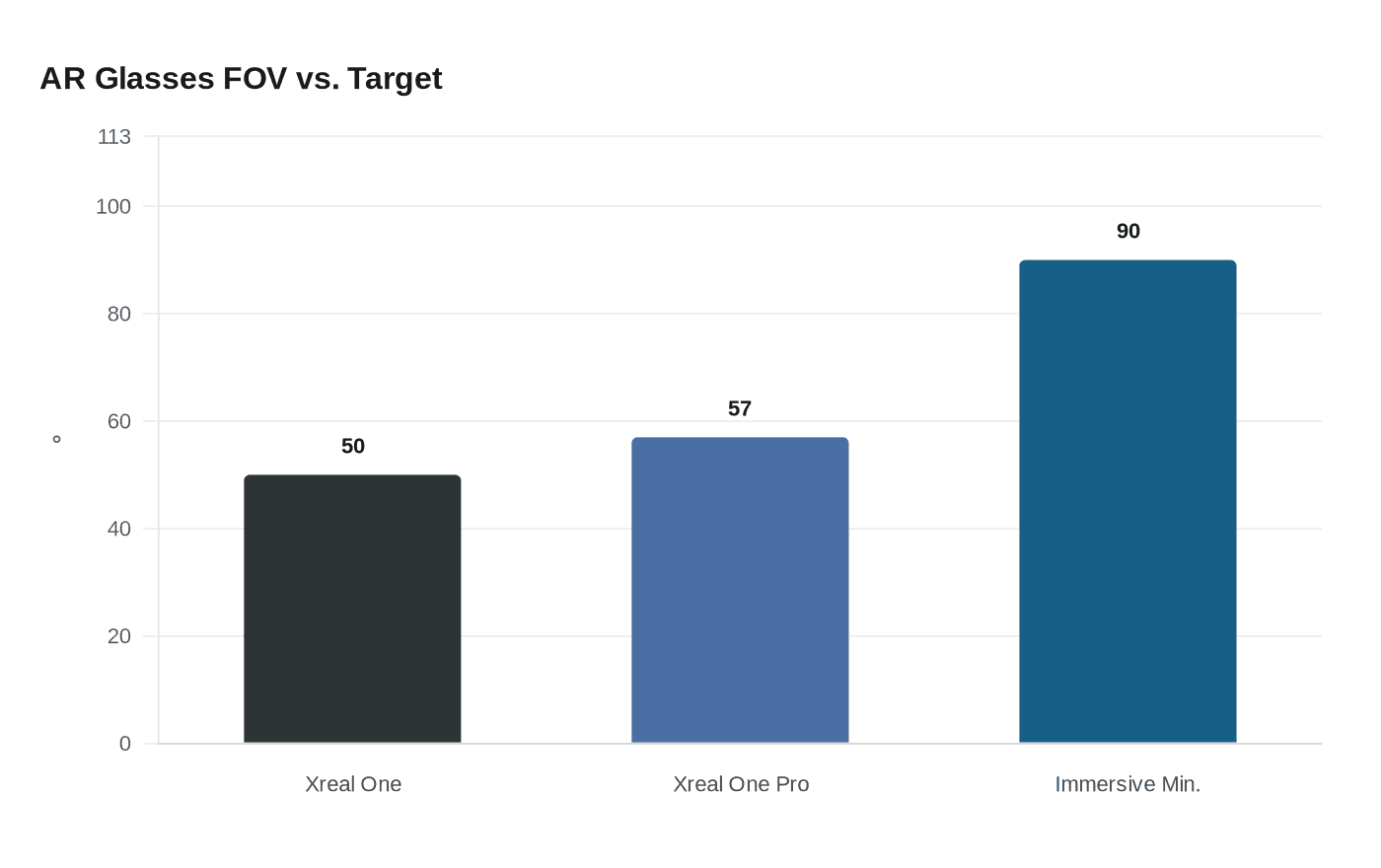
The most fundamental spec in any AR display is field of view, because it determines how much of your natural vision the virtual screen consumes. The Xreal One covers 50 degrees; the premium Xreal One Pro stretches that to 57 degrees using a self-developed optic engine that takes up 40 percent less physical space than the prior generation. The Viture Pro XR lands somewhere between those two, projecting onto a 135-inch virtual surface. In a head-to-head comparison by Tom's Guide, the Xreal One's slightly wider FOV reduces fringing around screen edges and gives it a measurable lead, though both fall well short of the 90-plus degrees that would make the experience feel genuinely immersive rather than like watching through a porthole.
For couch gaming, the porthole effect is tolerable. You lean back, frame the virtual screen in your center vision, and the 147-inch (or 171-inch in One Pro mode) projection fills enough of your attention that it holds. For commuting on a train or bus, where you need environmental awareness, a narrow FOV becomes a meaningful inconvenience, since peripheral vision is largely occupied by real-world surroundings, not the game.
Latency: The Number That Actually Matters for Gaming
Screen size means nothing if the image lags. The Xreal One Pro's X1 chip posts an advertised motion-to-photon latency of 3 milliseconds, which is competitive with many dedicated gaming monitors. For fast-twitch titles on the Steam Deck, whether a 2D platformer or a fast-paced action RPG, that figure is low enough that input-to-display lag is not the limiting factor. The bottleneck shifts back to the handheld itself.
The Viture Pro XR does not publish an equivalent figure with the same granularity, but its 120Hz refresh rate is a meaningful baseline. At 120 frames per second, each frame occupies roughly 8.3 milliseconds of display time, creating a ceiling on perceived smoothness that exceeds what most portable gaming hardware can actually output. In practical couch use with a Switch 2, the Viture's 120Hz panel delivers visibly fluid motion in titles that support high frame rates. Neither glasses model has solved the deeper latency problem that will define mainstream readiness: wireless transmission. Every current model in this category still requires a physical USB-C connection to the source device, a cable dangling from the bridge of your nose to your console.
Refresh Rate and Display Quality
Both the Xreal One Pro and Viture Pro XR use Micro-OLED or OLED-based panel technology, which delivers the contrast and black levels you would expect from that class of display. The Viture Pro XR pushes brightness to 4,000 nits, more than double what earlier Viture models offered, and its built-in electrochromic film allows the lens tint to adjust electronically, making the display usable in daylight without carrying an external shade clip. That is a genuinely underrated feature for commute gaming; earlier AR glasses required darkening a room or wearing a physical sun visor to achieve acceptable contrast. The Xreal One Pro uses a 0.55-inch Sony Micro-OLED panel with individualized color calibration, targeting a Delta-E below 3, which in practical terms means colors reproduce accurately without saturation drift.
Comfort and Weight: The 80-gram Problem
The Xreal One weighs 84 grams. The Xreal One Pro weighs 87 grams. The Viture Pro XR comes in at 80 grams. For reference, a typical pair of sunglasses weighs between 25 and 40 grams. That 40-to-60-gram premium is the physical cost of housing prisms, OLED microdisplays, optic engines, and speaker arrays in a form factor your nose and ears must support for hours.
In shorter sessions of 30 to 60 minutes, that weight is easy to ignore. During a long flight or an extended couch session, nose-bridge fatigue becomes real. Viture addresses this with interchangeable nose pads including an air-cushioned option that adapts under pressure. Xreal's One Pro offers two IPD (interpupillary distance) sizes covering an estimated 95 percent of consumers from 57mm to 75mm, which solves a historically persistent problem with AR glasses where mismatched IPD caused blurriness and eye strain long before weight fatigue set in. Neither solution is perfect; both represent meaningful progress over what the category offered two years ago.
Audio: Surprisingly Competitive
Neither the Xreal One nor the Viture Pro XR ship with dedicated earbuds, instead routing sound through open-ear speakers built into the temples. On paper this sounds inadequate. In practice, the Xreal One's Sound by Bose integration, tuned specifically for the glasses form factor, produces audio that reviewers at Tom's Guide described as loud and clear "with a surprisingly impressive amount of bass." For commute use, where privacy matters, open speakers lose to anything placed in-ear. For couch gaming alone, the open-ear output creates a soundstage that is pleasantly natural without headphone isolation fatigue.
Battery and Power: The Umbilical Cord That Won't Go Away
Not one current model from either Xreal or Viture includes an onboard battery. They all draw power through USB-C from the source device or an optional neckband. This is the category's most fundamental mainstream barrier. On a Steam Deck, the glasses are drawing current from a battery that also has to run an AMD APU under gaming loads; total play time shrinks accordingly. Viture's optional neckband adds capacity while also running a version of Android for app support, but it adds bulk and weight to a setup that already asks a lot of the user. Until manufacturers integrate even a small battery directly into the frame to handle at minimum the display and audio subsystems, the cord-from-your-face reality makes spontaneous gaming feel less elegant than the marketing suggests.
Compatibility and Connectivity
Viture's updated dock, designed to pair with the Pro XR glasses, now supports 120Hz passthrough and 3D video from attached devices including the Steam Deck, Switch, and smartphones. It also accepts glasses from other manufacturers, which is a notable ecosystem move. Xreal's approach centers on the Beam Pro hub for more advanced spatial computing features. Both ecosystems require deliberate setup; plug-and-play from a Switch 2's USB-C port generally works without additional hardware, but unlocking higher refresh rates typically means an adapter or dock in your bag. For commuting, that extra piece of hardware is a friction point that mass-market buyers will not tolerate.
Price: The $400 Floor
The Xreal One starts at approximately $399. The Viture Pro XR commands around $449. Viture's newer Luma Pro XR, which adds a 1920x1200 per-eye resolution and a 52-degree FOV, retails at $499. These are not impulse purchases. For context, a Nintendo Switch 2 launches at a price point that, combined with a pair of these glasses, pushes a travel gaming setup well past $700 before a single game is purchased. The value proposition is real for a certain type of user. It is not yet the kind of value proposition that converts the average handheld gamer into an AR display buyer.
What the Next Hardware Cycle Needs to Fix
The glasses are good enough today to genuinely change how a committed portable gamer travels. The nine features above reveal a clear map for mainstream readiness: wireless transmission to eliminate the USB-C cable, a wider FOV past 60 degrees, integrated battery capacity of at least two hours, IPD options at every price tier, a weight target below 65 grams, sub-$299 entry pricing, universal high-refresh compatibility without adapters, open-ear audio that holds up outdoors, and electrochromic dimming across the entire product line rather than just the premium tier.
Xreal and Viture are both within striking distance of several of those targets simultaneously. The Xreal One Pro's 3ms latency and 57-degree FOV put two boxes in the checked column today. The Viture Pro XR's 4,000 nits brightness and built-in electrochromic film check two others. When a single device checks seven or eight at a price below $300, AR gaming glasses stop being a niche curiosity for Steam Deck enthusiasts and start becoming the default way a new generation of gamers travels with their screen.
This article was produced by Prism’s automated news system from verified source data, official records, and press releases, then run through automated quality and moderation checks before publishing. The system is built and supervised by the people who set the standards it runs under. Read our full AI policy.
Did this article answer your question?