Arsenio Hall Reflects on Hip-Hop, Clinton, and His Late-Night Legacy
Arsenio Hall's memoir revisits how his groundbreaking late-night show reshaped American culture, from giving hip-hop a primetime home to putting a saxophone-playing candidate in the White House.
A Cleveland Kid Who Dreamed in Late Night
As a kid in Cleveland, Arsenio Hall remembers watching *The Tonight Show Starring Johnny Carson* and feeling that something was missing. "I could watch [Carson] for weeks at a time maybe never see a minority perform," he has said. That absence didn't discourage him; it gave him a blueprint. Hall's dream was simple: "to one day grow up and show the other side of show business."
He writes of his childhood in Ohio and how he realized he was meant to entertain. "I used to do a talk show in my basement," Hall recalls. He was about 11. "I would put out folding chairs, and the kids in the neighborhood would come and sit. And I had a record player. I'd put the needle on the record, and maybe one of the kids in the neighborhood ... Junior could sing. So Junior would be my musical guest, and we'd put on a Temptations song, and he would sing, and then I'd interview him." That childhood instinct, refined over decades, eventually became one of American television's most distinctive programs. Hall says of his ambition: "I dreamed it. I planned it. So I expected it. I was too dumb and naive as a Cleveland kid to think that it might not happen."
Now, Hall has put all of it on paper. His memoir, titled simply *Arsenio*, chronicles the full arc of a career built on audacity, cultural instinct, and the persistent belief that late-night television could look entirely different.
Building the Party: What the Show Actually Was
*The Arsenio Hall Show* premiered nationwide in January 1989. There was no desk. No sidekick. This was not *The Tonight Show*. It was a party. Hall was the first African American to host and produce a syndicated late-night talk show. The set design itself was a statement: without a desk between host and guest, Hall could lean into conversations in a way that traditional talk show furniture physically prevented. "I remember an interview where Diana Ross kissed me," he says. "You can't kiss me with the desk in between us." He held Rosie Perez's hand during an interview when she was nervous. The physical openness of the set created an intimacy that audiences immediately recognized as different.
The show's audience section, known as the "Dog Pound," became famous for its signature "Woof! Woof! Woof!" fist pump, a rallying call that telegraphed exactly who Hall was programming for: younger viewers, diverse audiences, and anyone who had never quite seen themselves reflected in Carson's couch. At its peak, the show was syndicated on nearly 200 stations, running second in the late-night ratings to Hall's idol, Carson.
Hip-Hop Finds a Home
The cultural contribution that may outlast everything else is what Hall did for hip-hop. *The Arsenio Hall Show* was a launchpad for some of hip-hop's biggest names, a gathering place for stand-up comics, political activists, and musical artists, from Prince to Elton John to Shirley Caesar. The show featured performances by rap and hip-hop artists such as Public Enemy and Tupac Shakur, as well as controversial guests including Louis Farrakhan, distinguishing it from traditional formats dominated by established network hosts.
The show served as the underrepresented urban voice for late nights. Its run from 1989 to 1994 coincided with hip-hop's golden age and the peak years of New Jack Swing. Artists from A Tribe Called Quest to Wu-Tang Clan made landmark television appearances on Hall's stage. The show's finale in 1994 featured an all-star hip-hop cypher with Yo-Yo, MC Lyte, Phife Dawg, Q-Tip, KRS-One, and others, a fitting send-off for a program that had functioned as the genre's most reliable national platform for five years.
"I wanted to do this show that didn't exist when I was a kid," Hall says, and that conviction was never more visible than in his embrace of hip-hop at a time when other network television formats largely refused to take the genre seriously.
The Clinton Moment and the Politics of Young Voters
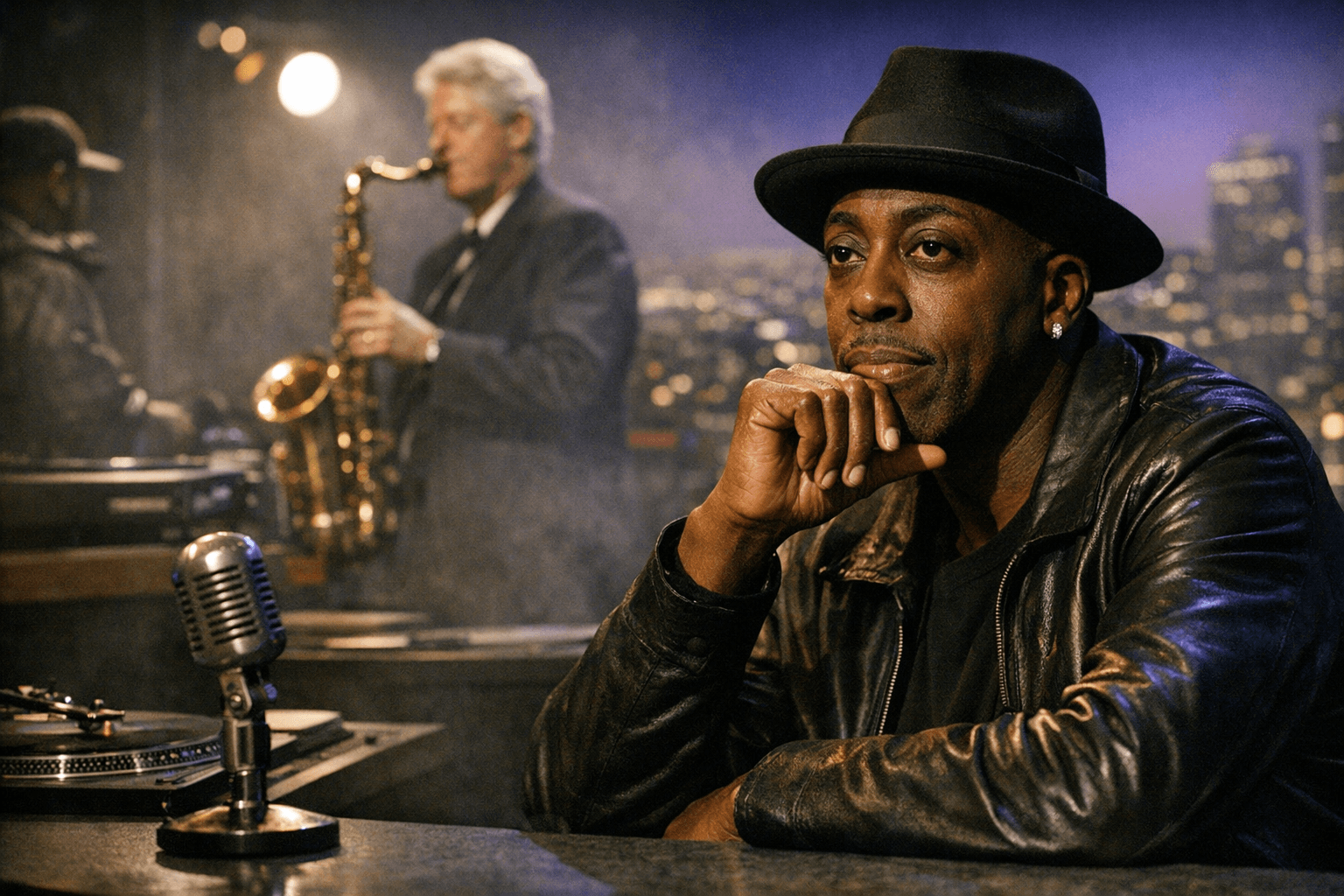
The most politically consequential night in the show's history came during the 1992 presidential election cycle, when then-candidate Bill Clinton sat in and played his saxophone on Hall's set. Clinton famously played his saxophone on set during the run-up to the 1992 presidential election. It was the kind of moment that could not have happened on a traditional late-night program: a presidential candidate meeting a young, multicultural audience on their own cultural turf.
Hall argues that Clinton grasped something other politicians hadn't. "They didn't see that in their vision, but Clinton did. And then after the numbers came in for my show, he went to MTV. He saw how you have to talk to young people." The appearance signaled a new calculus in political communication, one in which late-night television was no longer just entertainment but a direct line to voters who didn't watch the evening news.
The Criticism Nobody Talks About
Success did not insulate Hall from pressure on all sides. Hall says he faced criticism on multiple fronts: White audiences thought the show was too Black, while Black audiences accused the show of not being Black enough. "In America, you're never gonna be No. 1 if you have this insatiable desire to do Toni Braxton instead of Dolly Parton," Hall explains.
The friction with his own network partners started early. When the show was about to launch and go head-to-head against a late-night program hosted by Pat Sajak, executives at Paramount were deeply uncomfortable with Hall's vision. Hall's response, captured in a 1989 NPR interview, was unambiguous: "They're very, very uncomfortable because the people in that meeting room are not my audience. My audience is probably much hipper and much younger than the executives I'm in a partnership with. If they want Sajak, they should have hired him. This is what I do, and I can only be Arsenio." That confidence turned out to be warranted. Hall's show outlasted Sajak's late-night venture by years.
Moments That Defined an Era
Some of the most indelible moments in American culture happened on Hall's set. In 1991, Magic Johnson chose the show as the first place to speak after announcing his HIV diagnosis. That same year, a 6-year-old Bruno Mars won a week of free groceries after performing his Elvis impression on the show.
The Magic Johnson interview carries particular weight in Hall's memoir. Hall writes: "I call him Earv, Magic Johnson. He was a friend. And he called me because I had been worried about him... one of the things I remember most is he was afraid of losing friends, losing the love of friends and family. I remember the sentence, 'I want people to still give me my hugs,' because Magic is a warm and fuzzy guy." The interview became a landmark moment in public conversation around HIV, and the fact that Johnson chose Hall's show over any other platform spoke directly to the trust Hall had built with his audience.
The Legacy the Memoir Captures
*Arsenio* is ultimately a record of what happens when a television host refuses to make the show someone else wants him to make. Hall built something that ran second only to Johnny Carson at its peak, gave hip-hop its most visible national stage, helped reshape how politicians court young voters, and hosted cultural turning points that no other late-night program of the era would have touched. The show ran for five seasons and approximately 1,000 episodes before closing in 1994, a body of work whose influence on American entertainment, music, and political media stretched well beyond its original run. The memoir puts a name to what Hall always understood: the show he built was the one he had been rehearsing since he was 11 years old in a basement in Cleveland.
This article was produced by Prism’s automated news system from verified source data, official records, and press releases, then run through automated quality and moderation checks before publishing. The system is built and supervised by the people who set the standards it runs under. Read our full AI policy.
Did this article answer your question?