Artem
Before any crowd cheered, Navy diver Laddy Aldridge cracked open the Orion hatch 50 miles off San Diego, the first human to touch the Artemis II crew returning from the moon.
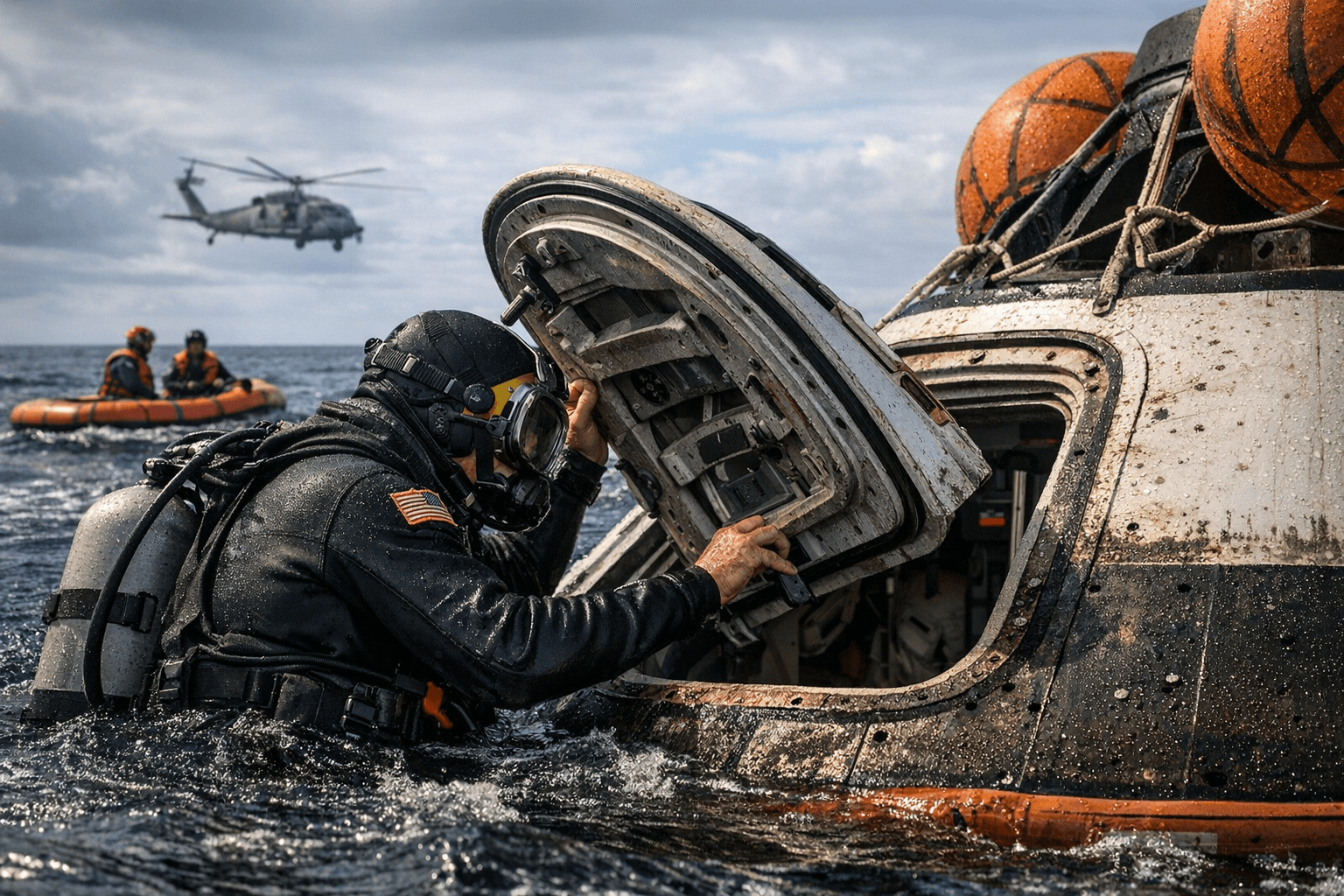
The Orion capsule hit the Pacific at roughly 20 mph at 5:07 p.m. PDT on April 10, slowing from nearly 24,000 mph during re-entry, and before any ceremony, before television cameras fixed on Naval Base San Diego, a four-person dive medical team was already at the hatch. Senior Chief Hospital Corpsman Laddy Aldridge was the first human to reach Commander Reid Wiseman, Pilot Victor Glover, Mission Specialist Christina Koch, and Mission Specialist Jeremy Hansen after their nine-day lunar flyby, cracking open the Orion capsule door approximately 50 miles off the California coast.
Aldridge's team came from U.S. Navy Explosive Ordnance Disposal Group ONE (EODGRU-1). Led by Lt. Cmdr. Jesse Wang, a board-certified emergency medicine doctor who completed his residency at Lincoln Hospital in the Bronx and joined the Navy in 2021, the unit also included Chief Hospital Corpsman Vlad Link and Hospital Corpsman 1st Class Steve Kapala, a sailor from Michigan. Their certifications cover undersea medical issues including decompression illness, training adapted here for astronauts whose bodies had spent nine days in microgravity.
The protocol begins before anyone enters the capsule. After Orion deploys inflatable ballasts to stay upright on the water, the divers arrive by small inflatable boats and set up the "front porch," an inflatable raft positioned outside the hatch that gives the crew a stable surface to readjust to Earth's gravity. Only then does the medical team enter to conduct initial triage, assess each crew member, and assist egress one at a time. MH-60S Sea Hawk helicopters from Helicopter Sea Combat Squadron 23, operating off the flight deck of USS John P. Murtha, hoisted each astronaut individually up to the ship.
The 684-foot San Antonio-class amphibious transport dock was chosen specifically for this architecture. Its well deck allows the Orion capsule to be towed inside for inspection; its medical facilities support immediate crew evaluation; its helicopter flight deck lets the Sea Hawks operate without diverting to shore. The Murtha positioned itself approximately 1.5 to 2 miles from the splashdown point, maneuvered to place its port side toward Orion, and held station roughly 2,000 yards away during crew extraction. Orion will be returned to Naval Base San Diego before transport to NASA's Kennedy Space Center in Florida for engineering analysis.
The engineering data collection started at the waterline. Navy divers photographed Orion's heat shield within minutes of splashdown; two heat shield specialists aboard the Murtha analyzed those images in near real time. That shield had absorbed a peak temperature of approximately 5,000 degrees Fahrenheit during re-entry, roughly half the temperature of the sun's visible surface, while 11 parachutes decelerated the capsule from 24,000 mph to about 20 mph before water contact. "We gathered a lot of data," Orion program manager Howard Hu said at the post-splashdown news conference.
Ahead of the mission, Wang captured the scope of the undertaking. "Our fellow divers, the sailors on the ship, the helicopter squadron, our partners at NASA, and everyone supporting this mission are ready to bring the Artemis II crew home," he said. "This team is undoubtedly making history."
The Navy's Third Fleet rehearsed this exact sequence off San Diego in March 2025, more than a year before launch, refining capsule approach, hatch procedures, medical assessments, and hoisting sequences. Artemis II was the first crewed return from beyond low Earth orbit since Apollo 17 in December 1972, a 53-year gap. Glover became the first person of color to fly to the moon; Koch became the first woman; Hansen of the Canadian Space Agency became the first non-U.S. citizen. During the mission, the three named a lunar crater "Carroll" after Wiseman's wife, who died of cancer in 2020.
All four came home safely. The Navy team completed their work at sea long before the world had finished celebrating.
This article was produced by Prism’s automated news system from verified source data, official records, and press releases, then run through automated quality and moderation checks before publishing. The system is built and supervised by the people who set the standards it runs under. Read our full AI policy.
Did this article answer your question?