Artemis II Crew Calls Home, Sharing Messages From Historic Lunar Mission
Flying farther than any crew since Apollo 17, the Artemis II astronauts reported chilly quarters and sleeping upside down as they raced toward the Moon.

Less than 48 hours into humanity's first crewed lunar mission in more than 50 years, the four astronauts aboard NASA's Orion spacecraft turned their cameras toward Earth and began describing what it actually feels like to leave it behind.
Speaking by video link from inside the compact Orion capsule on Day 2 of the mission, Commander Reid Wiseman, Pilot Victor Glover, and Mission Specialists Christina Koch and Jeremy Hansen fielded questions from ABC News' Gio Benitez and Fox News' Trace Gallagher, offering candid dispatches from a journey that will carry them farther from Earth than any crew since Apollo 17 in December 1972. At a NASA public affairs event, Wiseman opened with a shoutout to the astronauts' families, noting the crew had not yet had the chance to speak with them privately.
The personal details were striking. Koch described the eight-minute climb to orbit as "a steady rumble and a great ride," and offered a matter-of-fact account of sleeping in microgravity: "There is no difference between up and down, and so, yes, I've been sleeping with my feet there and my head down here, and it's very comfortable." Glover flagged a more practical concern: the Orion cabin was running cold, and he wished the crew had packed different sleeping bags. Mission Control in Houston was working to warm the capsule.
Hansen, making his first spaceflight after 17 years as a Canadian Space Agency astronaut and former Canadian Armed Forces colonel, sounded less like a veteran aviator than a kid at a window seat. "I just kept saying to them yesterday, like I really like it up here," he told journalists. "I wish I could have got here sooner. It's just such a tremendous place to be. The views are extraordinary. It's really fun to be floating around, and it just makes me feel like a little kid."
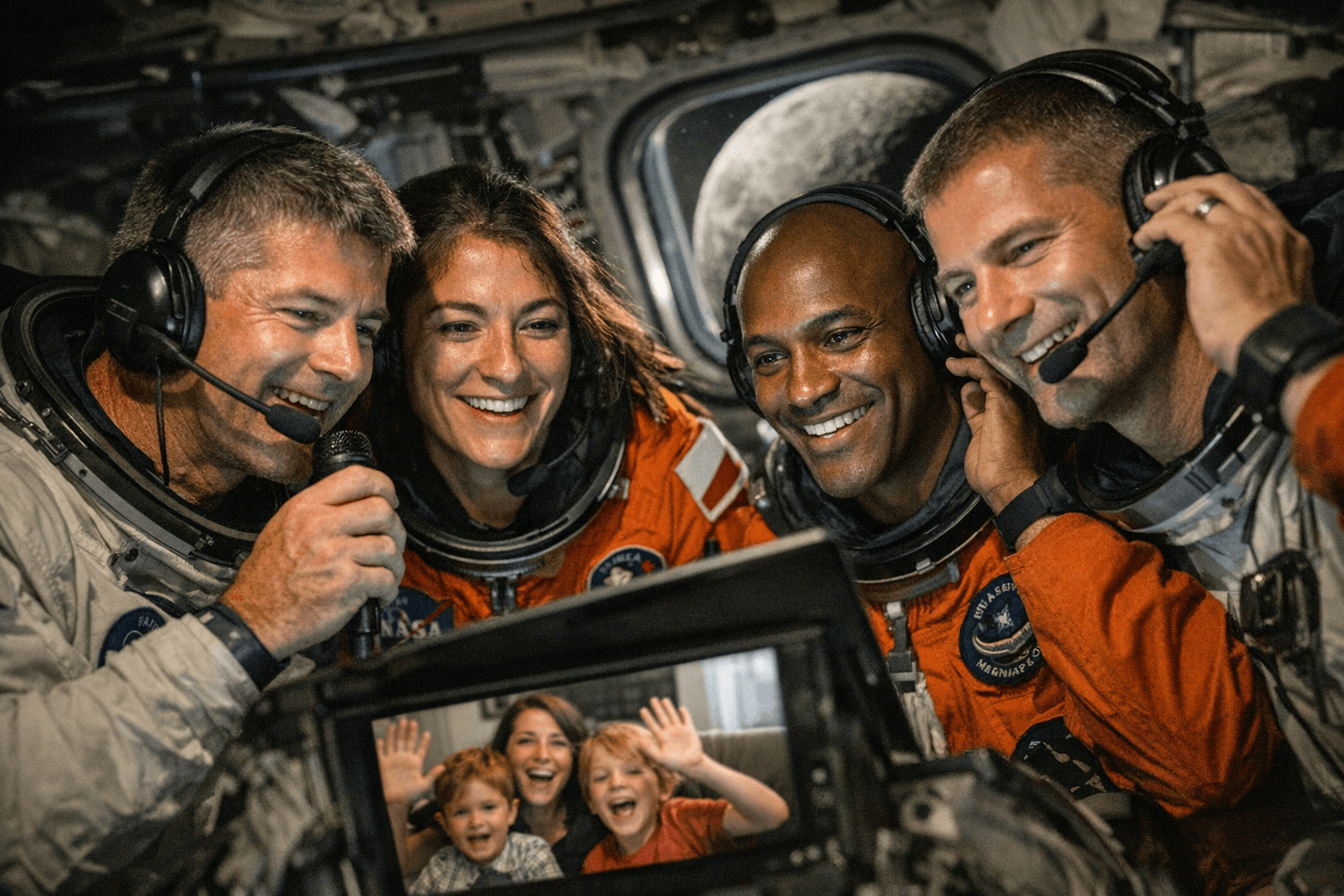
The wonder had context. The mission, which lifted off April 1 at 6:35 p.m. EDT from Launch Complex 39B at Kennedy Space Center atop NASA's 322-foot Space Launch System rocket, carries milestones that reach well beyond personal experience. Glover is the first person of color to travel around the Moon. Koch is the first woman. Hansen is the first Canadian and first non-American to make the journey. Before launch, Glover captured the crew's sense of collective purpose: "We are going for our families." Hansen added, "We are going for all humanity."
The technical checkpoint that defined Day 2 came early. The Translunar Injection burn, completed April 2, placed Orion on its trajectory toward the Moon. Hansen marked the moment directly: "We just wanted to communicate to everyone around the planet who's worked to make Artemis possible that we firmly felt the power of your perseverance during every second of that burn." The crew also checked out the AVATAR scientific payload, and a brief communications blackout traced to a Tracking and Data Relay Satellite ground configuration issue was resolved without mission impact.
Orion is expected to swing around the Moon on Monday, April 6, opening a roughly six-hour window for lunar observation. With that date now four days out, the lunar science team was already building a targeting plan for what the crew will study from the surface below.
Sources:
Know something we missed? Have a correction or additional information?
Submit a Tip