Artemis II Crew Completes Historic Lunar Flyby, Breaking 56-Year Distance Record
Four astronauts flew 252,756 miles from Earth, breaking a 56-year record set by Apollo 13, and became the first humans to see the far side of the Moon with their own eyes.
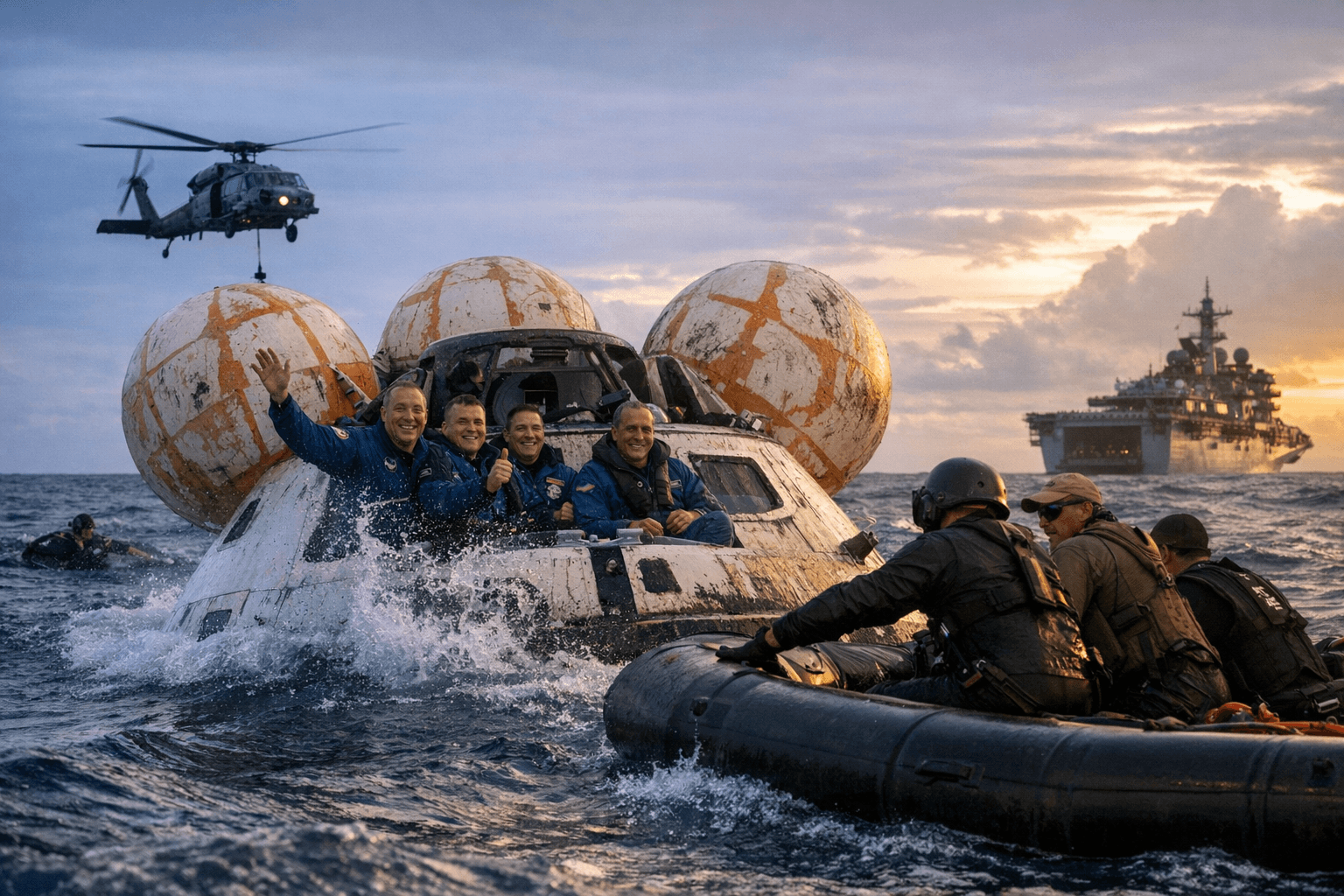
The Orion spacecraft carrying four astronauts splashed down in the Pacific Ocean off San Diego on Thursday evening, completing a 10-day mission that pushed humans farther from Earth than any crew in history and returned them to lunar distance for the first time since Apollo 17 touched down in December 1972.
At 1:56 p.m. EDT on April 6, six days into the flight, Orion reached 252,756 miles from Earth, eclipsing the previous record of 248,655 miles held by Apollo 13 since April 1970. Apollo 13's record was never intended: the crew reached that distance only because an onboard oxygen tank explosion forced mission controllers to swing the spacecraft around the Moon as the fastest route home. Artemis II exceeded it by approximately 4,100 miles, by design, on a fully functioning ship.
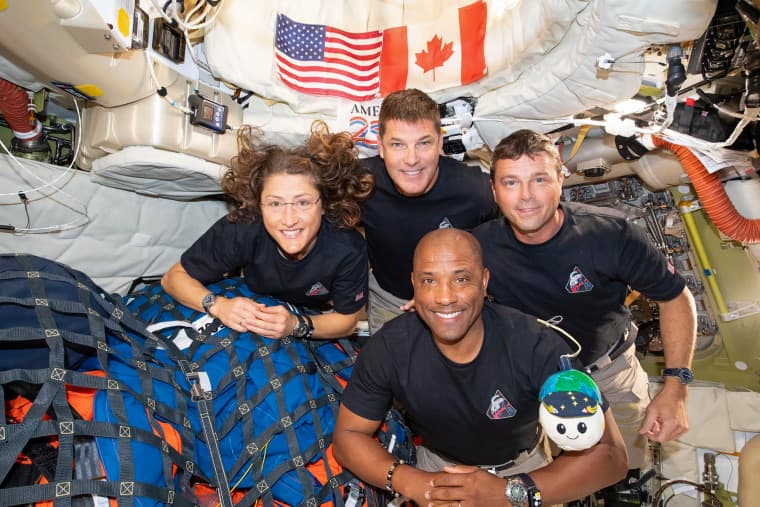
That same day, Commander Reid Wiseman, Pilot Victor Glover, and Mission Specialists Christina Koch and Jeremy Hansen completed a seven-hour lunar flyby that brought Orion within 4,070 miles of the surface. For the first time in human history, a crew viewed the entire far side of the Moon with their own eyes. The astronauts also photographed a rare in-space solar eclipse, and the images transmitted to Houston revealed what NASA described as regions no human had seen. Nicky Fox, Associate Administrator for NASA's Science Mission Directorate, publicly responded to the flyby imagery as it arrived. Those photographs represent more than spectacle: they document navigation precision, crew operational capability, and deep-space communication performance at lunar distances, all data NASA needs before committing a landing crew to Artemis III.
The mission also carried four historic firsts in a single crew manifest. Glover became the first person of color to travel around the Moon. Koch became the first woman. Hansen, flying for the Canadian Space Agency, became both the first Canadian and the first non-American to make the circumlunar journey, doing so on his very first spaceflight.

Wiseman's voice reached Mission Control in Houston at 8:07 p.m. ET on April 10 as the capsule settled into the Pacific: "What a journey. We are stable. Four green crewmembers." Koch was the first to exit, followed by Glover, Hansen, and Wiseman, before the crew was transferred to a recovery ship for medical evaluation. During the final descent, the crew had queued their own re-entry soundtrack: "Run to the Water" by Live, followed by "Free" by Zac Brown Band.
Orion launched atop NASA's Space Launch System from Kennedy Space Center in Florida on April 1. What Artemis II proved was significant: Orion and the SLS can carry a crew to lunar distance and return them safely, life support held across 10 days, and human physiology survived the radiation environment beyond low-Earth orbit. What it did not prove was a landing. That question, and all the risks attached to it, remains open for Artemis III.
Know something we missed? Have a correction or additional information?
Submit a Tip