Artemis II Crew Completes Historic Lunar Flyby, but Moon Landing Challenges Remain
Four astronauts splashed down safely after setting a new human spaceflight distance record, but NASA's path to a Moon landing now runs through two unproven commercial landers.

The Orion spacecraft named Integrity splashed down in the Pacific Ocean off San Diego at 8:07 p.m. ET on April 10, closing out a 695,081-mile journey that set a new distance record for human spaceflight and returned the first crew near the Moon in more than 53 years. Commander Reid Wiseman's radio call from the water was terse and telling: "What a journey. We are stable. Four green crewmembers."
The mission launched April 1 from Kennedy Space Center's Launch Pad 39B, carrying Wiseman, Pilot Victor Glover, Mission Specialist Christina Koch, and Canadian Space Agency Mission Specialist Jeremy Hansen. All four rewrote the record books: Glover became the first person of color to travel to the Moon's vicinity, Koch the first woman, Hansen the first non-American and first Canadian, and Wiseman the oldest person to venture beyond low Earth orbit toward the Moon. Their group of four also broke the deep-space occupancy record set by Apollo 8 in December 1968 at three.
On April 6, Orion passed within approximately 4,067 miles of the lunar surface. At 12:56 p.m. CDT that same day, the spacecraft reached 252,756 miles from Earth, breaking Apollo 13's 1970 distance record of 248,655 miles. The crew lost radio contact with Houston for 40 minutes during the far-side lunar pass, witnessed a rare total solar eclipse from deep space, and observed at least four micrometeorite impact flashes on the lunar surface.
NASA Associate Administrator Amit Kshatriya called the conclusion a turning point: "Fifty-three years ago, humanity left the Moon. This time we returned to stay." But mission managers flagged three technical items requiring resolution before Artemis III: the Orion heat shield needs close inspection, a service module valve requires redesign, and a toilet malfunction must be addressed.
The harder challenges lie in hardware that never left Earth. A NASA Office of Inspector General report published March 10, 2026 found that SpaceX's Starship HLS lunar lander is at least two years behind schedule, with an internal NASA analysis placing the odds of a further 18-month delay at nearly one in three. Blue Origin's Blue Moon lander is at least eight months late, with roughly half the issues from a 2024 design review still unresolved. Neither vehicle has demonstrated readiness to carry astronauts to the lunar surface.
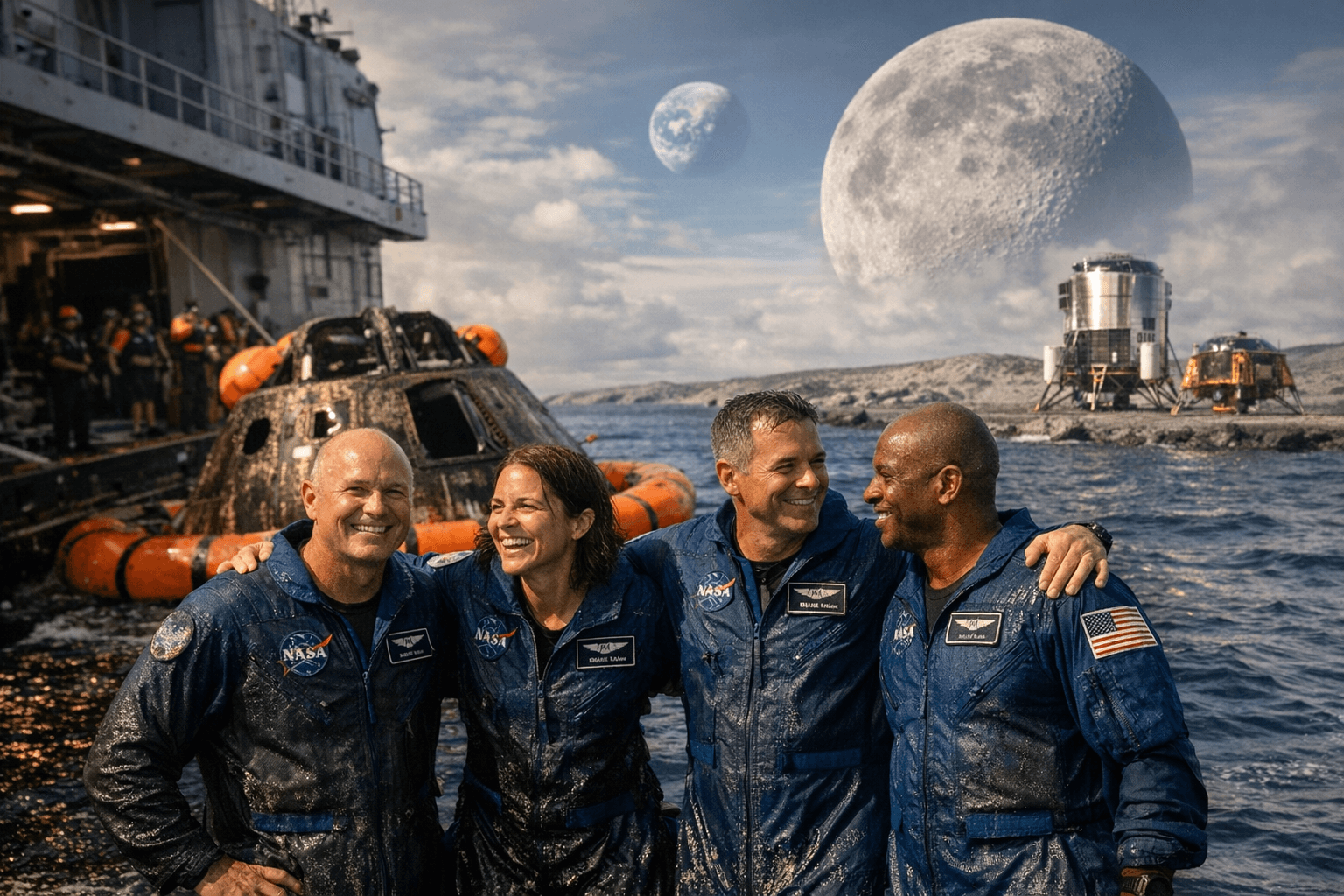
Those delays forced a fundamental restructuring of the Artemis roadmap. NASA redesigned Artemis III, now targeted for mid-2027, from a Moon landing into an Earth-orbit demonstration mission testing rendezvous and docking between Orion and the commercial landers, alongside evaluation of the Axiom Extravehicular Mobility Unit spacesuit. The first actual crewed lunar landing has shifted to Artemis IV, targeted for early 2028, a date NASA has preserved partly because it aligns with President Trump's space policy requiring Americans on the Moon within his current term.
NASA Administrator Jared Isaacman has outlined plans for one crewed lunar landing per year beginning in 2028, with Artemis V marking the start of a permanent Moon base. Independent analysts are skeptical. China's target of a crewed Moon landing by 2030, backed by its Long March 10 rocket in development, adds geopolitical urgency to a timeline that contractor performance has already strained.
The Starship HLS lander stands 35 meters tall, dwarfing the Eagle module that carried Neil Armstrong and Buzz Aldrin in 1969. Artemis II confirmed the crew and the capsule can handle the journey. Whether the commercial landers, the revised launch cadence, and the congressional appropriations required to sustain them can converge on 2028 is a question NASA's next two years will be forced to answer.
Sources:
Know something we missed? Have a correction or additional information?
Submit a Tip