Artemis II crew returns from historic Moon flyby, closer than ever
Artemis II’s four astronauts came home from the Moon with a record-setting flight and a new proof point for NASA’s return to the lunar frontier.
The Artemis II crew returned with more than a splashdown record. After nearly 10 days in deep space, Reid Wiseman, Victor Glover, Christina Koch and Jeremy Hansen brought home a flight that tested the hardware, the team and NASA’s next lunar ambitions.
Their Orion capsule hit the Pacific Ocean off San Diego at 5:07 p.m. PDT on Friday, April 10, after a 694,481-mile journey that carried the astronauts 252,756 miles from Earth, farther than any humans had ever traveled. The mark surpassed Apollo 13’s 1970 record of 248,655 miles and underscored how far Artemis has moved beyond symbolism and into operational rehearsal.
At NASA’s Johnson Space Center in Houston on Thursday, the crew described a mission that was as much about trust as technology. Wiseman said, “I am here to tell the world: we launched as friends, and we came back as best friends,” adding that they were “the closest four humans can be and not be a family.” The four were selected in April 2023 and trained together for three years, a long preparation that showed in the calm, coordinated way they described the flight.
That human chemistry mattered because Artemis II was never just a scenic loop around the Moon. NASA designed the mission, launched on April 1 from Kennedy Space Center’s Launch Pad 39B aboard the SLS rocket, to test deep-space systems before astronauts attempt to land again. The crew’s praise for Orion’s reentry, especially the heat shield, pointed to one of the flight’s most consequential results: the spacecraft behaved the way NASA needs it to behave if crews are to travel farther and return safely.
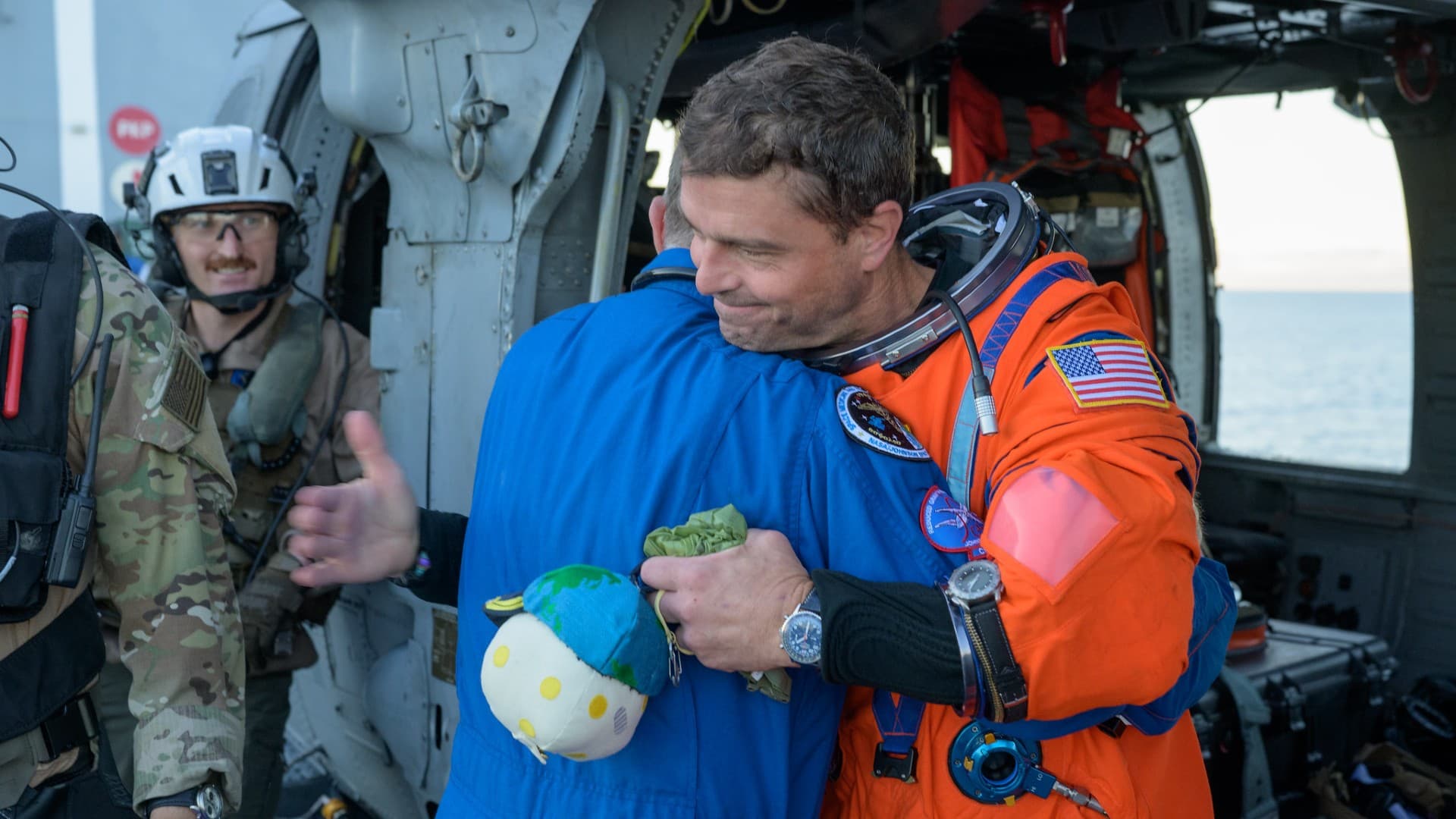
The recovery operation was equally deliberate. NASA and U.S. military teams retrieved the capsule, and the astronauts were flown by helicopter to the USS John P. Murtha for initial medical checkouts before returning to Houston the next day. Jeremy Hansen, the first Canadian to travel into deep space and the first Canadian to travel to the Moon, said he was struck by the public’s creativity and support, a reminder that spaceflight depends not only on engineering but also on public buy-in for missions that cost billions and stretch over years.
Christina Koch said her husband’s reaction moved her to tears and affirmed that the mission had made a difference. Victor Glover said the crew had done what it said it would do. For NASA, that matters now because the agency’s attention turns to Artemis III and the return to the lunar surface, with this flight serving as the bridge between lunar ambition and an operating pathway to the Moon and beyond.
Sources:
Know something we missed? Have a correction or additional information?
Submit a Tip