Artemis II Crew Speaks From Orion Spacecraft During Historic Lunar Journey
Artemis II's critical 6-minute engine burn placed four astronauts beyond Earth's magnetosphere, where heat shield performance and solar radiation pose unresolved risks before April 10 splashdown.
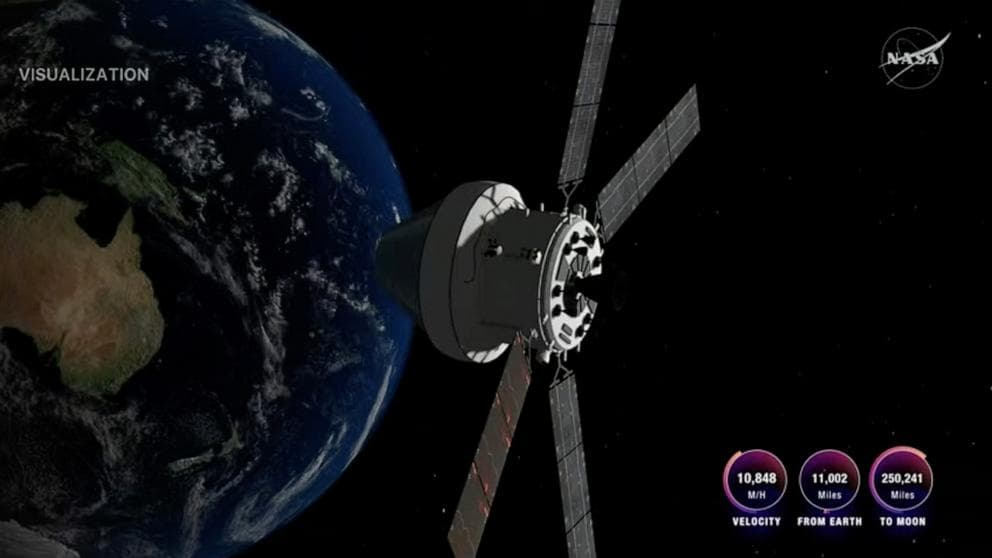
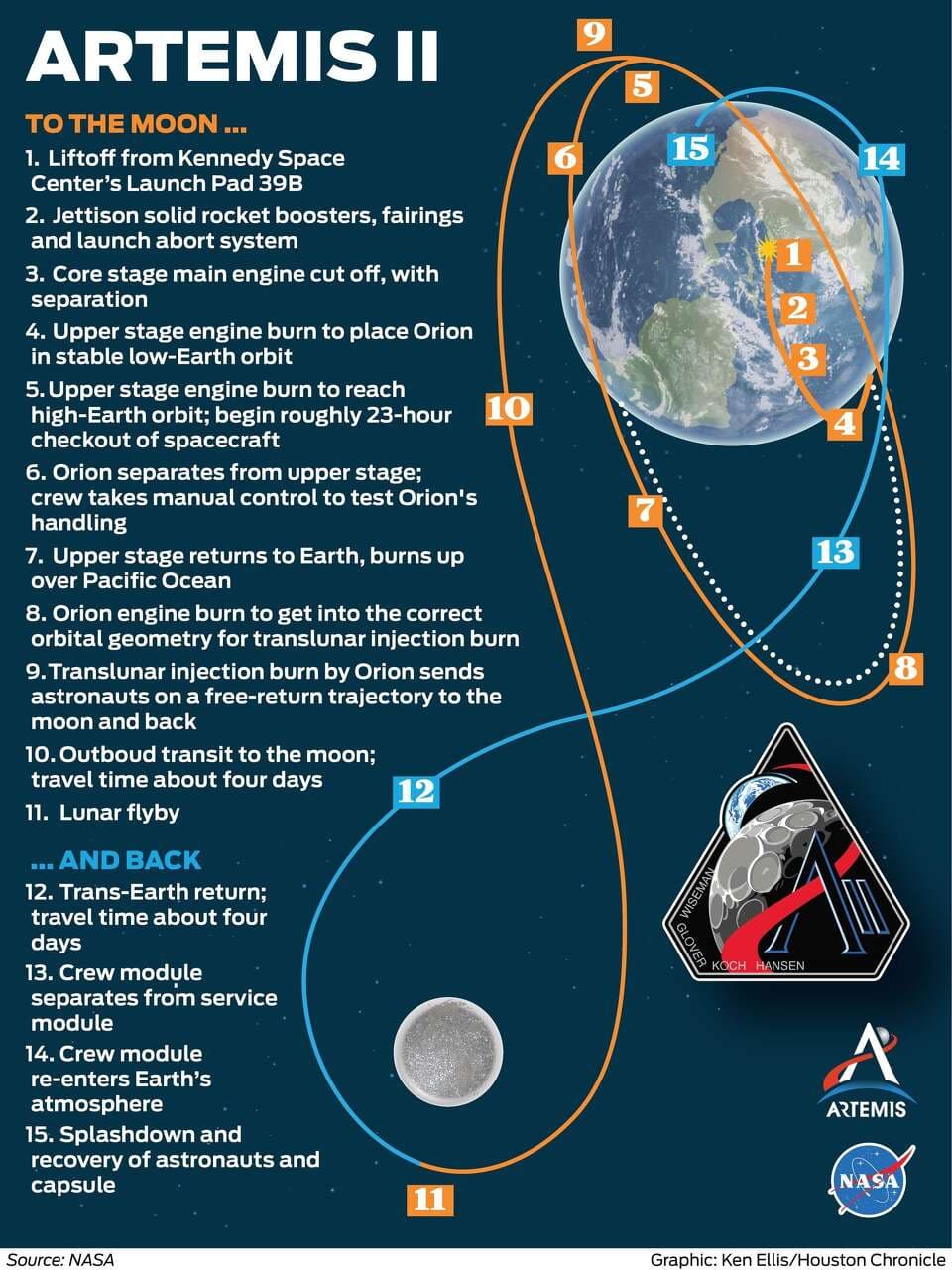
The engine firing that changed everything lasted six minutes and five seconds. That trans-lunar injection burn, completed approximately 25 hours after Artemis II lifted off from Kennedy Space Center, was the Orion service module's first real test in deep space: a sustained firing that had to work flawlessly to break the spacecraft free of Earth's gravitational pull and lock it onto a trajectory toward the moon. It worked.
Mission Specialist Jeremy Hansen radioed mission control shortly after: "With that successful TLI, the crew's feeling pretty good up here on our way to the moon." For Hansen, a Royal Canadian Air Force colonel and the first non-American ever to fly to the moon, Artemis II is also his very first spaceflight. He described the moment the boosters lit at launch as one of "disbelief."
The mission launched at 6:35 p.m. ET on April 1 from Launch Complex 39B at Kennedy Space Center in Florida, the same pad used for Apollo and Space Shuttle missions. Commander Reid Wiseman, 50, shouted "Let's go to the moon!" as the Space Launch System cleared the tower. But the 9.5-to-10-day flight is not a landing. It is an engineering audit conducted at 252,799 statute miles from Earth, and every verdict it returns will determine whether Artemis III can put humans on the lunar surface in 2027.
The systems under scrutiny are specific. Orion's ablative heat shield drew intense scrutiny after post-flight inspections of the uncrewed Artemis I mission in 2022 revealed unexpected char loss during reentry. Engineers ran additional damage-scenario analyses before NASA Administrator Jared Isaacman cleared the mission to fly with the existing shield; design changes are planned for Artemis III. Life support and environmental control systems are being evaluated with a crew aboard for the first time. Artemis II is also testing an optical communications system capable of transmitting data to Earth at up to 260 megabits per second, alongside a hybrid navigation architecture combining NASA's Near Space Network and Deep Space Network.

Beyond Earth's magnetosphere, the risks ahead are concrete. The crew faces galactic cosmic rays and the unpredictable threat of solar energetic particles released by flares or coronal mass ejections. Baseline radiation exposure from background cosmic sources is expected to total roughly five percent of an astronaut's career limit; a significant solar event would add measurably to that. NASA's Moon to Mars Space Weather Analysis Office at Goddard Space Flight Center is continuously monitoring solar activity alongside NOAA's Space Weather Prediction Center. Trajectory constraints also narrow the crew's options: the free-return path minimizes transit time through the Van Allen Radiation Belts but leaves little room for course deviation.
Pilot Victor Glover, 49, the first Black astronaut ever assigned to a lunar mission, said before launch: "We want everybody to be a part of this mission." Mission Specialist Christina Koch, 47, the first woman to fly on a lunar mission and the record-holder for the longest single spaceflight by a woman at 328 days, described the view from Orion: "There's nothing that prepares you for the breathtaking aspect of seeing your home planet." The crew's physiological responses to radiation and deep-space conditions are themselves being formally tracked, feeding a medical data set that will shape crew protocols for Artemis III and eventual Mars missions.
At closest approach, Orion will fly 4,112 statute miles beyond the moon's surface before looping back toward Earth. Splashdown is scheduled for April 10 in the Pacific Ocean off San Diego. The first crewed lunar mission since Apollo 17 in December 1972 will be judged not on how it felt, but on what it proved.
Sources:
Know something we missed? Have a correction or additional information?
Submit a Tip