Asian Shares Fall as Oil Surges on Middle East War Fears
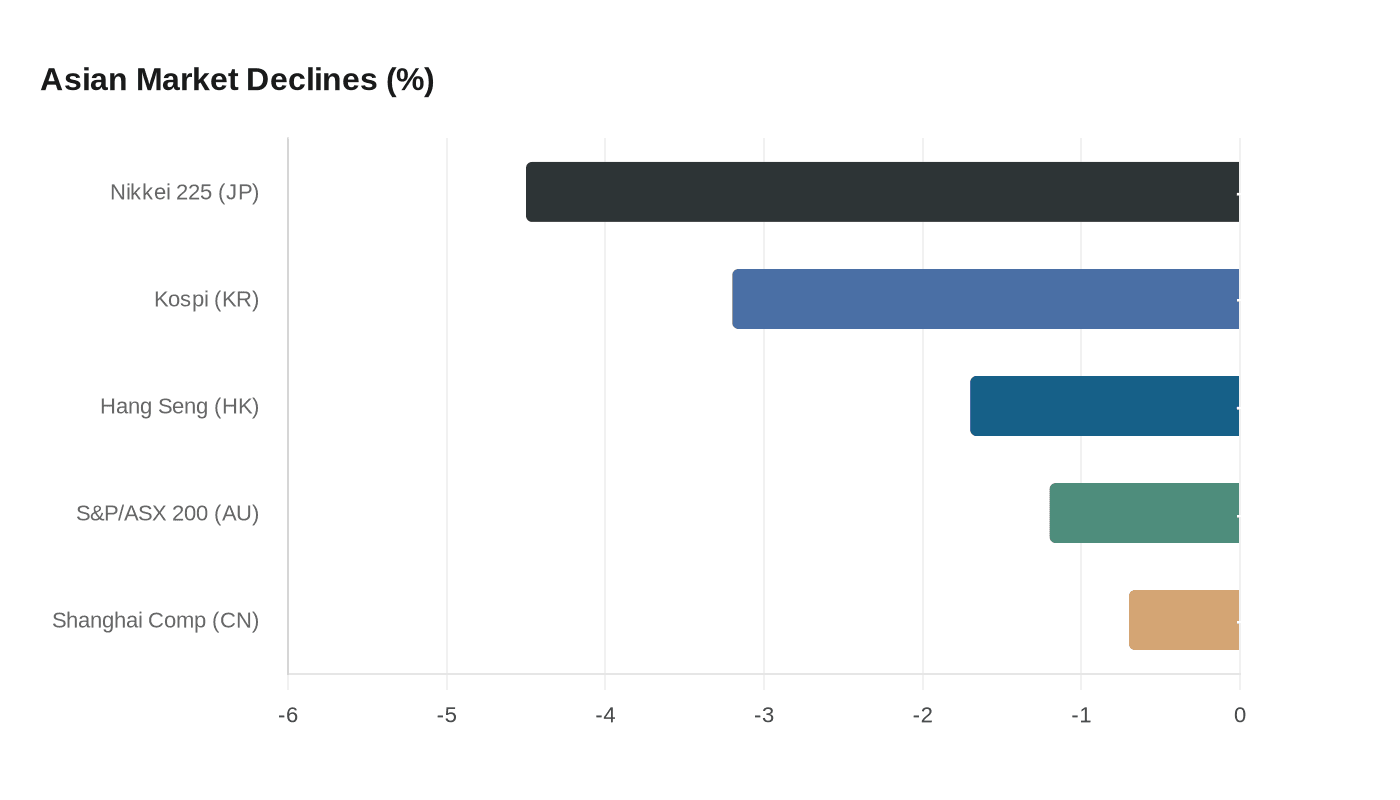
Japan's Nikkei 225 sank 4.5% as Brent crude surged to $115 a barrel after Yemen's Houthis fired missiles at Israel, adding a new front to the five-week-old U.S.-Iran war.
Japan's Nikkei 225 sank 4.5 percent to 50,979.54 in Monday morning trading as Brent crude climbed to $115.35 a barrel, with Yemen's Houthi movement launching ballistic missiles at Israel for the first time in the U.S.-Iran conflict, opening a new front in a war that has choked global oil supplies for five weeks.
South Korea's Kospi fell 3.2 percent to 5,264.32. Hong Kong's Hang Seng lost 1.7 percent to 24,519.63. Australia's S&P/ASX 200 shed 1.2 percent to 8,417.00, and the Shanghai Composite slipped 0.7 percent to 3,884.57.
The declines followed the deep losses on Wall Street last Friday that finished off a fifth straight losing week, its longest such streak in nearly four years. The Dow Jones Industrial Average tumbled, falling into correction territory; the 30-stock Dow fell 793.47 points, or 1.73 percent, to close out the session.
Oil was the proximate cause. West Texas Intermediate crude futures rose 2.58 percent to $102.19 per barrel during early Asian hours. May futures for Brent, the international benchmark, gained 2.47 percent to $115.35, with the contract heading for a record monthly jump. Worries have been great in Japan and the rest of Asia about the effective lack of access to the Strait of Hormuz, through which roughly one-fifth of the world's oil normally passes. The waterway has remained largely closed since the conflict began with U.S. and Israeli strikes on Iran on February 28.

Yemen's Houthis said Saturday they had launched missiles at Israel, marking their first direct involvement in the U.S.-Israel war against Iran. Spokesperson Yahya Saree said the group fired a barrage of ballistic missiles at what it called sensitive Israeli military targets, in support of Iran and Hezbollah forces in Lebanon. Ed Yardeni, president of Yardeni Research, said global equities were beginning to reflect a scenario of "higher-for-longer" oil prices and interest rates, as the risk of a prolonged conflict grows.
The stakes are particularly acute across Asia. Energy-intensive manufacturing economies from Tokyo to Seoul depend on Gulf crude imports and shipping lanes now shadowed by conflict. Higher fuel and insurance costs compress margins for exporters already navigating slowing global demand, while prolonged supply disruptions raise the specter of an inflationary shock that could delay the AI-driven capital spending cycle benefiting semiconductor and heavy-industry sectors.
Bank of Japan policymakers discussed the need for further rate hikes at their March meeting, as rising oil prices linked to the Middle East conflict add to inflation pressures. Tighter monetary policy layered on top of an energy shock presents a difficult combination for equity markets that had been counting on easier conditions to extend recent gains.
Australia moved to cushion its domestic consumers: Prime Minister Anthony Albanese announced the government would halve the fuel excise on petrol and diesel for three months to ease rising costs, a measure expected to lower prices at the pump by 26.3 Australian cents per litre.
With the conflict now entering its fifth week and no diplomatic resolution in sight, analysts tracking oil futures and shipping-route notices warned that thin liquidity in some market segments means even incremental escalations can produce outsized moves before conditions stabilize.
This article was produced by Prism’s automated news system from verified source data, official records, and press releases, then run through automated quality and moderation checks before publishing. The system is built and supervised by the people who set the standards it runs under. Read our full AI policy.
Did this article answer your question?

