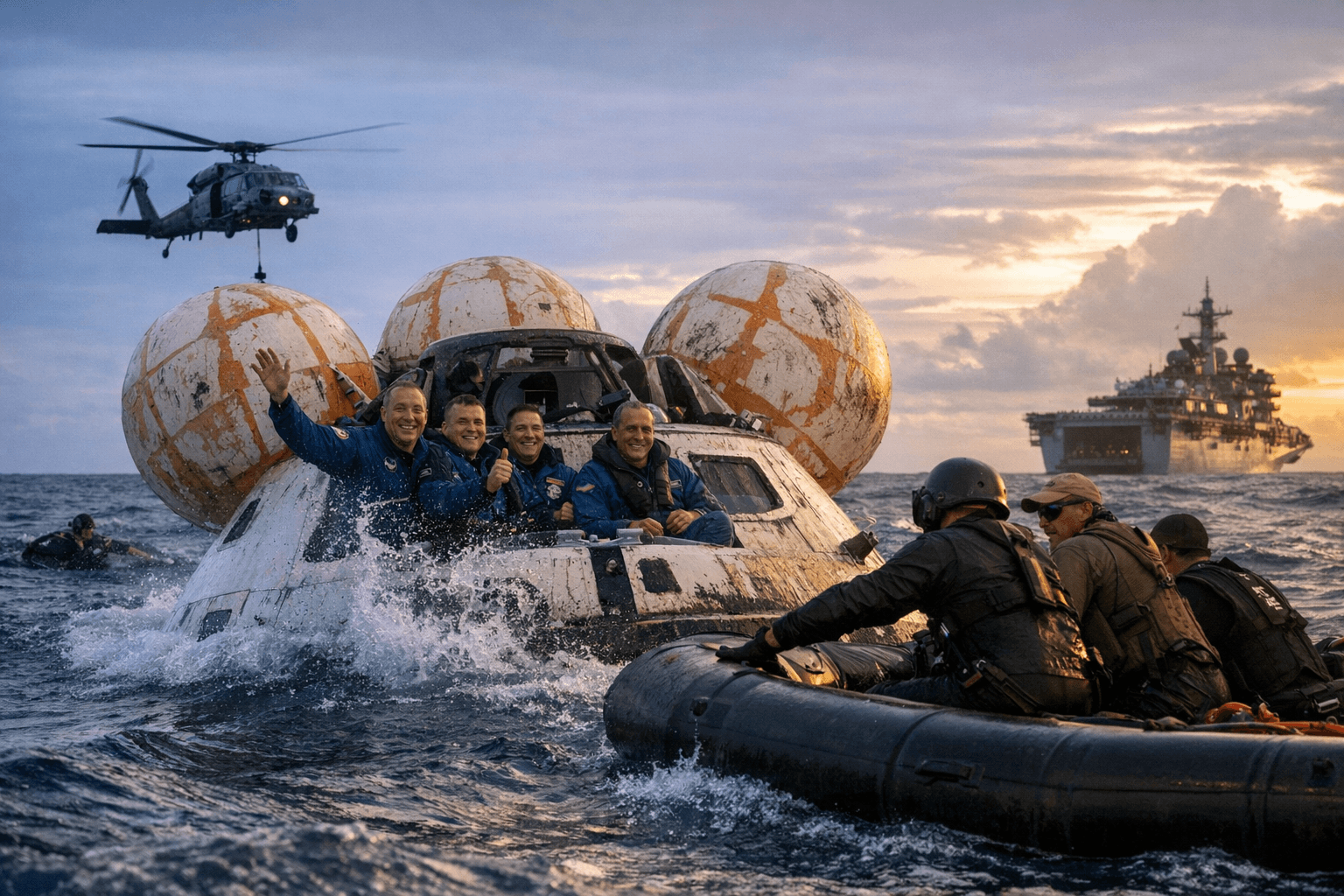
Astronauts Return Home, Set for Medical Checks and Family Reunions
The Artemis II crew splashed down after traveling 694,481 miles, then immediately faced a ladder-climbing obstacle course NASA designed to gauge how 10 days in deep space had reshaped their bodies.
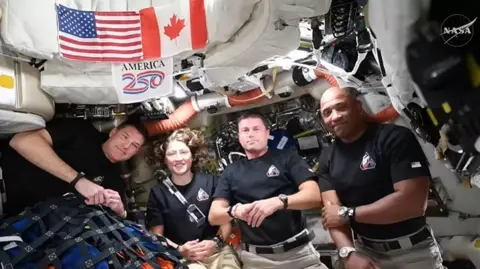
Before the hugs and handshakes with family waiting in Houston, Commander Reid Wiseman and his three crewmates had a ladder to climb.
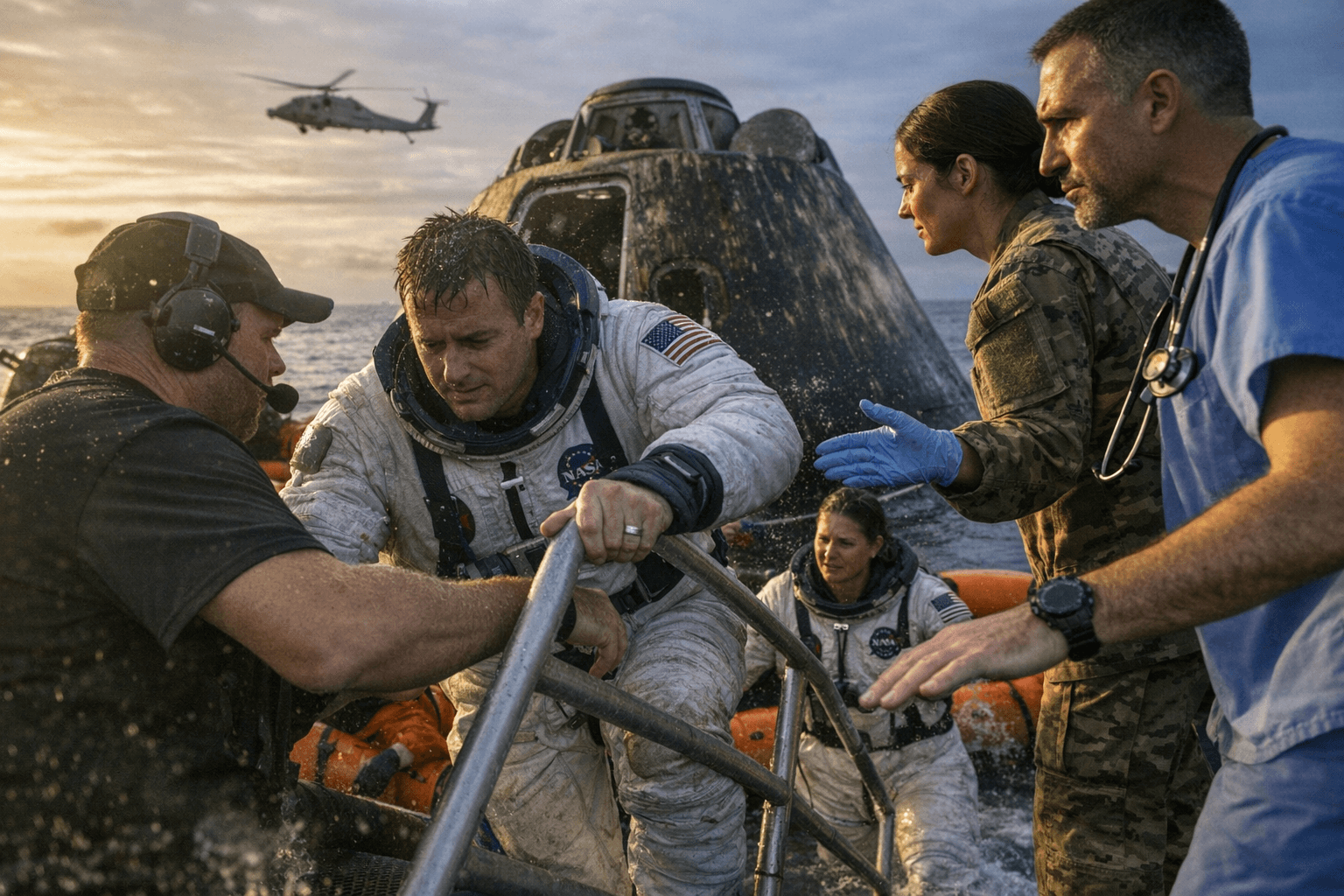
Within hours of the Artemis II Orion capsule's splashdown in the Pacific Ocean on April 10, NASA put Wiseman, pilot Victor Glover, and mission specialists Christina Koch and Jeremy Hansen through a carefully instrumented obstacle course aboard the USS John P. Murtha. The exercise, which included climbing a ladder and simulating an emergency capsule exit, was not ceremonial. Every stumble, hesitation, and grip was data.
"You're going to typically see them move a little slower, and they're not going to move laterally very quickly," said Jason Norcross, NASA EVA Physiology Laboratory senior scientist and lead of the agency's Human Health and Countermeasures program. The routine, conducted within one to four hours of splashdown, helped NASA calibrate how 10 days of microgravity had degraded the crew's ability to function, information that matters enormously as the agency prepares for its first crewed lunar landing since 1972.
Orion, named Integrity, splashed down at 8:07 p.m. EDT roughly 100 miles west of San Diego, completing a 694,481-mile journey around the Moon and back. The crew was taken to the recovery ship, where they received medical checks. The mission began with liftoff on April 1 at 6:35 p.m. EDT from Kennedy Space Center. Navy recovery crews brought the astronauts to the USS John P. Murtha for medical checks before they were slated to helicopter back to land. From there, a NASA aircraft carried them to Johnson Space Center in Houston, where family members waited.
Some astronauts experience a rough bout of space adaptation sickness, making it difficult to reacclimate to life on the ground, Norcross noted. Fortunately, the Artemis II astronauts had only been in space 10 days, meaning regaining their Earth legs should not be too large an issue. Still, the threat of orthostatic intolerance, the tendency of returning astronauts to faint or become dizzy when they stand upright, required active mitigation. Earlier data showed that roughly 25 percent of shuttle astronauts struggled with blood pressure regulation on return, a number that climbed to nearly 80 percent during early space station missions. NASA cardiovascular physiologist Steve Platts developed a compression garment worn under the suit to counteract blood-pressure changes. The vestibular system posed a separate challenge. Platts noted that the inner ear is "a tricky thing" that spaceflight disrupts, making it difficult for crew to move around for a few days after return. "It recovers between three and five days," he said.
The medical significance of Artemis II extends well beyond its 10-day duration. The mission carried AVATAR, or A Virtual Astronaut Tissue Analog Response, a set of organ-on-a-chip devices roughly the size of a USB thumb drive. Built from bone marrow cells grown from each crewmember's own preflight blood donations, the chips measure how individual astronauts responded to deep space radiation beyond Earth's Van Allen Belt, something the International Space Station cannot replicate. "We've never done this before," said Lisa Carnell, director of NASA's Biological and Physical Sciences Division. Carnell expects to gather data on the crew's immune responses to the higher radiation levels of deep space, with those insights potentially leading to individualized treatments for future missions.
Those findings carry direct weight for Artemis III, the planned first crewed lunar surface landing. Platts acknowledged that the physiological gap in NASA's knowledge runs deep: the agency has limited data on how bodies manage the transition from microgravity to the Moon's one-sixth gravity, and no long-term data on three-eighths gravity, the pull astronauts would face on Mars. Blood and saliva samples collected during the mission will also help researchers track whether dormant viruses, including those responsible for chickenpox and shingles, were reactivated by deep space stress, a phenomenon previously documented on the ISS.
Orion program manager Howard Hu told reporters: "We're going to learn from this mission, we're going to look at the data, and we're going to move forward. This is the start of a new era of space exploration."
Artemis II is widely viewed as a critical proving ground for longer missions. For Wiseman, Glover, Koch, and Hansen, proving it started with a ladder test on a Navy ship. The family reunions in Houston came after.
Sources:
Know something we missed? Have a correction or additional information?
Submit a Tip