Autonomous Drones Face Elite FPV Pilots in Abu Dhabi A2RL Season Two
Autonomous AI teams and elite FPV pilots faced off in Abu Dhabi's A2RL season two, testing split-second decision-making and signalling new benchmarks for real-world autonomy.

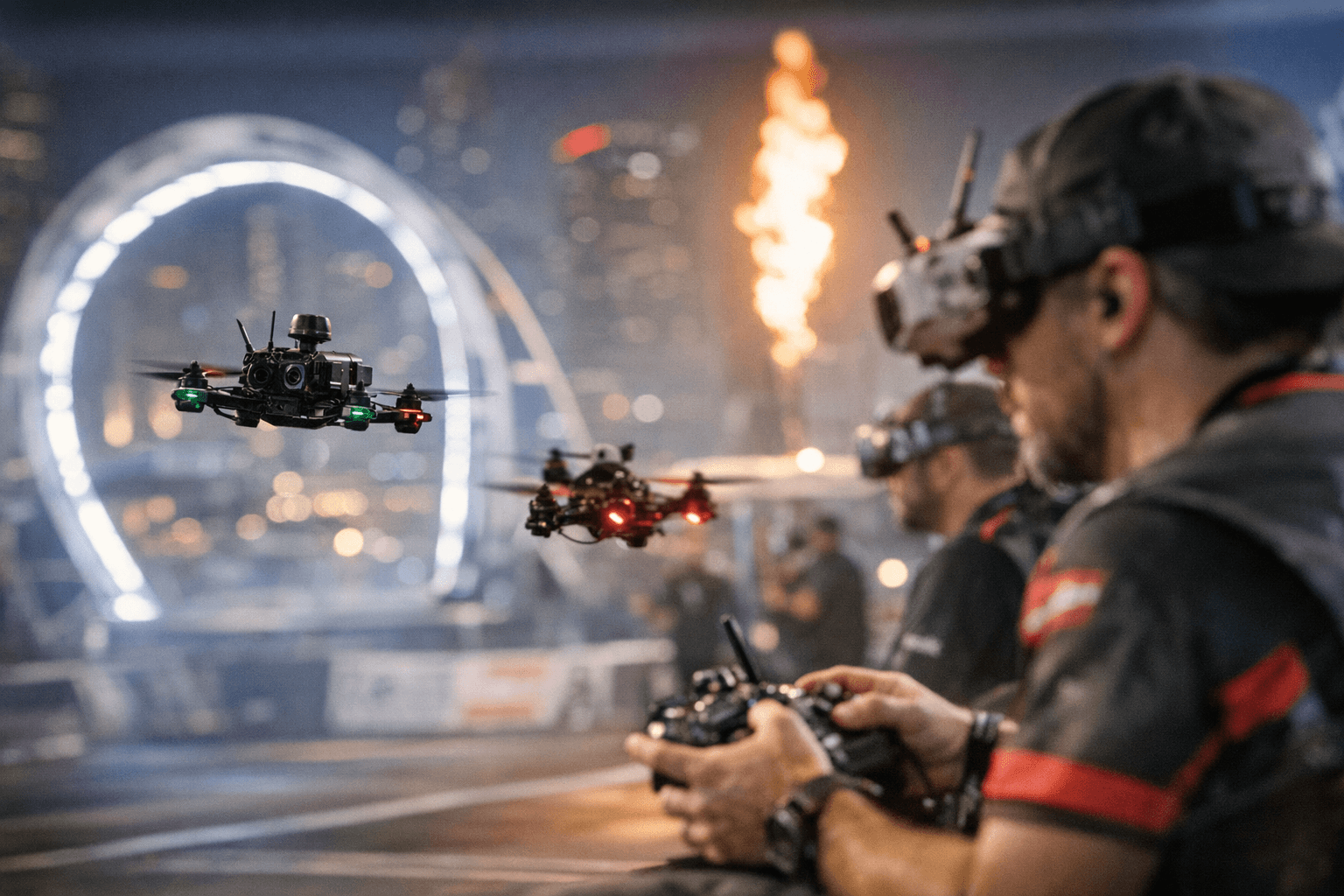
Autonomous drones and human pilots converged inside a custom-built Abu Dhabi arena as A2RL season two unfolded at UMEX, pushing AI systems to race, dodge and predict at breakneck speed. The two-day championship brought six of the world’s most advanced autonomous teams into direct competition with four elite FPV pilots and with one another, shifting the narrative from pure velocity to perception, planning and resilience under pressure.
The event featured three distinct formats and a $600,000 prize pool. The AI Speed Challenge demanded two-lap clean runs on a shortened, technically demanding course; peak speeds topped 140 kilometres per hour and "the best teams are expected to finish in under 15 seconds," Stéphane Timpano said. The AI vs AI Multi-Drone Race placed three or four autonomous racers on track simultaneously, forcing systems to trade ideal racing lines for split-second collision avoidance. The finale paired the top four AI teams against four world-class FPV pilots in the Human vs AI Showdown, a spectacle built around milliseconds and razor-thin margins. "This year, the gap is even smaller," Timpano said. "We’re talking milliseconds."
Organizers leveled the hardware playing field to spotlight software innovation. All competitors used identical drones with a minimalist sensor suite: a single RGB camera, an inertial measurement unit and fully onboard computing. There was no GPS, no LiDAR and no external processing. "What separates winning systems is how they process information," Timpano explained. "They all know where the gates are. The challenge starts when another drone enters the picture." That constraint amplified the importance of visual-perception stacks, trajectory prediction and robust decision policies when confronted with interference or changing sightlines.
More than 150 teams entered qualification; six finalists represented the global field, including TII Racing from Abu Dhabi’s Technology Innovation Institute and contenders from the Netherlands, South Korea, Türkiye and the UAE. Season two's course favored nimble reactions over raw top speed, with tighter gates, higher-density layouts and mission-style tasks designed to pressure test planning and adaptation. Lighting emerged as a decisive technical bottleneck for camera-first systems, so race organizers kept illumination stable to reduce vision failures. "Collisions can happen in milliseconds," Timpano said. "Avoiding them becomes just as important as finding the fastest line." Teams leaned heavily on simulators in the lead-up, "Simulation is critical. You can break a virtual drone hundreds of times without consequences, and that’s how you build the right behaviours for the real world," Timpano said, using virtual trials to iterate control policies that would be costly or dangerous to test live.
Beyond sport, A2RL functions as an industry crucible. Standardized, transparent competition produces benchmarks that feed autonomy research and commercial applications in inspection, logistics, emergency response and air mobility. Abu Dhabi’s Advanced Technology Research Council and ASPIRE framed the league as a pathway to accelerate safe real-world autonomy while creating a spectator spectacle around human-AI rivalry.
For fans and technologists alike, season two underlined that drone racing is now both entertainment and engineering. The immediate scoreboard may have focused on lap times and clean runs, but the longer-term headlines will come from software breakthroughs proven under pressure and from teams that translate split-second perception into reliable real-world performance. The next steps will be clearer metrics, broader public participation and continued convergence between FPV craftmanship and autonomous code as A2RL refines what competitive autonomy can deliver.
Know something we missed? Have a correction or additional information?
Submit a Tip