B2B buyers choose vendors earlier, across search, AI, and peer channels
B2B vendors are being chosen before forms are filled, forcing agencies to win visibility in AI answers, reviews, and peer channels long before sales engages.

The real competition now starts before the lead form. B2B buyers are choosing vendors earlier, inside bigger buying groups, and across more touchpoints than classic SEO reports can capture, which means agencies have to stop thinking only about traffic and start thinking about pre-conversion influence.
The shortlist is being built long before sales gets involved
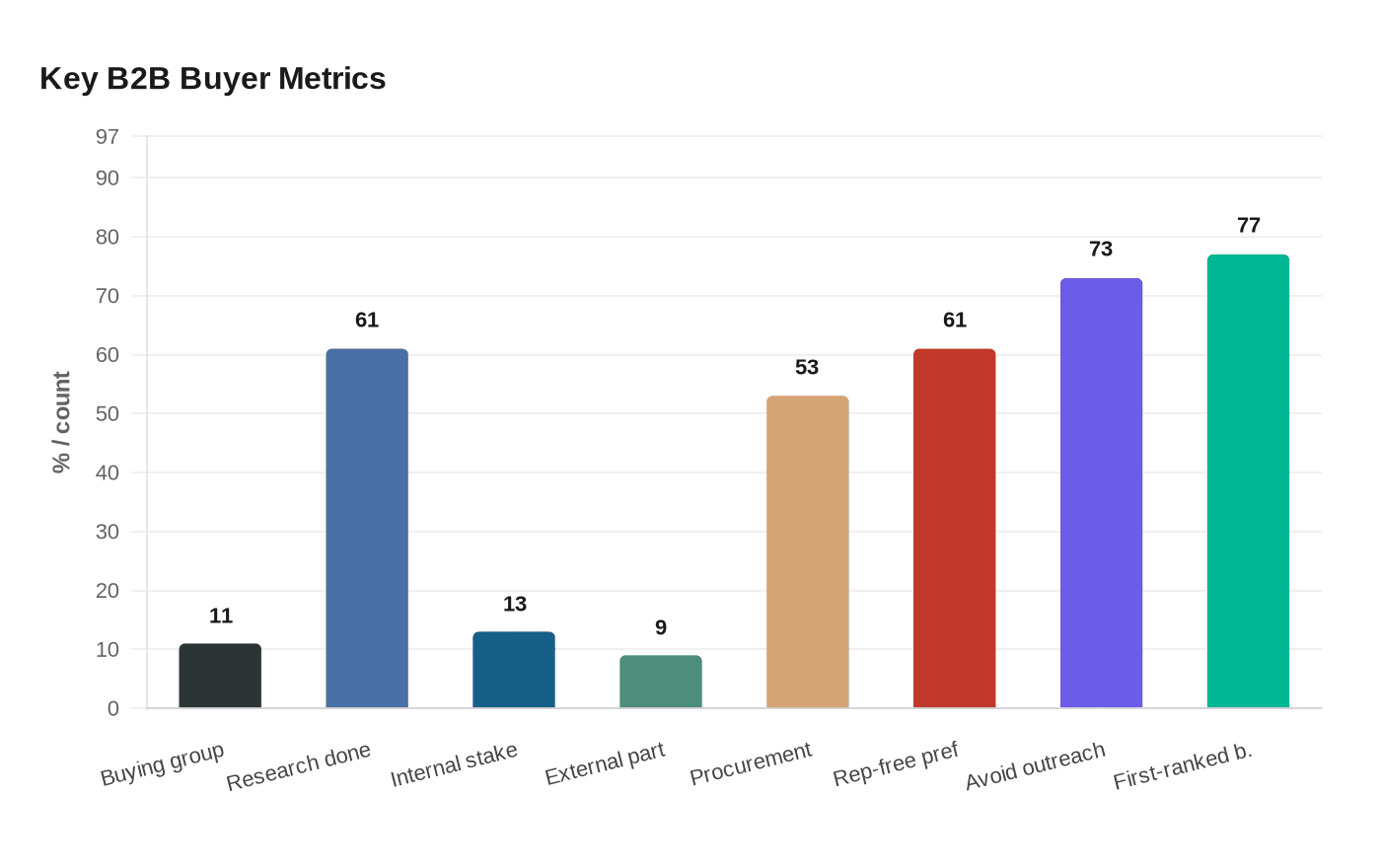
Search Engine Journal’s latest analysis makes the shift plain: B2B buying groups average 11 members, and buyers complete about 61% of their research before they ever contact a vendor. That changes the central question for 2026 from “How visible is the brand in search?” to “How much of the discovery process does the brand own before a salesperson enters the picture?”
That distinction matters because the winning moment is moving upstream. By the time a buyer fills out a form, the committee may already have compared options, narrowed the field, and mentally assigned frontrunners. Agencies that still report success only through last-click leads are measuring too late in the journey.
Buying committees are larger, messier, and harder to influence with one channel
Forrester’s 2026 buyer research says business purchasing now involves, on average, 13 internal stakeholders and nine external participants. It also says procurement is a decision-maker in 53% of buying cycles, which means the audience is not just bigger, but more procedural and risk-aware than many marketing teams assume. For more complex purchases, the committee expands even further, making one-channel strategies feel increasingly outdated.
That same body of research shows that buyers are not relying on a single source of truth. They increasingly turn to colleagues, communities, peers, AI tools, consultants, analysts, and journalists before they ever talk to a provider. For agencies, that means the real visibility map extends far beyond branded search results and owned content. The task is to show up wherever trust is being built, not just wherever clicks are recorded.
AI, peers, and reviews are now part of the buying path
Traditional SEO still matters, but it is only one part of the decision stack. Buyers are using AI tools, review sites, technical documentation, and professional communities to validate claims and reduce risk, and that broadens the list of places where a vendor can be discovered or dismissed. In practice, a brand can lose the deal in a comparison thread, a review profile, a community answer, or an AI-generated summary long before a sales team sees the opportunity.
Gartner’s June 2025 findings underline why that matters. It reported that 61% of B2B buyers prefer an overall rep-free buying experience, and 73% actively avoid suppliers that send irrelevant outreach. That is a blunt signal to agencies and their clients: visibility must feel useful, credible, and timely, or it becomes noise buyers learn to tune out.
Why the old demand-capture model leaves money on the table
The pipeline risk is clear in 6sense’s 2025 Buyer Experience Report. Typical B2B purchases involve 10-plus people and take close to a year, yet 94% of buying groups rank preferred vendors before first contact. Even more telling, buyers ultimately purchase from their first-ranked vendor 77% of the time. That means the list is often formed before sales outreach begins, and the vendor at the top of that list has a major head start.
6sense also says the research-to-seller-engagement split shifted from 70/30 to 60/40 in 2025, showing that more of the journey is happening in self-directed mode. The average buying cycle also shortened from about 11 months in 2024 to 10 months in 2025, compressing the time agencies have to shape perception. When the timeline tightens, early visibility becomes even more valuable because there are fewer chances to recover from being absent.
How agencies can build a pre-conversion visibility playbook
The most effective agency strategy now looks less like a traffic report and more like a pipeline influence plan. That starts by identifying the invisible decision-stage touchpoints where buyers actually validate vendors. Those touchpoints usually include AI search results, peer recommendations, review platforms, professional communities, analyst commentary, technical docs, and comparison content that helps buyers justify a safe choice inside a committee.
- Search coverage for category, problem, and comparison queries that buyers use before vendor contact
- AI visibility work that helps the brand surface cleanly in answer engines and summary tools
- Review and reputation management across platforms buyers trust during shortlisting
- Peer-channel participation in communities where practitioners compare experiences and tradeoffs
- Technical content that supports evaluation, implementation, and risk reduction
- Analyst, journalist, and consultant awareness that reinforces outside validation
A practical playbook should include:
This is where agencies can stop selling “more content” and start selling influence over the shortlist. The point is not just to be found, but to be preferred before the first conversation.
How to prove ROI when attribution arrives late
This shift also changes reporting. If buyers are already 61% of the way through research before they speak to sales, then the most valuable work may never show up cleanly in first-touch or last-click dashboards. Agencies need to connect pre-conversion visibility to downstream pipeline indicators such as branded search growth, review sentiment, share of voice in category queries, AI citation presence, and the quality of opportunities entering the CRM.
That is where the broader research history matters. Forrester’s 2024 business buying research found that more than 80% of buyers were dissatisfied with the provider they ultimately chose, a reminder that many purchases happen under frustration, not delight. Its earlier reporting also said 13 people were involved on average and 89% of purchases crossed two or more departments. In other words, the buying process has been collaborative and risk-heavy for years; AI is simply speeding up the parts that happen before a vendor is invited in.
For agencies, the reporting challenge is to show progression across the whole influence path. If a campaign lifts visibility in AI answers, improves review standing, strengthens peer validation, and increases category presence before first contact, that is pipeline work even if attribution software cannot isolate the exact handoff.
The new agency brief is influence, not just capture
Jeremy Schwartz, Kerry Cunningham, and Alexander Kesler are all pointing to the same reality from different angles: buyers are deciding earlier, through more voices, and with less tolerance for irrelevant outreach. The agencies that win in this environment will be the ones that treat search, AI, reviews, and community presence as one integrated discovery system.
That is the playbook now. Own the shortlist before the form fill, prove influence before the attribution model catches up, and treat pre-conversion visibility as the new center of B2B growth.
Know something we missed? Have a correction or additional information?
Submit a Tip