Backrooms and Obsession show Gen Z still buys original horror
Two YouTube-born horror hits proved Gen Z will still buy originality, but their success was built on different playbooks studios cannot simply clone.
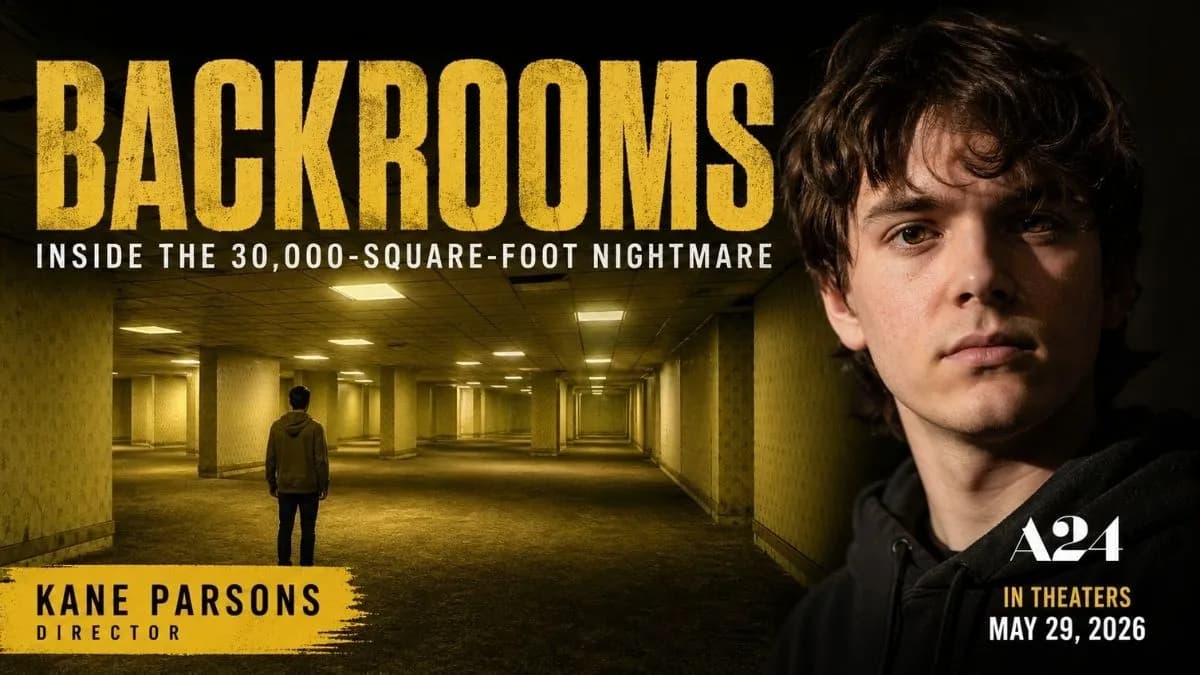
Hollywood’s franchise machine just collided with a pair of original horror breakouts that did what many executives assume is impossible now: they drew young audiences into theaters without familiar IP. A24’s Backrooms and Focus Features’ Obsession have become a rare one-two punch, but the bigger story is not that horror works. It is that these two films worked for different reasons, and studios risk learning the wrong lesson if they treat them as the same blueprint.
A box-office shock that looked like a trend, but isn’t one
Backrooms and Obsession arrived as twin signals that Gen Z still turns out for theatrical horror when the hook feels fresh and the conversation feels live. Kane Parsons, 20, and Curry Barker, 26, came into the studio system after building audiences on YouTube, and both films extended that creator-to-cinema bridge in a way that felt unusually direct. The result was not just buzz, but scale: Backrooms was reported at about $118 million worldwide, while Obsession crossed $100 million domestically and reached roughly $150 million worldwide after just over two weeks.
The speed matters as much as the totals. Backrooms became A24’s highest-grossing film in North America in just five days, and Variety reported an $81 million opening, with some estimates in circulation pushing the domestic debut as high as $90 million. Obsession, meanwhile, did something horror rarely does: it kept growing. Variety reported a $26.4 million third weekend, and one report said it was the first film since 1982 to increase in both its second and third weekends outside of Christmas.
Why these films connected with audiences
The most obvious common thread is that both directors arrived with communities already attached to their names. That online base gave the films a head start in awareness, but not in the lazy sense of internet fame becoming instant ticket sales. Instead, the YouTube background seems to have given both projects something Hollywood often tries to fake after the fact: trust, tone, and a sense that the filmmakers understood the audience they were inviting into the theater.
Aaron Couch of The Hollywood Reporter pointed to that YouTube lineage as a major factor in the success. James Wan, who co-produced Backrooms through Atomic Monster, praised the rise of the YouTube generation, saying they have learned by making and uploading work online, and Variety quoted him calling YouTube a kind of global film festival. Sarah Taher, a Canadian producer on Backrooms, framed the lesson more bluntly: stop underestimating the audience. That warning matters because these films did not win by sanding down their identities. They won by leaning into them.
There is also a practical box-office lesson here. Trade coverage said both films were made on small budgets relative to their returns, with one report putting Backrooms around $10 million and Obsession at $750,000. TheWrap said the two films combined for about $185 million in domestic box office against roughly $11 million in combined production spend. That is the kind of ratio Hollywood loves to celebrate and then misunderstands.
What studios should not try to mass-produce
The danger in a breakout like this is overgeneralization. Analysts quoted in trade coverage have already warned that Hollywood should not treat Backrooms and Obsession as a single template, because each reached its audience differently. One film exploded out of the gate, while the other built momentum through unusually strong holds. Those are not interchangeable outcomes, and they do not suggest one neat algorithm for future greenlights.
The Hollywood Reporter also said rumors that the films were ghost-directed were unfounded, which is an important reminder in moments like this. When a success looks too clean, the industry starts hunting for hidden explanations, as if youth, craft, and audience-building cannot possibly be the answer. In truth, that impulse says more about Hollywood’s discomfort with new talent pipelines than it does about the films themselves.
Studios should also resist the urge to mistake this moment for a simple anti-franchise referendum. The timing is part of why the conversation became so loud: Backrooms and Obsession were being discussed alongside Disney’s The Mandalorian and Grogu, which saw a steep second-weekend decline. That contrast fed a familiar industry narrative about originality versus franchise fatigue, but the smarter reading is narrower. Audiences are not rejecting franchises in general. They are rewarding movies that feel distinct, social, and worth leaving home for.
What is actually repeatable, and what is lightning in a bottle
There are pieces of this success that can be repeated, and pieces that cannot. Studios can absolutely look for creators who already command attention, keep budgets tight, and let filmmakers preserve a strong point of view. They can also pay attention to how online communities become theatrical ones, because that bridge appears to be more durable than executives often assume.
But other parts are not scalable on command. The exact timing, the unusual hold pattern, the comparison to Barbenheimer-like theatrical buzz, and the rare convergence of two breakout horror hits all made this feel bigger than the sum of its parts. Industry chatter has already turned that feeling into opportunity, with reporting that Curry Barker has received a seven-figure offer for his next movie before even pitching it. That is a market signal, but it is also a warning: the industry will pay a premium for the illusion that it can manufacture a repeat.
The cleaner lesson is the one the box office keeps underlining. Original horror still has an audience, especially when it is built by filmmakers who already know how to speak to one. The studios that benefit most will be the ones that learn to spot that voice early, back it with discipline, and resist the temptation to turn a singular hit into a factory preset.
This article was produced by Prism’s automated news system from verified source data, official records, and press releases, then run through automated quality and moderation checks before publishing. The system is built and supervised by the people who set the standards it runs under. Read our full AI policy.
Know something we missed? Have a correction or additional information?
Submit a Tip

%3Amax_bytes(150000)%3Astrip_icc()%3Afocal(999x0%3A1001x2)%2FCole-Escola-060726-db1db268e1cf462a8be0d43cf2c77c29.jpg&w=1920&q=75)