Beijing opens Two Sessions with 3,000 journalists as tech shows loom
A press center registered more than 3,000 journalists ahead of the Two Sessions, which will finalize the 15th Five-Year Plan and set priorities on tech, budgets and diplomacy.
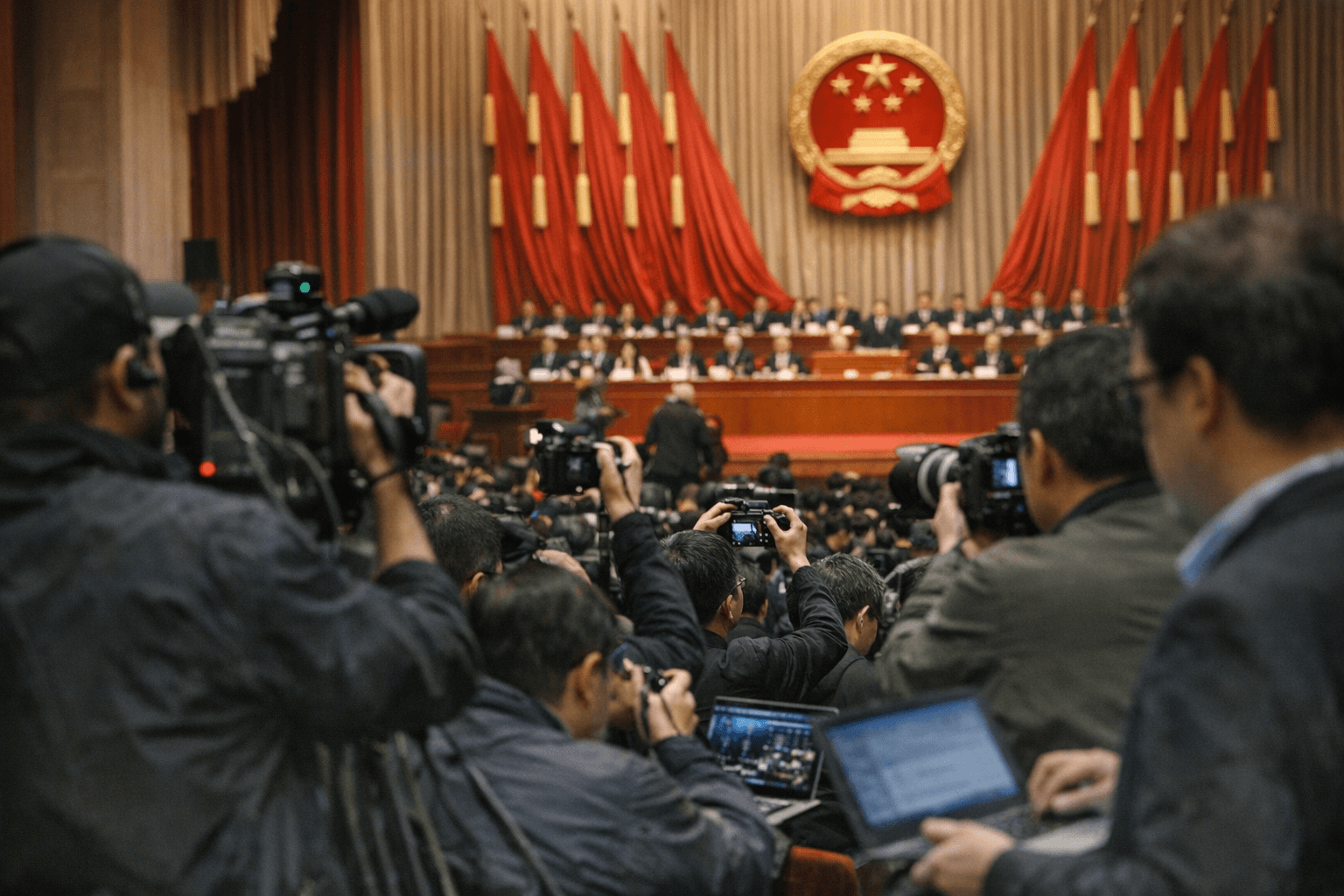
A press center opened at Beijing’s Media Center Hotel and more than 3,000 journalists, including over 1,000 from Hong Kong, Macao, Taiwan and abroad, have registered to cover China’s annual Two Sessions, signaling intense global attention as the meetings prepare to finalize the 15th Five-Year Plan for 2026–2030. The Chinese People’s Political Consultative Conference convenes March 4 and the National People’s Congress opens March 5, with plenary agendas running through the following week.
The Two Sessions will stage a concentrated set of policy choices that affect still-fragile domestic growth and global technology and trade networks. Leaders are expected to present a growth target and fiscal direction, announce a defense budget scale and lay out mid-to-long-term instruments for industrial policy. Officials have framed the meetings as the place where the Chinese Communist Party leadership’s policy stance is finalized, and planners are using the forum to define a strategic mix of stimulus, regulation and industrial support to address an economic slowdown, sluggish domestic demand, a property crisis and declining investment.
Technology and industrial policy are central to that agenda. Beijing will press mechanisms to secure “technological leadership,” with explicit emphasis on achieving self-reliance in advanced semiconductors, artificial intelligence and biotechnology and on transforming manufacturing through advanced manufacturing and smart technologies. Those priorities are being presented alongside plans to stabilize supply chains and to strengthen trade partnerships in energy, transportation and the digital economy, with the Two Sessions portrayed as an instrument for deepening ties with countries across Asia, Africa and the Middle East.
The diplomatic signal emerging from the meetings will be closely watched in Washington and among global firms. Chinese officials have criticized the United States’ “unilateralism” and “interference in internal affairs,” even as they signal a calibrated approach designed to manage rivalry and avoid direct confrontation. Beijing is expected to emphasize “mutual respect” and “avoidance of conflict,” while making clear it “cannot concede on its core interests.” In his Government Work Report, Premier Li Qiang framed that posture as part of a broader foreign policy aim: “We will stay committed to an independent foreign policy of peace and peaceful development. We will remain firm in pursuing a strategy of opening-up for mutual benefit.”
The Two Sessions will also articulate how China intends to position itself with the Global South, offering a governance and innovation model tied to infrastructure, trade and digital cooperation and framing the 15th Five-Year Plan as a vehicle for high-quality development and Belt and Road initiatives. That outreach has implications for companies and governments deciding whether to deepen procurement, investment and technology partnerships with Chinese firms.
For global markets and industry, the key near-term items to watch are concrete numeric targets and instruments: the formal growth target, fiscal revenue and expenditure plans, the announced defense budget figure, and any explicit subsidies, procurement commitments or export controls tied to semiconductor and AI development. The meetings precede a U.S. presidential visit scheduled for March 31 to April 2, adding diplomatic stakes to any hardening of trade or technology policy.
The Media Center Hotel will host a series of press briefings in the coming days where senior officials are expected to elaborate on these priorities and take journalists’ questions. Reporters and analysts will be parsing the Government Work Report and the finalized 15th Five-Year Plan for the first detailed metrics that will determine Beijing’s policy mix through 2030.
Know something we missed? Have a correction or additional information?
Submit a Tip