Beijing robot wins half-marathon faster than human world record
A humanoid robot won Beijing’s robot half-marathon in 50:26, beating the human men’s record by more than seven minutes.
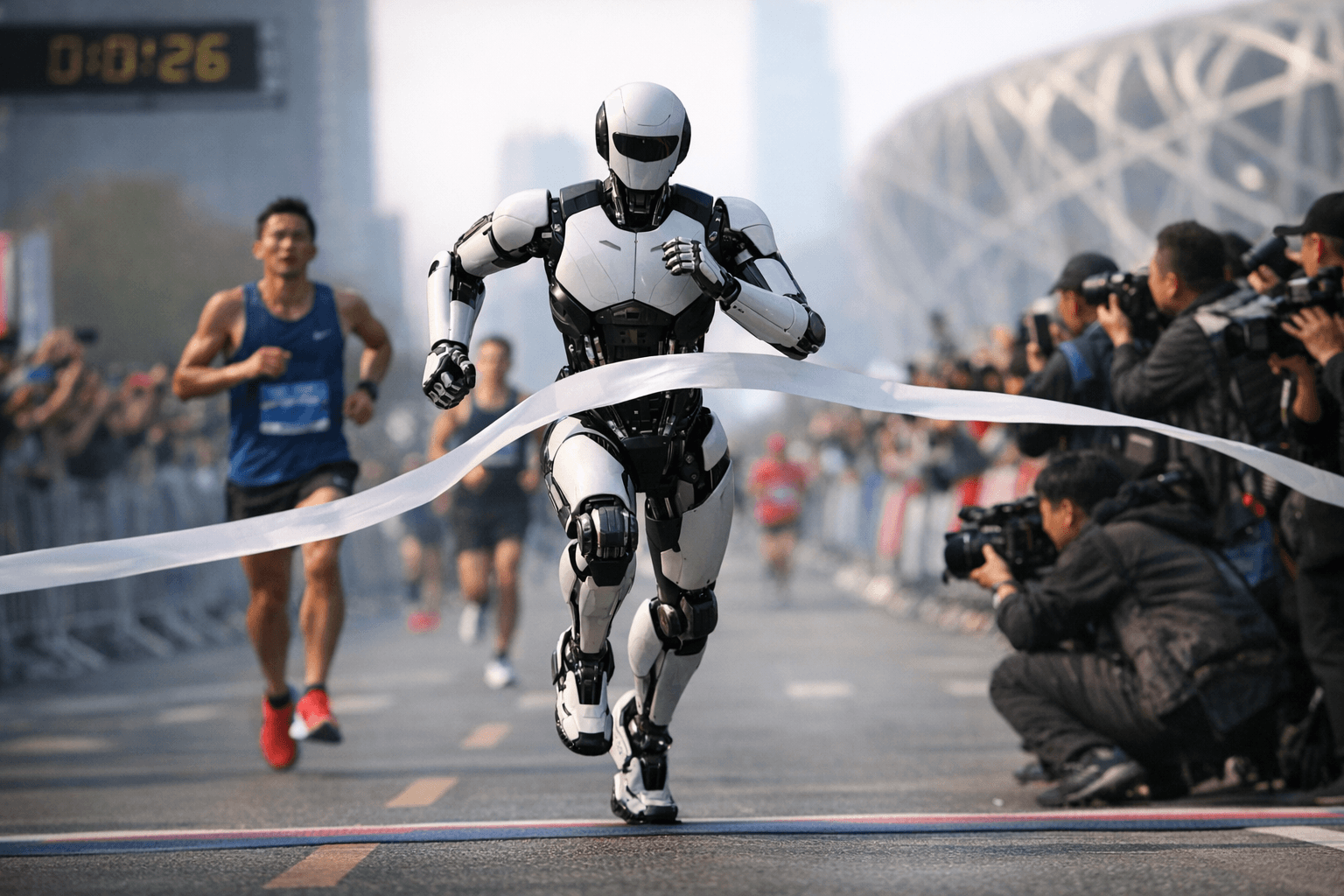
A humanoid robot crossed the finish line in Beijing in 50 minutes and 26 seconds, winning a half-marathon for robots and finishing faster than the current men’s human world record. The result was striking, but the deeper significance was more technical than theatrical: it showed how far Chinese robotics has come in sustained, real-world motion, while still underscoring how controlled the test remained.
The winning machine came from Honor, the Chinese smartphone brand spun off from Huawei, and it completed the 21.0975-kilometer race in Beijing’s E-Town, the Beijing Economic-Technological Development Area. The official men’s half-marathon world record stands at 57:20, set by Jacob Kiplimo in Lisbon on March 8, 2026. That comparison will draw attention, but it is not a simple one-to-one contest between machines and elite runners. The robots ran on parallel tracks with 12,000 human runners to prevent collisions, and the event was structured as a robotics showcase as much as a race.
Honor engineer Du Xiaodi said the winning robot had been in development for a year. He said the design used legs measuring 90 to 95 centimeters to mimic elite human runners and included liquid-cooling technology used in Honor smartphones. The first three finishers were all Honor robots, and all three navigated the course autonomously rather than by remote control, a detail that mattered as much as speed. Nearly half of the robot entrants handled the course on their own, a sign that autonomy is moving from scripted demonstration toward more robust operation.
The field also expanded quickly. The number of participating robot teams rose from 20 in 2025 to more than 100 this year, turning last year’s rough debut into a larger technical test. That first race was plagued by mishaps, and most robots failed to finish. The winner then, Tiangong Ultra, needed about 2 hours, 40 minutes, and 42 seconds to complete the course. The contrast between that time and Saturday’s 50:26 finish shows meaningful progress in balance, pacing and battery management, not just in raw speed.
That is why industries beyond entertainment are watching. Du said the sector was still nascent, but could eventually affect manufacturing and other fields where machines must move reliably over long physical tasks. For now, the Beijing result is best read as a benchmark: not proof that humanoid robots have arrived, but evidence that endurance in motion is becoming less of a stunt and more of an engineering race.
Know something we missed? Have a correction or additional information?
Submit a Tip

