Billy Idol Reflects on Punk Roots, Solo Career, and Stage Persona
At 70, Billy Idol is releasing concept albums, headlining arenas, and confronting his own mythology — proving punk's most visual survivor still has something urgent to say.
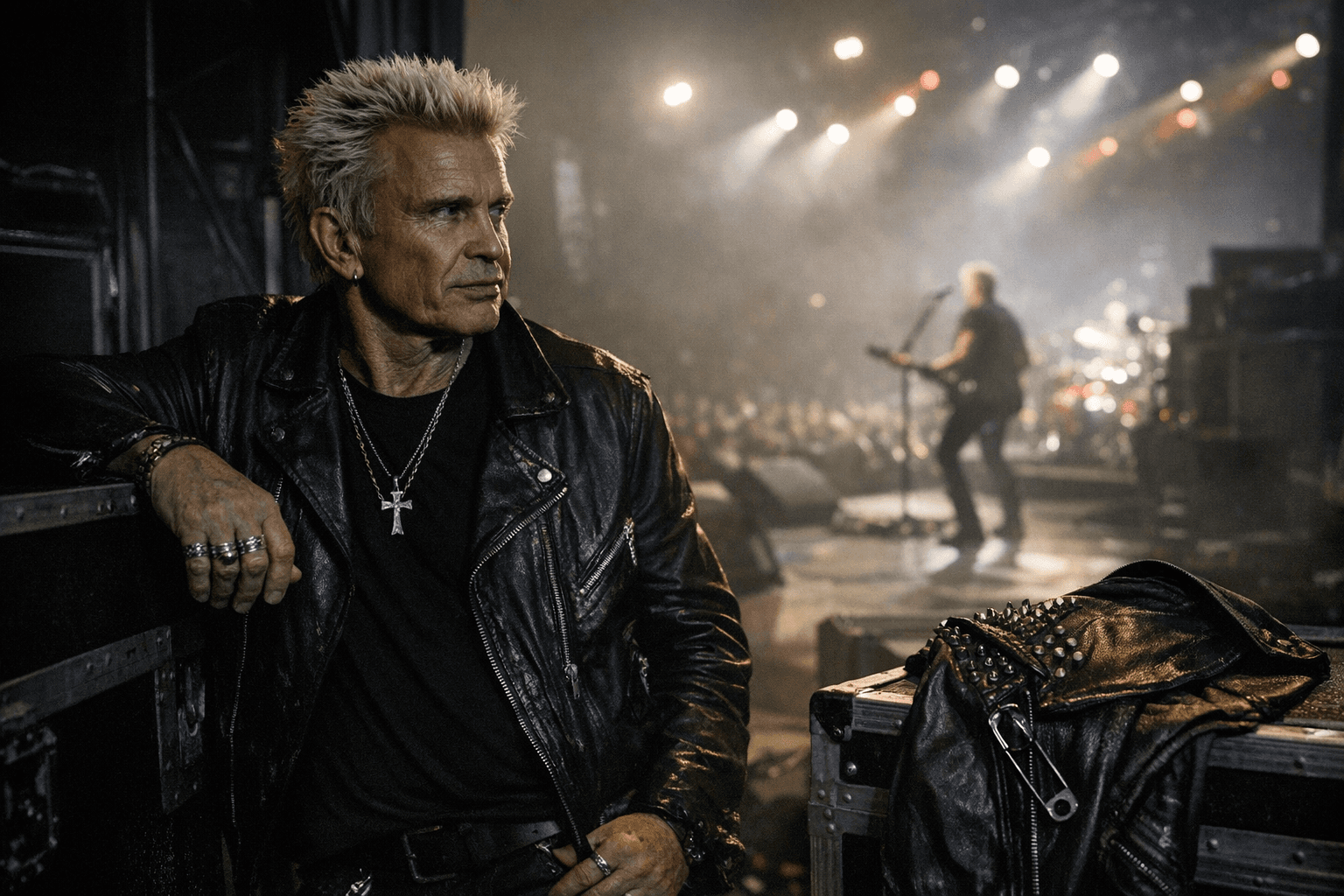
Born William Michael Albert Broad on November 30, 1955, in Stanmore, Middlesex, England, Billy Idol built one of rock's most durable careers on a foundation of calculated reinvention. The stage name itself was an act of subversion: a schoolteacher had dismissed him as "idle," and in late 1976, as London's punk scene was rewriting cultural history in real time, he adopted the label as his permanent identity. The joke became the brand. Decades later, with over 40 million records sold, a Hollywood Walk of Fame star, and a new album climbing European charts, the arc from suburban dismissal to global rock icon is one of music's more improbable transformations.
From Punk Squats to British Television
Idol's entry into music was characteristically restless. He joined the punk band Chelsea in 1976 but departed after only a few weeks, co-founding Generation X with former Chelsea bandmate Tony James. The new group distinguished itself from their peers almost immediately: where much of the punk scene embraced deliberate abrasiveness, Generation X leaned into melody, producing catchier, more radio-accessible material. That instinct paid off. The band became one of the first punk acts to appear on British television, and "Dancing with Myself" developed into an underground anthem that would eventually outlast the band itself. Idol had briefly enrolled at Sussex University before music pulled him away entirely, and by 1981, when Generation X disbanded, he was already planning his next move.
The MTV Architecture
The move to New York City in 1981 was strategic. Idol signed with manager Bill Aucoin, who had built Kiss into an arena-filling juggernaut, and paired with guitarist Steve Stevens, whose glam-rock precision locked perfectly into Idol's rawer punk energy. The debut album, simply titled *Billy Idol*, arrived on July 2, 1982, via Chrysalis Records, and benefited from timing as much as craft: MTV was hungry for artists who understood the visual medium, and Idol, with his bleached spiked platinum hair, leather jackets, and signature lip-curling snarl, was born for it. "White Wedding" and "Hot in the City" received heavy rotation, and the aesthetic of the record, equal parts rebellion and spectacle, helped define what critics would later call the Second British Invasion.
Rebel Yell and the Record Books
If the debut established Idol's commercial viability, *Rebel Yell* confirmed his staying power. Released on November 10, 1983, and recorded at Electric Lady Studios in New York, the album incorporated the percussive texture of the LinnDrum and Roland TR-808 drum machines alongside Stevens' signature guitar work. It sold two million copies in the United States alone, earning double platinum certification from the RIAA, and spawned two of Idol's most enduring singles: the title track and "Eyes Without a Face." The song "Rebel Yell" earned Idol his first Grammy nomination, for Best Male Rock Vocal Performance at the 27th Annual Grammy Awards. His total worldwide sales now stand at more than 40 million records, a figure that spans multiple format eras and underscores just how cleanly his catalog translates across listening contexts.
The Crash That Redefined Everything
On February 6, 1990, at approximately 8:30 a.m., Idol was riding his Harley-Davidson through Hollywood when he ran a stop sign and was struck by a car. He was not wearing a helmet. He was rushed to Cedars-Sinai Medical Center in Los Angeles with a broken leg, fractured between the knee and ankle, and a fractured left forearm. Surgeons worked for seven hours, inserting a metal rod to save the leg he nearly lost entirely. The physical toll was severe, but a second consequence stung almost as sharply: the accident cost him the role of the T-1000 villain in *Terminator 2: Judgment Day*, one of the most coveted parts of the era. Idol later described the period as "a particularly horrible, painful time, when I really didn't know what was going to happen," and acknowledged that he had been "a bit of a drug addict" at the time, reflecting a substance struggle that had shadowed much of his commercial peak. He has since told CBS that he considers himself "super lucky to be here," a sentiment that carries more weight given that heroin was, in his words, "a pitfall that a lot of people were falling into" in the punk and post-punk scenes he inhabited.
Writing It Down
The full accounting came in print in October 2014, when Idol published his autobiography, *Dancing with Myself*, released on October 7, 2014, through Touchstone, an imprint of Simon & Schuster. The book covered his childhood in England, his abortive year at Sussex University, the frantic energy of the London punk scene, and the American fame that followed. It became a New York Times bestseller and was named a Rolling Stone Top 10 Best Music Book of the Year, demonstrating that there was genuine appetite for a frank reckoning with the mythology he had spent decades constructing and surviving.
Dream Into It: The Business and Art of Longevity
The economic logic of legacy rock stardom has shifted dramatically since Idol's commercial peak. Streaming flattens catalog royalties while amplifying catalog discovery; touring has become the primary revenue engine for artists of his generation; and new music, once the assumed driver of an artist's commercial identity, now functions more often as a reason to tour than as a standalone commercial proposition. Idol has navigated these realities with unusual effectiveness. He received his star on the Hollywood Walk of Fame in 2023, cementing his status as a mainstream institution rather than a nostalgia act.
His 2025 album, *Dream Into It*, released on Dark Horse Records, is a concept record structured around two thematic halves titled "Dying to Live" and "I'm Reborn," making it the most autobiographically ambitious work of his career. Idol has described the album's genesis as inseparable from his work on a companion documentary, "Billy Idol Should Be Dead," directed by Jonas Åkerlund and released on June 10, 2025: "With this album, I wanted to really talk about all of my life. Lyrically, I couldn't help but bounce off the documentary, sequencing the album so it told the story of my life." The album features Steve Stevens throughout, alongside guest appearances by Avril Lavigne, Joan Jett, and Alison Mosshart of The Kills. It peaked at number 2 in Germany and charted in the top 5 in both Switzerland and Austria, evidence that his audience remains geographically broad and commercially active more than four decades into his career.
The accompanying tour, promoted by Live Nation across arenas and amphitheaters, includes dates at New York's Madison Square Garden and Los Angeles' Kia Forum, with Joan Jett and the Blackhearts joining as supporting act. Five dollars from each Los Angeles ticket sale was directed to American Red Cross Southern California Wildfire Relief, a gesture that reflects how deliberately Idol has cultivated his public role beyond music alone.
What the CBS interview with Anthony Mason makes clear is that the persona, the snarl and the spike and the leather, was never simply a costume. It was a strategy, forged in punk's utilitarian ethos and refined through one of music's most visually demanding eras. The man who was called idle turned that word into 40 million record sales. At 70, he is still finding new ways to spend it.
This article was produced by Prism’s automated news system from verified source data, official records, and press releases, then run through automated quality and moderation checks before publishing. The system is built and supervised by the people who set the standards it runs under. Read our full AI policy.
Did this article answer your question?