Binghamton Study Finds European Blue and Green Tattoo Inks Mislabeled, Banned Pigments
Nine of ten blue and green tattoo inks sold in Europe failed REACH compliance; four contained banned material, and two Intenze products showed clear 1,3-butanediol signatures.

Binghamton University chemist John Swierk and colleagues report that nine out of ten blue and green tattoo inks distributed to the European market were not REACH compliant, and four contained banned material, including evidence for Pigment Blue 15:3. The ten inks came from five manufacturers and all claimed REACH compliance on their labels.
The study, published in the journal Analyst, analyzed ten green and blue inks and compared ingredients against REACH rules instituted in 2022, which limit the use of approximately 4,000 substances. Swierk’s lab noted this result follows their prior U.S. work that found 45 out of 54 U.S. inks did not match label contents, underscoring a repeat pattern across markets.
Analytical work used Raman spectroscopy as the primary pigment-identification method with both 785 nm and 532 nm excitation wavelengths and supplemented pigment work with 1H and 13C NMR to identify solvents and additives. The paper’s supplemental material includes Raman results (Figure 2) and NMR spectra (Figures S3-4) supporting the identifications.
The Analyst abstract states plainly: “Nine out of ten inks analyzed were found to not be compliant.” It also reports that “Four contained banned material.” The authors found labeling inaccuracies in the majority of inks, specifically noting “the addition of unlisted poly(ethylene glycol) and propylene glycol.” For Pigment Blue 15 the team reported, “The polymorph of Pigment Blue 15 found in four inks was unable to be determined.”
Spectral evidence identified 1,3-butanediol in two named products: Intenze GenZ Light Grass and Intenze Blue sky. The NMR data cited 1H peaks at δ 1.11 ppm, δ 1.56 ppm, δ 3.85 ppm, and δ 3.58 ppm and 13C peaks at δ 23.5 ppm, δ 41.5 ppm, δ 60.1 ppm, and δ 66.1 ppm, which the authors say “strongly support the presence of 1,3-butanediol.” The supplemental notes also record an alkene signal observed at low concentration that could not be integrated for identification.
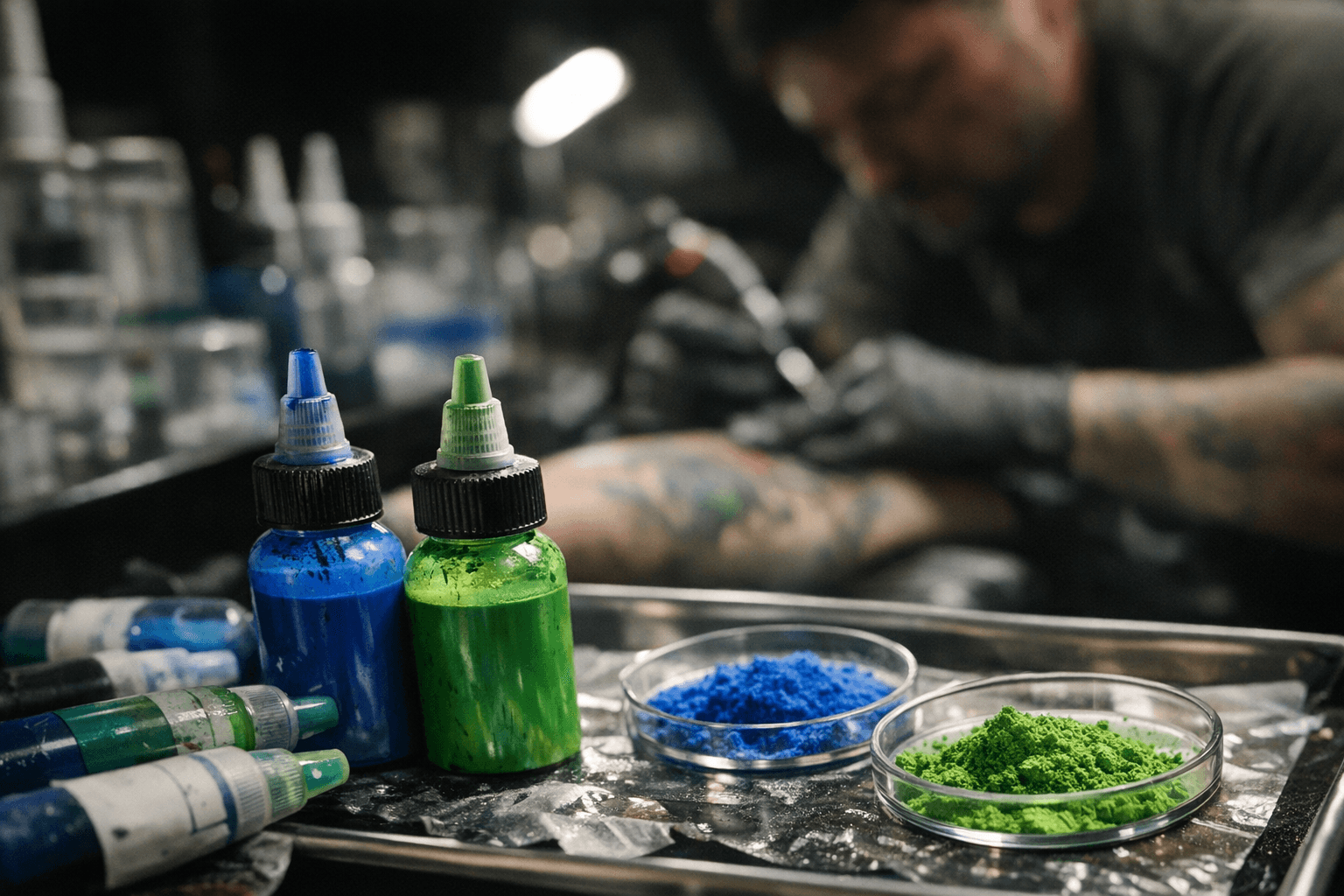
Regulatory specifics in the source material name Pigment Blue 15:3 as banned for tattoo use. There is a discrepancy in the green pigment identifier across materials: the peer-reviewed Analyst abstract and RSC summaries name Pigment Green 7 as banned, while a Binghamton University news summary in the provided materials refers at one point to Pigment Green 8. The study materials do not reconcile that difference within the excerpts.
Swierk framed the findings around transparency and enforcement: “Our work cannot say anything about the safety of tattoos, but we think it’s an important first step in addressing the question ‘Are tattoos safe?’” He added, “If we don’t know what’s in a bottle of tattoo ink, then we cannot figure out what might be causing an adverse event in the near and long term, whether that’s an allergic reaction or something more serious.” He warned that “There are regulations on the book that are not being complied with, at least in part because enforcement is lagging,” and urged better manufacturing standards and possible regulatory reevaluation.
The Analyst paper and Binghamton team conclude the European market shows a significant traceability and labeling gap for blue and green inks. For follow-up or comment, the corresponding author listed in the Analyst article is John Swierk at jswierk@bingham.edu.
Know something we missed? Have a correction or additional information?
Submit a Tip