Block cuts roughly 4,000 jobs as Dorsey says AI enables leaner teams
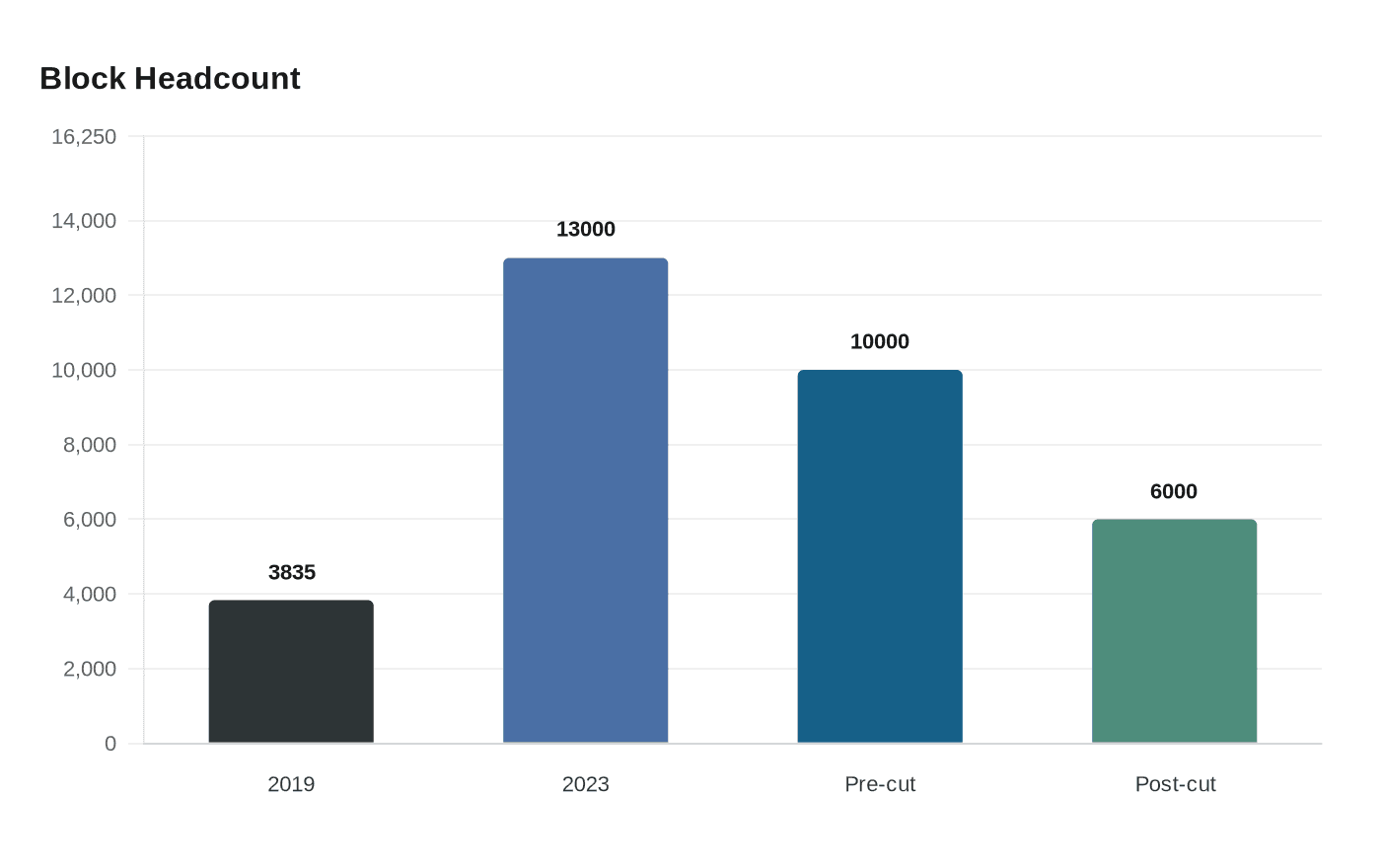
Block eliminated over 4,000 roles, shrinking headcount from more than 10,000 to just under 6,000; company cites AI integration and expects $450M–$500M in restructuring charges.

Block said it would reduce its workforce by roughly 4,000 positions, cutting headcount from over 10,000 to just under 6,000 as the payments company retools to embed artificial intelligence across its operations. CEO Jack Dorsey framed the move in a series of posts on X, writing, "we're making @blocks smaller today. here's my note to the company," and adding, "today we're making one of the hardest decisions in the history of our company: we're reducing our organization by nearly half, from over 10,000 people to just under 6,000. that means over 4,000 of you are being asked to leave or entering into consultation. i'll be straight about what's happening, why, and what it means for everyone."
Block said the cuts are intended to create a single, more efficient organization and to accelerate a shift to what Dorsey described as an "intelligence-native" model that embeds AI in product development and operations. He wrote that the company opted for a single deep round of reductions rather than a series of smaller layoffs, arguing the smaller workforce "gives us the space to grow our business the right way, on our own terms, instead of constantly reacting to market pressures."
The market reacted immediately. Shares jumped roughly 22% in after-hours trading, reversing a long slide that had left the stock down about 40% since January 2025 and trading around $51 before the announcement, according to market data. Block also said it expects to incur approximately $450 million to $500 million in restructuring charges tied to the reductions and reported adjusted profit of $0.65 per share for the quarter ended Dec. 31, up from $0.47 a year earlier.

Affected employees will receive severance and transition support, Newsweek reported: 20 weeks of pay plus one additional week per year of tenure, equity vesting through the end of May, six months of health care, corporate devices and $5,000 in transition support, with comparable packages promised outside the United States adjusted for local requirements.
Analysts and executives are framing Block’s move as part of a broader wave of AI-attributed workforce changes. Forbes cited data from InformationWeek that about 55,000 U.S. tech workers were affected by AI-attributed layoffs in 2025, and TrueUp.io counted more than 49,000 tech jobs eliminated globally in the first two months of 2026. Forbes also noted that Block’s headcount ballooned from roughly 3,835 at the end of 2019 to nearly 13,000 at its 2023 peak, and reported the company is targeting more than $2 million in gross profit per employee under the restructuring, versus a pre-pandemic baseline near $500,000.
For investors, the appeal is clear: faster cost cutting and AI-driven productivity gains can lift margins and earnings per share. For workers and policymakers, the risks are immediate. Large, concentrated reductions accelerate unemployment claims in local labor markets and heighten the urgency of retraining programs and social safety nets. Economists say the short-term savings for firms often come with longer-term adjustment costs as displaced workers search for new roles or new skills.
Block’s announcement crystallizes that tension. The company has signaled a willingness to accept near-term restructuring charges to pursue smaller headcount and higher per-employee productivity; whether those gains materialize and how quickly the displaced workers find new employment will shape both investor returns and the broader labor-market narrative around AI.
This article was produced by Prism’s automated news system from verified source data, official records, and press releases, then run through automated quality and moderation checks before publishing. The system is built and supervised by the people who set the standards it runs under. Read our full AI policy.
Did this article answer your question?

